



















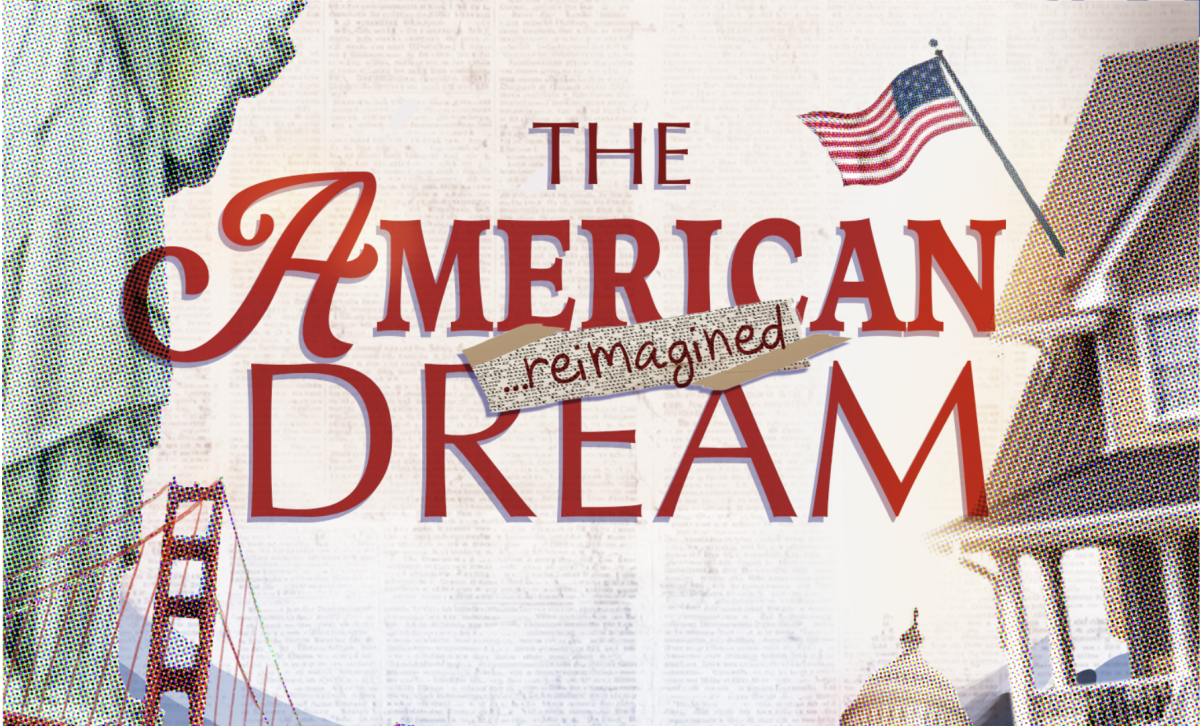
Over the past several years, the idea of the American Dream has faced renewed scrutiny. Economic uncertainty, political polarization, and widening inequality have challenged traditional notions of upward mobility and self-made success. What once symbolized opportunity and progress now looks different to many Americans—especially for families whose roots trace back to immigration stories and promises of a better life.
Within the Nueva community, students, parents, and teachers are reflecting on how that dream has evolved. For some, it remains a symbol of hope and perseverance. For others, it has become a reminder of both the barriers that persist and the new challenges emerging in today’s world.
Where the Dream came from
When alumni parent Sara Espinoza first came to the United States, she carried the same hope as millions of others: that hard work and perseverance would lead to stability, opportunity, and a better life for her children. She emigrated from Peru in 1992, pursuing a career in STEM and seeking to escape the violent political unrest caused by the Shining Path, a far-left guerilla group active during her adolescence. Decades later, she wonders whether that promise still holds.
“The United States gave me everything and more than what I expected. Hopefully, we’ll revert from this authoritarian administration,” Espinoza said. “We have to be careful, because our democracy is so fragile. We have to protect it. Because right now, the land of the free is no longer the land of the free.”
For generations, the “American Dream” has symbolized upward mobility and self-made success. Today, amid rising inequality, political polarization, and shifting social values, many Americans—immigrants and lifelong residents alike—are reconsidering what that dream means, and whether it’s still attainable.
Psychology teacher Amy Hunt defines the American Dream as a narrative that promises that hard work will produce social mobility and economic stability.
“The American Dream provides a framework for people to think that they have agency in their lives, where if they take actions and expend effort, their world will change,” Hunt said. “In the U.S., there’s a collectively held narrative that says if you work hard, you will get these success markers, particularly financial gain.”
The term “American Dream” entered the national lexicon during the Great Depression, coined by historian James Truslow Adams to capture the ideal that a better life would be possible for anyone in America, regardless of birth or status. Tested through an era of economic uncertainty, the American Dream persisted through the Great Depression into the postwar era, becoming associated with opportunity and growth.
Many parents, including Peter Lee, echo that belief in opportunity for upward mobility and innovation. Lee moved to the United States while working at Samsung, a Korean company; he helped set up a new Samsung office and team in the Bay Area, and worked there for several years.
“You want to live where [people] strive for innovation, strive for new things—that’s most important. And I think America is still chasing, chasing the dream of being something new, doing something new,” Lee said. “In America, because you start from the clear, fresh ground, you have more opportunities to be successful. As long as you’ve been diligent and continue to envision whatever you want to be, I think it’s a fair playing ground for everybody else in the world.”
Like Lee, who works in technology, parent Giovanni Iachello was also drawn to the United States by opportunity and innovation. Iachello immigrated from Italy as a young adult, seeking to further his education and build a career in technology.
“There’s a lot of opportunity: I got to study here, I got a fellowship,” Iachello said. “[Living here] opened up a whole set of possibilities, from a professional standpoint, that I would never have had in Italy.”
For parent Mark Choey, the American Dream comes down to one word: freedom. His father, an artist, immigrated from Singapore with Choey’s mother and uncle to pursue his passion at the Art Students League of New York.
“I watched my father and uncle pursue their individual artistic careers by charting their own paths —whether it was starting their own retail stores or pursuing their art careers in exhibitions or private shows: doing what they wanted, when they wanted, and how they wanted,” Choey said.
“Growing up in that environment inspired me to pursue my own professional ambitions, constantly generating new ideas and working hard across different roles, jobs, and ventures as I shaped my career.”
For many parents, the fulfillment of their own dreams naturally extends to their children—particularly through education.
“My child’s education has been one of the most important things in my life,” parent Pamela Resser said. “I certainly define that as success for myself, because I hold so much importance to it and have been working towards it in my career.”
Their values often shape the next generation. Soraya J.。 ’26, whose parents immigrated to the U.S., has inherited her parents’ values and sees education as the cornerstone of security and opportunity in the American Dream.
“Security plays a huge role in my perception of success. Both my parents contributed to me finding education as a way to be secure, because it was a foundational aspect of their American Dream,” she said. “My mom could only build her career because her mom immigrated here through receiving an education. My dad could only come to the US because his education gave him an advantage. Education is something that can’t be taken away from me and sets me up for a lasting career.”
When the dream falls short
To history teacher Tom Dorrance, hard work has been portrayed as a core value of the American Dream that allows for social mobility.
“[There’s this belief] that anyone, no matter what circumstances they were born into, should have the opportunity to rise or fall depending upon their talents,” Dorrance said. “Work ethic is the classic articulation of the American Dream.”
However, as he explains, the meritocracy the American Dream represents is often constrained by social class and entrenched systems.
“I think the aspirational ideal for the American Dream is that it should apply to all people,” Dorrance said. “And I think one of the struggles of American history is the efforts of people to lay claim to the American Dream.”
Hunt warns that this emphasis on individual effort can create a culture of personal blame when success is not achieved.
“What happens when you work hard and don’t achieve these markers? It can feel really discouraging, and people have a lot of shame.” Hunt said. “It makes the person think they aren’t working hard enough. But in reality, many people attain ‘success’ through ways other than sole merit, and many people have systems working against them. This belief system that everybody keeps repeating—that’s the problem.”
Mars R. ’27 shares Hunt’s concerns, particularly regarding the pressures created by the American Dream’s promises.
“The American Dream narrative allows people to feel individual blame for not being successful,” Mars said. “The narrative of ‘I can do it, I can become a CEO, I can come from nothing’ is harmful when I’m not doing that. The blame falls on me rather than where I was born or the opportunities I have.”
Beyond these intrinsic pressures, Resser described external challenges that can make pursuing the dream especially difficult for marginalized groups.
“Everything’s going in the wrong direction. The American Dream is supposed to be that anybody and everybody is welcome,” Resser said. “But right now, the [Trump] administration is making it harder to be a person of color, to be a woman, or any minority. People live with fear, which cannot be part of the American Dream. We are going backwards in every imaginable way possible.”
Class stratification is another limiting factor, according to Mars.
“Success is becoming increasingly unattainable in late stage capitalism and the rise of nepotism where people can’t achieve social mobility. That American Dream has crumbled and isn’t accessible to anyone anymore,” Mars said.
Soraya shares a similar perspective. Her foundational belief in the American Dream was shaped by her family history: her mother fled the 1979 Iranian Revolution with a single suitcase, and her father left a small town in Sweden to attain a quality education in the United States. Today, she finds that pathway of success to be less feasible.
“In the past, minorities and people of color came to the United States where they could distinguish themselves into a higher class and achieve their American Dream and goals,” Soraya said. “Now, discrimination is so intrinsic to our system—reinforcing the notion that not everyone can achieve the American Dream.”
Espinoza also sees upward mobility as especially challenging for immigrants under the current administration.
“The American Dream is about immigrants bringing in different perspectives to advance culture and society, while bringing a sense of ingenuity to the industry,” Espinoza said. Instead, “thousands of immigrants are being cruelly arrested and deported without due process.”
Part of Espinoza’s vision of the American Dream was to find security, and now she worried about whether her children will be able to.
“I’m concerned for my children,” Espinoza said, “because in the administration they are growing up with, every decision about Spanish-speaking and darker-skinned people is made out of fear and anger.”
Reimagining the American Dream
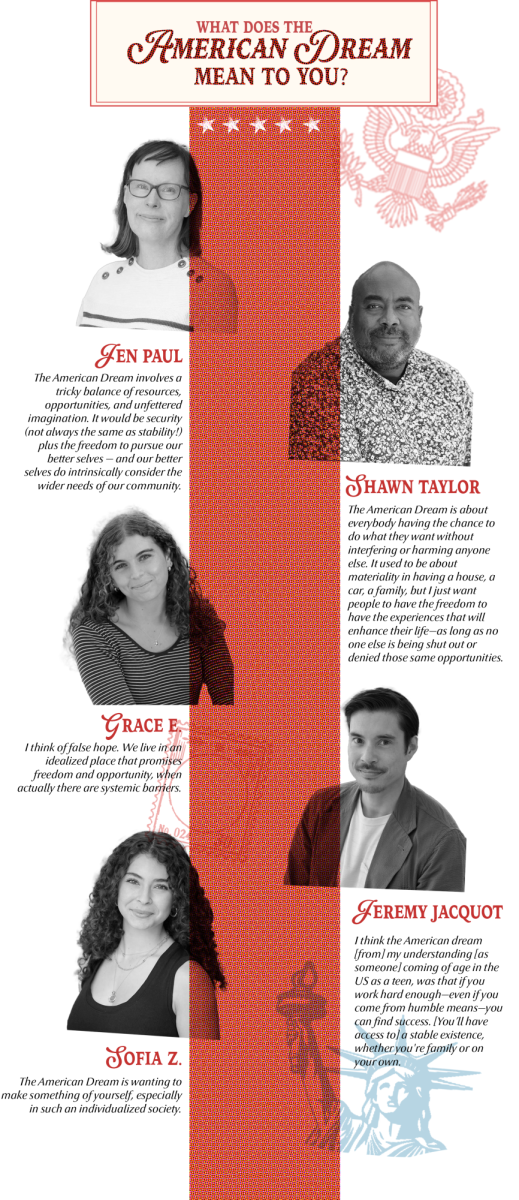
Though aspects of the American Dream may be flawed, its ethos continues to influence/shape the hopes and dreams of many immigrant families in the Nueva community. For them, the Dream embodies both the journey to America and the opportunities they have built—privileges that remain out of reach for many.
“For somebody who came here as a foreigner, this country has given an enormous amount to me personally and to our family,” Iachello said.
The American Dream has also provided vast opportunities for the children of immigrants. Hubert C. ’27 reflected on how his parents’ journey influenced his own opportunities.
“My parents grew up in a small town in China in the eighties, and I think that their dream was to just get into the big city, get a good job,” said Hubert. “I’m lucky to have parents that strive for more, and that’s why I’m here in the U.S. I’m very grateful for that.”
Similarly, Daniel K. ’27 sees the United States as offering more opportunities than would be available elsewhere.
“I personally always want to continue growing up in America—working here once I graduate college and after,” Daniel admitted. Although his extended family lives in Korea, Daniel believes the professional and educational opportunities in the U.S. are unparalleled.
Mars considers these opportunities as a privilege the majority of Americans don’t have access to. In a community like Nueva, where students benefit from top-tier education and abundant social connections, success feels more attainable.
“Our connections give us so much more social mobility, which is a privilege given the current political atmosphere,” Mars said. “We are surrounded by CEOs and billionaires, which also makes the student body so ambitious in terms of their aspirations.”
Soraya and Mars emphasize that using these privileges and opportunities is crucial in their definition of success. They feel a shared obligation to utilize their privileges for communal benefit.
“As I start to recognize my own privilege being from the Bay Area, I won’t feel as successful if I just sit on my wealth without doing something productive with it,” Soraya said. “Everyone from this area owes it to the world to give back a little bit more. That’s not what the U.S. looks like right now.”
“There needs to be a reframing of the American Dream from the individual to the collective. We need to focus on how you can uplift your community, and how your community as a whole can have more of a voice rather than this individual splintering,” Mars said. “Especially if you start from a disenfranchised community and move up the socioeconomic ladder, your original community usually doesn’t reap those benefits.”
Pamela aims to elevate this value with her business, whose mission is explicitly to “provide its services for the community.” Espinoza also highlights the importance of finding purpose and building connections, especially in terms of defining success. This “privilege of focusing on personal fulfillment” is “completely different” from her journey coming to America.
“I believe in the optimization—not maximization—of human potential,” Espinoza said. “Making tons of money even though you’re miserable does not translate to success. Success is to know and love yourself first, to be whole and present, to aim for balance, and to be financially independent.”
This balance is central to Hunt’s definition of a fulfilled American Dream, though she finds it lacking in Nueva’s high-achieving culture.
“After we meet our needed means for a comfortable life, there’s a point where having more money or stuff doesn’t actually improve our set point happiness level. When people keep chasing for more, they engage in what we call the hedonic treadmill,” Hunt said. “But that’s not where happiness comes from; even if it grants a temporary boost in dopamine, that craving and fulfillment cycle isn’t healthy for thriving as humans.”
Like Espinoza, Hunt believes people need to maintain connection, purpose, and personal values for a fulfilling life.
“It’s really important to be part of something that matches your values when you work hard, and by that, I mean invest in yourself,” Hunt said. “If the American Dream is about connection, meaning, and purpose, be an agent in your life. Particularly, engage in reciprocal relationships that offer a feeling of belonging—that’s the optimal state for humans.”
These ideals of personal fulfillment are mirrored in the aspirations of Tammy Dare.
Dare, who recognized her parents’ sacrifices at a young age, wishes to alleviate the “adult worries” that many immigrant children, including herself, took on. With this in mind, Dare aims to give her children the opportunity to decide their passions.
“Our kids, we don’t necessarily want them to pick something that’s safe. We want them to pick something for them that they feel like, ‘This is what I was meant to do,’” Dare said. “We want more for them than just survival, we want them to find their purpose.”
Similarly, Espinoza is optimistic for the future of her children, and America as a whole. Despite the current “cruel” situation Espinoza witnesses, she is optimistic that America will achieve a climate where her American Dream can thrive.
“America is like a team, and right now, we are going through a very rocky period,” she said. “But I see people waking up. As long as we keep protesting and [advocating], the future of America will be excellent.”