
















Part I. “We Don’t Date at Nueva”
In the hallways on campus, few students hold hands. At school dances, hardly anyone seeks or is sought to be a date. Ask a friend about their love life, and expect a laugh. The story that many Nueva students tell themselves is simple: we just don’t date.
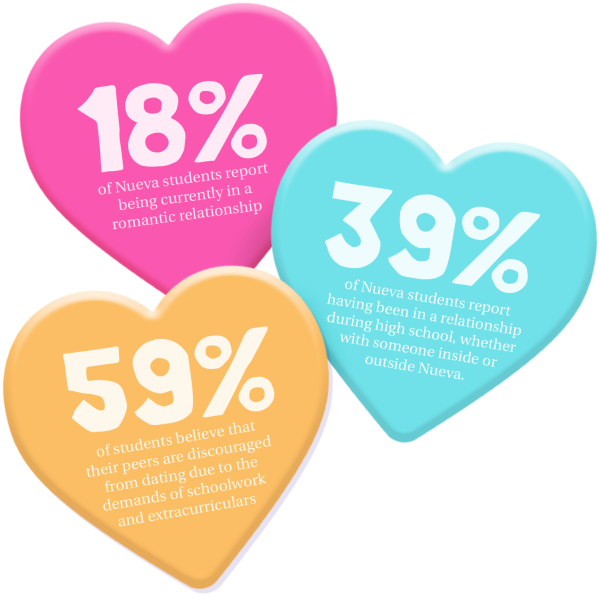
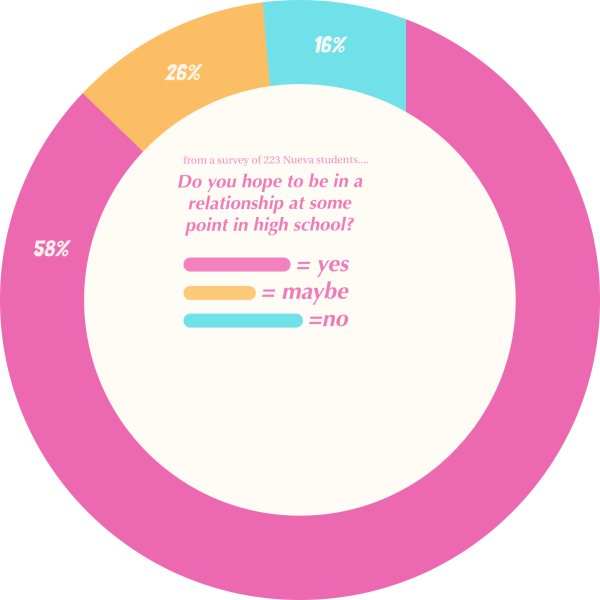
As it turns out, love isn’t entirely dead among students at Nueva. According to a survey by The Nueva Current of 231 Upper School students, 39% of students have been in a relationship during high school, whether with someone inside or outside Nueva.
Meanwhile, national trends show declining high school relationships: while 76% of Gen X and 69% of Millennials reported having a high school relationship, just 56% of Gen Z have had one, according to a 2023 American Enterprise Institute study.
Not all Nueva students are chronically single, nor do their dating habits necessarily drastically lag behind other high schoolers’ today. Yet, a perception persists of Nueva’s complete lack of romance, community members raise some very realistic barriers to engaging in relationships within the school, and just 9% of survey respondents reported dating within the school.
Part II. A Couple Problems
At many high schools, exploring a crush—sliding into someone’s DMs, asking someone to a dance, or merely getting to know each other within the school walls—is between just two people. At Nueva, that exploration can sometimes feel like a school-wide event.
With a student body of 451—around 110 students per grade—some students feel that gossip about crushes, dating, or breakups can spread quickly.
Given the potential social consequences of pursuing romantic relationships at Nueva, sex education teacher Kate Bedford finds it “deeply reasonable” for students to feel hesitant about dating a fellow Nueva student.
“Everybody’s watching in a way that doesn’t feel great. You can feel a little fishbowled,” Bedford said.
Bedford, who’s taught at Nueva for 20 years, has observed that students lacking relationship experience can often pass the most judgment onto others—a trend that several interviewed students named, too. Bedford explained that judgment can often stem from fear or insecurity.
“It’s so much easier to be like, ‘Nope, ew. Those people over there, gross,’ than to be like, ‘Actually, I want to be desired. I want to be liked. I want someone to find me special. I’m willing to put myself out there,’” Bedford said.
While Bedford acknowledged that students’ insecurities are valid, they can also lead to a culture of quick judgment.
That small-school culture manifested for Ava J. ’26 as classmates randomly approaching and asking her to explain a recent breakup. “I love tea just as much as anyone else,” Ava said. “I think it’s fun, but I don’t know you. I think it’s just crazy to blatantly ask someone you’re not really friends with [about a breakup].”
Having experienced firsthand invasive comments and questions about her romantic relationships at Nueva, Ava posited an explanation for the lack of couples within specifically the senior grade (three at the time of publication): “I feel like there’s so little dating in our grade because everybody is so judgy and gossipy,” Ava proposed.
Students can be hyper-invested in each other’s lives, and word can spread quickly—and this dynamic hasn’t just affected Ava’s grade, but underclassmen, too.
For Nate S. ’29, who’s new to Nueva this year and is open to dating within Nueva, the fear of being a subject of his peers’ gossip holds him back. “If I ask somebody, and then they tell all their friends, I don’t want to be then labeled as weird,” Simon said.
He did push past that fear once. He asked a classmate to a dance and, unfortunately, got rejected—only to find himself sitting next to her in one of his classes for the rest of the semester. “I felt bad for the person,” Nate said, wincing at the circumstances of being in a small school post-rejection. “It was just very awkward.”
Nate’s worry about unwelcome commentary from his peers speaks to a larger pattern among students. Upper School Lead Counselor Aviva Jacobstein has supported several students who bring their romantic experiences to her, and she’s heard Nueva students say “really unkind things” about their peers’ romantic lives.
Judgmental commentary, she noted, can specifically harm girls in heterosexual relationships. Because many students can place heavier emphasis on scholastic achievement, Jacobstein worries that girls exploring romance or sexuality can be “perceived as somehow less academic, which feels really unfair.”
Sakura T. ’26, who likes to spend time with her boyfriend and friends outside of school, has felt that implicit judgment over the years. “I think some guys just think that because I’m short, I’m a girl, I date people, and I go out—I’m just dumb, basically,” Sakura said. “And no one has said that to me explicitly, but I’ve definitely felt that from other people, especially a lot of guys.”
Once, Sakura was talking to one of her male friends about the IQ test and the score she got, and she remembers him being very surprised by her high score. “There’s this idea that if you date or go out, you don’t fit into the mold of a Nueva academic weapon,” Sakura said.
English teacher Allen Frost, who teaches the Gender & Sexuality elective, similarly recognized a tension between the culture’s heavy emphasis on building a resume and the core of dating. “[Dating] is something that’s about the present, which I think is really important. But there’s a sense that dating is a frivolous pursuit and frittering away time that could be used for something more valuable,” Frost said.
Meanwhile, Ava thinks that having equally busy schedules can potentially enable a successful relationship between two students at Nueva. “If anything, I feel like Nueva people just kind of get it,” Ava said. “I know my partner’s busy, too, with their own stuff. I actually think that relieves some of the pressure.”
Still, there may just be limited opportunities for finding partners—the dating pool is small and contains people who have known each other for many years. For alumni and lifer Maya Sprosts ’25, who’s still dating Max Roche ’25, exploring romantic relationships with people she’s known since elementary or middle school was difficult to imagine.
“When you’ve grown up with each other, at least to me, they feel a little too much like siblings,” Sprosts explained. She and Roche (the latter joined Nueva in ninth grade) bonded at the start of their relationship by comparing stories from their different childhood experiences—a foundation that many Nueva students can’t build, having already grown up or gone through middle school together.
The dating pool is even smaller for queer students. Asher J. ’27, who identifies as a trans male, knows that making a move is scary for anyone—but trans people also consider an added, complex layer.
“What if I shoot my shot, and they out me? Or, what if I shoot my shot, and they’re transphobic to me?” Asher asked. “People can be like, ‘Oh, I support trans people, but I don’t want to date one.’ And that’s fine—you can date whoever you want for whatever reason you want.”
For bisexual students like Madison M. ’26, the math is still complicated. Madison pushed back against the notion that bisexual high schoolers have “double the dating pool,” which her friends often joke with her about: a fraction of the girls in her grade like other girls, and Madison just doesn’t feel romantic feelings for any of them. “Just because I like girls doesn’t mean I like every girl, just like my friends who like guys don’t like every guy,” she said.
Frost empathizes with the queer students at Nueva, who—despite living in a very different time and place than Frost’s suburban Arkansan high school experience—can struggle with the same lack of options Frost felt as a young gay man.
“At Nueva, there’s already the expectation that you’re all supposed to be friends, right? So then to actually consider that [other gay person in your grade] as a romantic partner is really awkward,” Frost explained.
Frost appreciates that queer students are not pressured to date within a pool with more limited options—a unique absence of pressure that also extends to the student body more broadly.
For students like Cate G. ’28, that absence of pressure is especially visible at school dances. Unlike at other high schools that she’s observed, the student culture doesn’t have an expectation of arriving to a dance with a partner—unless a couple is already dating.
“[What] I hear from other schools [is], ‘I need a prom date. I’ll get anyone,’” Cate said. Though Cate doesn’t desire a culture so extreme, she’d appreciate being able to more casually attend dances with a date, a notion that can be difficult to imagine under the school’s gossipy and all-or-nothing culture.
But the student life experience hasn’t always been this way. Though The Nueva Current lacks empirical evidence for total dance proposals in recent years, Student Council social media and spirit point archives reveal a different picture in past years.
In 2021, students prepared at least 20 proposals for the Homecoming dance; in 2022, at least 15 for Prom; and in 2023, at least 11 for the Winter Formal. While some proposals were romantic, others were in casual, platonic fun.
One example: in a staged spectacle, four Class of 2023 students presented posters vying for Daniel Rosario ’23 to be their Homecoming date—right before Rosario pulled out his own poster and invited all four of his proposers to the same dance.
Sprosts, who witnessed a decline in casual dance proposals—and perhaps, by extension, romance—over her years in the Upper School, can appreciate both the dynamics of today and years past.
“If I’m being honest, I loved going to the dances with my friends,” Sprosts said. “But I also think a school dance is a good way to ask someone out, and [now there’s] one less excuse to do it.”
However, even if the social dynamics were different at Nueva—in regards to dances, sexual orientation, academic expectations, small class sizes, or more—Bedford emphasized that exploring romantic relationships is never easy.
“Dating takes courage. It takes work. It takes vulnerability,” Bedford said. “And those things can feel scary. So, putting yourself out there and potentially being rejected? That’s hard.”
Frost echoed Bedford’s message about the universal challenges of dating, adding one final observation about Nueva students.
“Particularly in this community, there’s a real sense of perfectionism. Well, it’s hard to date perfectly,” Frost said. “You’re putting yourself in this vulnerable position. There’s no rubric for this, right?”
Part III. The Case for Love
When students do leap towards love, they can discover healthy experiences for enjoyment and growth.
For example, Aaron Huang ’24 found that exploring romantic relationships helped him gain skills like communication and emotional maturity during his high school years.
“I love Nueva because it’s taught me how to make relationships with other people, whether romantic or social,” Huang said. “In high school, I think that one of the most important things you could do is play around with the idea of building romantic connections with other people.”
Huang has been in a relationship with Selin Kandemir ’24 for two years. He feels that bonding with her played a huge role in his development as a person—and a high school experience that Huang values.
Looking back, Huang has one piece of advice for current students: Avoid seeing Nueva solely as a place to study or participate in clubs.
And yet, Nueva has a sizable population of academically and extracurricular-focused students. Even if Huang’s advice is good, is dating harder for Mavericks?
Well, computer science teacher Wes Chao pushes back against the stereotype that “nerds” can’t have romantic success or emotional acuity.
“You can be good at [subjects like CS and math] and also good at understanding what people want,” Chao explained.
In the case of Sprosts, the I-Lab—where Chao and many CS kids spend their time at Nueva—was even an environment that subtly helped nurture her relationship with Roche.
While Sprosts and Roche were still getting to know each other, she’d work on building Team 4904’s robot after school. Meanwhile, robotics teammate Aadit Barde ’26, who was friends with both, helped Sprosts feel a little more confident of Roche’s reciprocated feelings.
“I definitely liked Max, and Aadit would be like, ‘Oh, he definitely likes you,’” Sprosts recalled.
Jonathan H. ’27 also gained support from his friends while courting his now-girlfriend, Bella B. ’27, to Homecoming. As a result, Jonathan and Bella pushed back against the perception that their peers are excessively judgmental.
“Nobody’s ever been weird about it. Everyone’s like, ‘Oh, you guys are so cute,’” Bella said.
For Livie P. ’26 and Cristopher B. ’27, who have been together for about five months, any judgment about their relationship wouldn’t really matter to them.
Instead, by focusing on their relationship, Livie and Christopher push each other to be better. “He challenges me, in a really good way, to better myself, discover myself, and to embrace parts of myself that I hadn’t before,” Livie said.
By dating Livie, Christopher has learned how to balance his academic and personal commitments. He and Livie have always been explicit about prioritizing their schoolwork and clearly communicating their needs and limitations, and Christopher intentionally makes time for his girlfriend during busy periods.
Dating within Nueva can even optimize for balance, according to Asher, who’s had two romantic relationships at Nueva. “As a person with a busy schedule, it can be really nice knowing that I could say hi to my [significant other] in a passing period,” he explained. In Asher’s eyes, proximity isn’t always a complication—but can be helpful in building a successful relationship.
Psychology teacher Amy Hunt, who teaches a unit about love and attraction in her Intro Psychology class, appreciates students who want to embark on relationships during high school.
“I’m a big fan of being in the moment without knowing where things are going and just enjoying the ride for however long it lasts,” Hunt said. “But if people are worried about being in the fishbowl of Nueva and schedules, that would get in the way of letting something just sort of unfold naturally.”
Part IV. Leaving the Door Open
The lack of pressure to date at Nueva has costs: unasked questions, forgone connections, lonelier dances, and judgment for those who do. While most community members disagree with the stigmatization of dating, not everyone longs for more pressure than the status quo.
SEL teacher Lee Holtzman has spent years thinking about the development of gifted students, and she’s neither surprised nor certain if there’s reason to be concerned that gifted high schoolers might not wish to date at this stage in their lives. Some gifted students, according to Holtzman, mature academically and emotionally at very different paces.
“I don’t think Nueva kids innately won’t date. It’s a timing thing,” Holtzman said, having stayed in touch with alumni who share experiences with her about exploring meaningful romantic relationships post-graduation.
For freshmen, for example, 14 and 15 may be too young an age to engage in a serious relationship. Hunt emphasized that psychology research has found that kids under 15 years old benefit from focusing on forming their own self-identity before seeking a romantic commitment.
Asher, as someone who dated in his freshman year, echoed Hunt’s advice about dating too young. He advised not dating someone coming in as a ninth grader to Nueva. “Give yourself some time to figure out who you are and who you want to be. But as you get further down the line—if you fancy someone, go tell them,” Asher said.
Hunt agreed: research shows that seeking romantic relationships once over the age of 15 can facilitate personal development for young adults and be emotionally profound. As such, Hunt hopes the school’s culture leaves the door open for forming those relationships.
“If people do have the time and want to have high-quality relationships, I would hope that they’re not shying away from them because [the culture at] Nueva doesn’t support that, it’s too public, or there’s too much possibility for shame involved,” Hunt said. “That breaks my heart a little bit because there’s so much good that can come out of a high-quality relationship.”
Huang believes that students can find more romance at Nueva by reorienting their mindset. “If you’re like, ‘I can’t date [at Nueva],’ of course you’re not going to,” he said.
Ultimately, Huang believes, successful dating at Nueva requires less judgment from peers and more confidence among couples.
“I think people are so afraid of the term dating because of the drama that ensues after it. But, at the end of the day, dating is a label,” Huang said. “It doesn’t really mean that much unless you give it weight. So, if you’re having fun with someone, why not date?”
Whether or not students at Nueva choose to date during high school, Bedford likes to tell all of her graduating seniors one message: “I hope that, by the time kids leave and go off to college, they have a little bit of swagger. They really are a catch, and somebody would be super lucky to date them.”
And for those who have already found love, the reality can be simpler than some people imagine, even with real barriers to dating at school.
“At Nueva, love is in those moments between class, or who shows up in the audience, or genuinely caring about someone’s intellectual activity,” Asher said. “I think love shows up in the margins a little bit more.”