












This year, 116 sophomores traveled to Hawaii during Upper School Trips Week, spread across six trips to all four major islands. Each had a different focus—ecology, open-ocean wayfinding, cultural immersion, wilderness safety—but all grappled with the same question: how do you travel responsibly to a place with a complicated relationship to tourism?
The Hawaii trips are designed as an extension of what sophomores have been studying throughout the school year. History 10 examines processes of colonialism and decolonization, and in English 10, all students read Jamaica Kincaid’s essay A Small Place, which critiques tourism as a modern form of colonialism that harms local culture and environments for the consumption and benefit of privileged travelers.
Upper School Academic Support Coach Gretchen Kellough, who used to teach English 10 and lived in Hawaii for several years, helped design one of the Kaua‘i trips as a response to Kincaid’s text.
She started by asking her local and native Hawaiian friends a blunt question: was it even possible to bring dozens of students to a small island responsibly?
“I asked them, [can] we make this pono?—meaning righteous, balanced, responsible,” she said. “And the answer [they gave] was yes, but it had to be really thoughtful.”
Those conversations also reshaped Kellough’s understanding of service work, a core component of many Hawaii trips.
“It was interesting for me to hear that there is a benefit in the cross-cultural experiences where [trip partners] get to interact with young people [from] the mainland,” Kellough noted.
Through these connections with local residents, thoughtful travel—even thoughtful tourism—has the potential to reshape and expand perspectives on both sides. Cultural exchange, especially, is hard to replicate without physical travel, and the revenue tourists bring (~$12 billion annually in Hawaii) can flow into local businesses and cultural preservation initiatives.
But physical travel comes with a slew of environmental harms: emissions, pollution, erosion, wildlife interference, and the massive amounts of energy swallowed by hotels, resorts, or golf courses. Meanwhile, short-term commercial tourism tends to flatten the complexity and richness of local culture into superficial stereotypes.
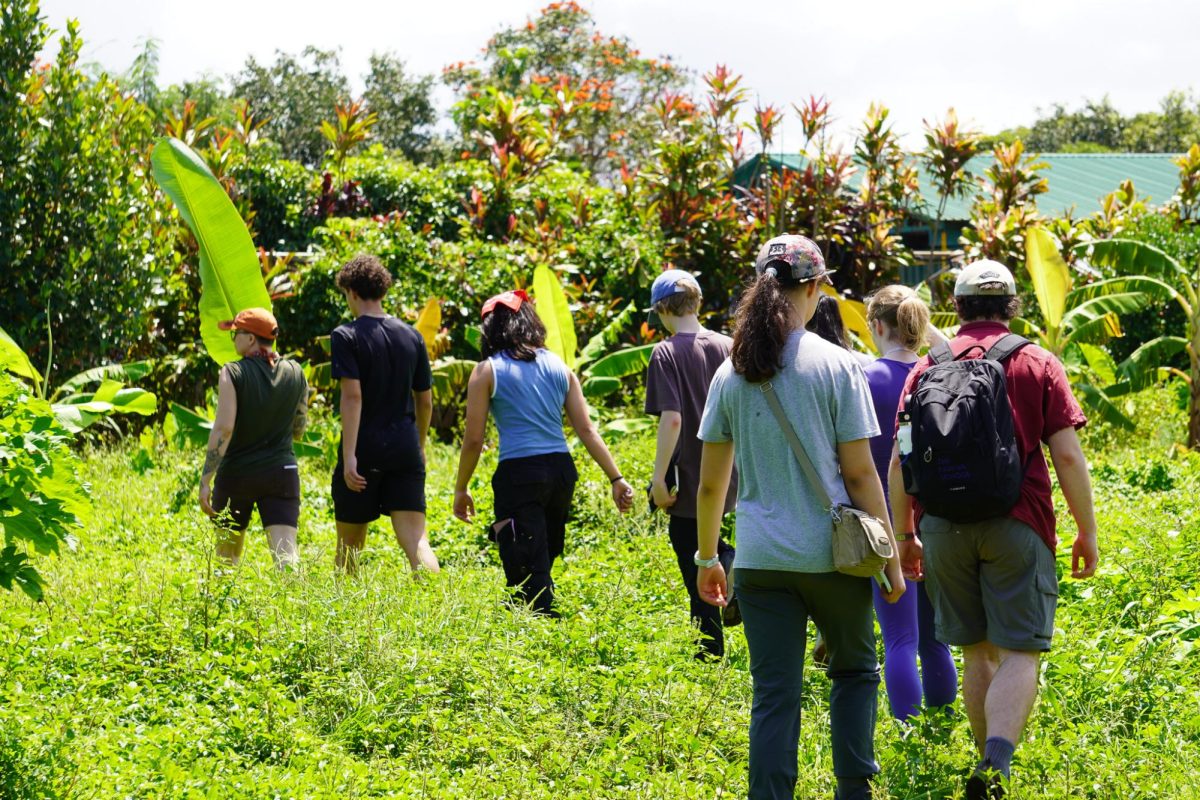
To avoid these harms, the trip Kellough led to Kaua‘i this year focused on supporting local organizations and forming connections with local residents. Students also stayed in condos and houses with kitchens, instead of hotels, to minimize food waste.
Lily Z. ’28 traveled to O’ahu and said that her trip put a similarly welcome focus on building community, both in and out of Nueva.
“Seeing yourself as being in community and cultivating that kind of empathy is really important,” she said.”
But Lily also felt that the issue of tourism was “skirted around.” Students stayed in Waikiki, a well-known tourist hotspot, though they spent most of their days farther up the coast, learning about invasive species and biogeography at state parks and farms.
“The rhetoric [was that] we’re being environmentally conscious and socially conscious of our harm—this idea that we are just atoning for our sins,” Lily said. “We kind of de-emphasized the problems [inherent in] tourism in the first place.”
Lily also expressed concern with the concept of “service work” as a way to justify or offset the school trips.
“I think that service is not a thing that exists. I think that actually doing something for your community is not an act of service,” she said. “It is just you participating in a larger ecosystem and doing your part in that larger environment.”
Camilla K. ’28, who traveled to West Kaua‘i, described how her trip revolved around wilderness conservation work, a different type of service. “[We] primarily focused on traveling safely and with as little impact in outdoor spaces, while also learning about Hawaiian culture,” she said.
For her, the trip’s curricular tie-in to colonialism was less explicit, and the most memorable moments instead came from spending time in nature, cooking from scratch, exploring culture, and bonding with the other dozen students on her trip.
She also recognized the tension between learning about colonialism in the classroom and actually spending time in Hawaii, even as the trips were designed with an awareness of potential harm.
“[Although we are] understanding the impacts of colonialism in English and History, we are actively feeding a tourism economy built due to colonialism,” Camilla said. “While the Nueva trips work hard to avoid this directly by engaging with local organizations, and not following a traditional tourist itinerary, there is still inherent tourism with all Hawaii trips.”
As Kellough was grappling with these questions, she landed on the realization that tourism is, in many ways, “inevitable” in Hawaii. “You’re going to be touching, in some way, that infrastructure, whether it’s because you’re [on] a trip that’s using a hotel or you’re visiting tourist sites,” she said.
Head of School Liza Raynal added that concerns with tourism are not unique to Hawaii, and that guidelines around responsible travel are designed to apply to every single Nueva trip.
“Where we’re going to stay, who we’re going to meet first, what kind of prep [students] need to know before [they] go—all of those are choices that trip leads or chaperones are making that we hope are setting the [right] context towards the kind of travelers we want to be,” she said.
Still, Lily remains unconvinced. “The material damage that tourism does in Hawaii is something that we can resolve by just not going there,” she said.
Upper School Dean of Students Jackee Bruno, who uses his Trips Feedback Survey to gauge the student experience and factors like sustainability and repeatability, acknowledged the ongoing tension. “[With trips, we’re] constantly trying to move away from consumerism,” he said. “Traveling in itself is a privilege.”
Kellough put it simply: “We are guests in a place that has a very complicated history with the mainland, and we have to acknowledge that.”
