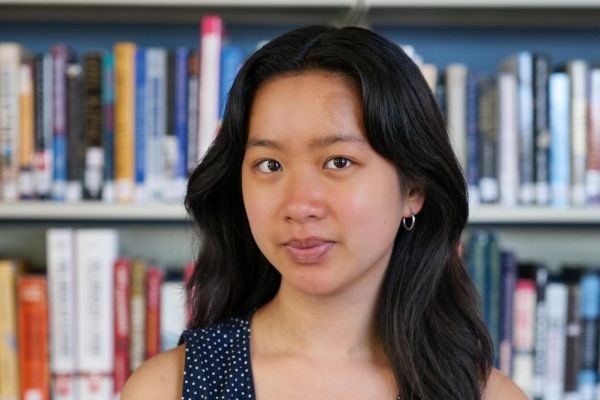
























In ninth grade, Mila B. didn’t get into any of her top choice electives for the year: Intro. to Microeconomics, Intro. to Macroeconomics, or Intro. to Psychology. It wasn’t too surprising—the classes were popular and Mila was only a freshman. She was still determined to learn the material on her own. So Milas took matters into her own hands—she signed up for Advanced Placement (AP) exams.
That spring, Milas took five AP exams, mostly for her own learning. To fill the void of the electives she hadn’t gotten into, she sat for AP Microeconomics, AP Macroeconomics, and AP Psychology. To strengthen her writing, she took AP English Language and Composition. And since chemistry was already part of her freshman curriculum, she figured she might as well take AP Chemistry too.
“I honestly took them just to force myself to actually study subjects that I was interested in with a curriculum that was going to teach me over time, instead of just watching random [educational] videos once in a while,” Milas said.
In addition, with no time-extensive extracurriculars, Mila figured that freshman year was the optimal time to commit to the study workload of APs.
Mila is far from alone. At Nueva, 93 students took AP exams in 2026, accounting for 142 exams total. That’s down from 2025, when 106 students sat for 174 exams—but the broader trend points upward: the number of students taking AP exams has grown 58% over the past four years. Underclassmen are driving much of that growth, with more freshmen and sophomores taking exams than before, though juniors led the school this year with 38. The majority of students only take one AP exam, with only 33 students taking more than one AP exam this year.
Nueva does not offer any AP classes or explicit exam prep, yet it still hosts several AP exams on campus, including AP Calculus, AP Chinese, and AP Chemistry. For exams not offered at Nueva, students are responsible for finding their own test sites and transportation.
Opting into AP exams comes with an “opportunity cost,” according to Nueva’s college counselling team—the added study time and workload pull students away from other pursuits. In a statement on AP exams, the team was candid about their stance that taking APs is simply not a necessity for Nueva students: “Our program is explicitly not designed to prepare students for AP exams; we can and do offer something better,” adding that students who choose to take them are “ opting out of an experience designed specifically for them in order to participate in something designed to be a ‘least common denominator.’”
Still, the college counselling team also acknowledges one of the more practical draws of AP exams: college credit. Roughly 60% of U.S. colleges accept AP scores to place out of introductory courses, though policies vary widely by school.
For Jason C., college credits were his primary motivation for taking three AP exams: AP Calculus and AP Physics Mechanics in sophomore year, and AP Chemistry in senior year.
“I thought I might as well get it done [so I] get credits,” Jason said. “Also, it’s a nice motivator to make sure I’m focusing and also accustomed to testing, ’cause in college, you’ll have standardized testing.”
He noted how a fully self-motivated and self-regulated study process can be tedious in comparison to learning in a Nueva class. “Frankly, I found the content kind of boring on my own,” Jason said.
Nevertheless, he felt the preparation was helpful for his study habits.
“It does help give me a little bit of creativity in the sense of predicting what’s going to be on the test and then what to practice,” Jason said.
How the AP scores would look on his college application did not inform his decision, given the college counselling team’s general guidelines around AP exams, which include an emphasis on how submitting AP scores does not enhance a student’s application to US colleges. This reasoning has consistently been included in emails to students and parents about APs, as well as standard college counselling presentations to students.
Asher J., with these guidelines in mind, described the decision to take AP Biology this year as one not influenced by such college considerations at all. At the beginning of the year, he signed up simply because he wanted to, ready to study and prepare.
By the time the exam rolled around, however, he hadn’t spent much time studying. Undeterred, he still took the AP exam. He gained a newfound appreciation for his ability to adapt and apply knowledge in the process.
“I thought, what if I just take it and see what happens? And I gained new confidence in my reasoning skills and applying what I know in different situations,” Asher said, and added, “But I definitely think you should study if you are going to take an AP.”
For Colin C., test-taking and studying skills were precisely what he hoped to improve when he took AP Chemistry as a senior.
“For me, it was honestly just trying to become a stronger test taker, making sure that I’m not letting things go in senior spring, and trying to hold myself to a standard of continuing to build better habits,” Colin said.
He also took the AP Calculus exam as a sophomore, and the AP Computer Science Principles and AP Physics exams as a junior. Throughout the past three years, his primary motivations have remained relatively consistent: to learn, maintain and demonstrate his knowledge, and shore up test-taking skills.
“I feel like there’s no harm in taking the tests,” Colin said. “If anything, it will help me understand where my strengths and weaknesses are.”
In particular, the study process for AP exams has been particularly helpful in understanding how to organize his time effectively. During his studying, Colin was able to implement new learning strategies on his own, while occasionally relying on Nueva teachers for help with any concepts he was confused about.
Freshman Reed C. used a similarly collaborative study plan—only, he worked with a study group of five other freshmen. Together, they worked through textbook problems and exchanged advice for the AP Calculus exam they were studying for.
Reed viewed AP Calculus as an opportunity to get college credit, and freshman year was the right time since he was currently taking calculus at Nueva—all standard reasons he heard amongst other freshman test-takers. Still, the number of freshmen test-takers was surprising; he had not expected so many people around him to be taking APs.
Reed pointed to worries about falling behind in terms of college applications or academics as potential contributing factors.
“A lot of times it can feel like: oh, all my friends are taking APs; in order to catch up, I need to take APs too, otherwise I’ll be really behind,” Reed said.
Ultimately, none of these students would trade the Nueva curriculum for the AP curriculum, or for a more traditional AP academic program. Colin described the current opt-in Nueva framework for AP tests as a balance that is the “best of both worlds” and praised the Nueva academic experience.
“Nueva[’s] projects and rubrics [have] definitely been very transformative for me and other classmates,” Colin said. “It’s ignited in me a passion for specific academic areas, and I think that will carry me much further than a test focus or test-centric learning style will.”