

















On Friday, Feb. 13, 2026, everyone who cared about figure skating—and many who ordinarily wouldn’t—sat watching as Ilia Malinin skated onto a ~17,000-square-foot sheet of ice in Milan, emblazoned with Olympic rings.
The 21-year-old was carrying the expectations of many. His parents, Olympic figure skaters themselves. His own world records, national and world titles, and first-place finish in the Olympic short program three days before. The other U.S. figure skaters, whom he’d led to a gold medal in the team event earlier in the week. His fans, who believed he was destined for the individual gold. And the media—the slew of articles, profiles, interviews, social media edits, brand deals, and general hype—who told those fans that Malinin was a phenom, revolutionary, dominant, unbeatable.
Then, everyone watched him get beaten.
After a clean quadruple flip to open his four-minute free program, Malinin set up his iconic quadruple axel and popped it, completing only one rotation. Time seemed to stretch as he flailed nearly three feet in the air, free leg bent and dangling, staring down at the ice with a terrified expression.
After that, it was over. Malinin fell twice, landed only one other jump cleanly, and popped several others. The final score of 156.33 put him fifteenth in the free program and a shocking eighth overall, far removed from the podium.
The loss was shocking in part because of the natural talent he displayed in his undefeated two-year run. But it was also shocking because the world had been primed for a first-place finish through a media storm that took favoritism to an unhealthy extreme. In the leadup to Milan, The Atlantic called him “The Man Who Broke Physics.” The New York Times declared that, for him, “all that’s left is Olympic superstardom.”
Favoritism in sports is nothing new. Neither is the so-called “Olympic Favorites Curse,” which, since at least 2014, has been blamed for dramatic, shocking endings in the women’s skating event. But only recently has the media buzz around ultratalented athletes like Malinin reached a fever pitch of a whole new level. It takes the most exceptionally composed—and extremely rare—athletes to ignore or even transcend the weight of those amplified expectations.
Six days after Malinin’s medal-less event, fellow American Alysa Liu, wearing a blingy gold dress and a loose ponytail, skated a flawless program in the women’s free skate and won herself the Olympic gold. It was a surprising finish. Prior to her win, the word “favorite” had been tossed around Liu a few times, but mostly by optimistic reporters ignoring the more obvious choices of Kaori Sakamoto, Amber Glenn, or Adeliia Petrosian. Being labeled a favorite was a passing fancy for Liu in the leadup to the Games, colorful but short-lived. For Malinin, it was an iron chain: after his disastrous finish, a result of him crumbling under pressure, a slew of articles pounced on images of him clutching his head in anguish, fighting back tears as he took a bow, and lying splayed on the ice.
In Liu’s case, the media was also quick to emphasize that her story is one of the most unlikely trajectories in figure skating, a sport that rewards consistent maintenance of extreme strength, flexibility, and a low body weight. A child prodigy, she retired at 16, only to return at 18. It’s nearly unthinkable to expect a skater’s arsenal of fiendishly tricky movements to remain muscle memory after a two-year break. Liu’s return is a testament to her talent but, even more, her mental fortitude.
The media’s prying eyes still feasted upon her story as impressive and revolutionary, which it is. She was profiled in The New Yorker prior to the Olympics, but, although the article talked about her talent, it focused on her newfound agency and joy. This type of media coverage is very different from what surrounded Malinin, which was a constant focus on his superhuman talent and “destiny” for gold.
And joy was central in Liu’s gold-medal skate. With her hair dyed in her now-signature thick halo stripes, she grinned and bopped to the music, floating into her jumps with a beautiful ease. When it was over, she skated over to the cameraman and yelled “THAT’S WHAT I’M F—ING TALKING ABOUT!”
But don’t write Liu off as simply blessed with superhuman clarity, or berate Malinin for not withstanding the pressure cooker. That’s another kind of favoritism, and just as harmful, because it removes the blame from the forces that cause such extreme situations in the first place.
Professional athletes become famous partially because of the curated image they project to the public. That image is largely created by media outlets shaping a narrative from games and competitions. But when any human being is portrayed as a myth, the fact that no one can be extraordinary all the time is obscured. The question then becomes when the athlete, and the world, will realize this. And the answer is often found in devastating moments like Malinin’s.
Yes, figure skating thrives on risk and high stakes. Yes, Malinin chose, and happens to be incredibly gifted at, his sport. And yes, media coverage boosts his profile, introduces the sport to a wider audience, and memorializes it for future generations of fans.
It’s tempting to glorify someone like him, whose technical ability is so clearly exceptional. It’s when the myth begins to obscure the person that appreciation can quickly turn toxic.
Malinin will recover. His talent has not gone away. But fans, reporters, and commentators have a responsibility to give athletes space to ascend to the highest levels of their (sometimes unfathomable) capabilities without deciding what those are in advance.
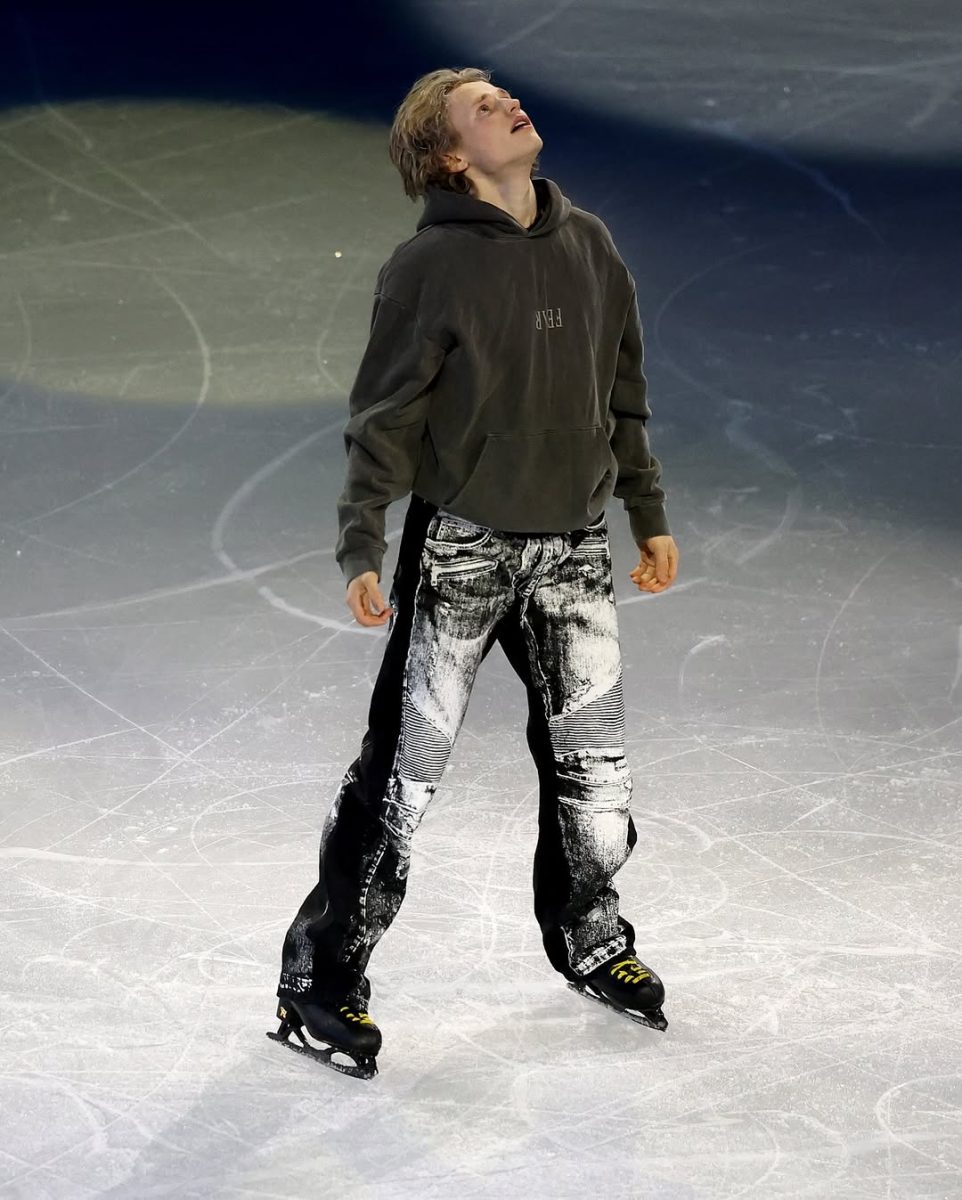
In the Exhibition Gala, the non-competitive, invitation-only culmination to the Games, Malinin skated to “Fear” by NF, wearing a sweatshirt and jeans. His performance was technically perfect, showcasing his typical explosive jumps and innovative choreography. It was also heartbreaking. He opened by miming scrolling on his phone while a buzz of chatter and pinging notifications grew to a swell. At the end, the phone came back, before he cast it aside and abruptly turned his gaze upwards, fighting back tears.