















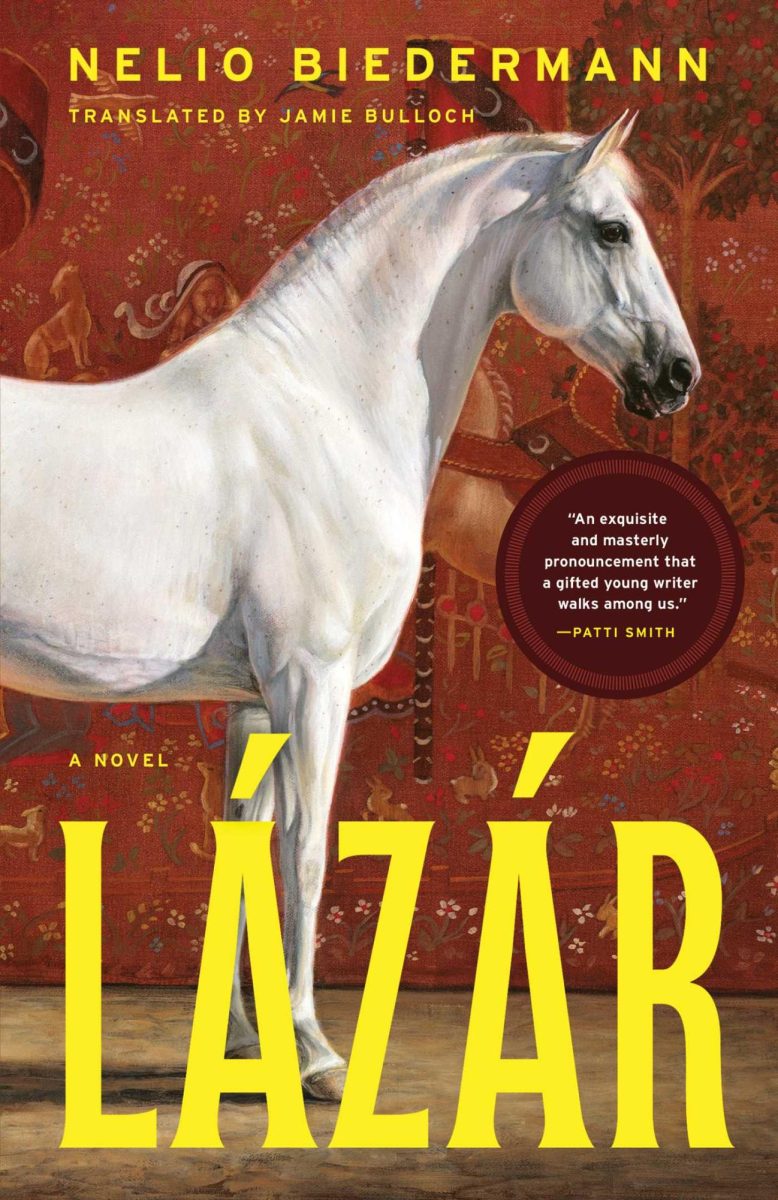











“Lázár” is the first novel of young Swiss writer Nelio Biedermann to be translated into English, and it establishes him as a keenly perceptive author with a knack for narrative momentum and compelling, flawed characters.
Biedermann uses his heritage to his advantage: “Lázár,” a sweeping, multigenerational saga that covers decades of tumultuous 20th-century Hungarian history, is based on Biedermann’s own family’s story.
We meet the Lázárs in the sunset years of the Habsburg Monarchy, the last of the Austro-Hungarian Empire. The current Lázár patriarch, Sándor von Lázár, is dismayed by the birth of his son Lajos (a “translucent child”), and his unstable marriage becomes an allegory for his country’s political situation.
Families evolve and decades pass, but the novel always zeroes in on the intimate, using moments of connection and discord to propel the years forward. Biedermann has said that the novel’s chief protagonist (if there is one) is time, and it certainly feels that way: “Lázár” moves with surprising agility compared to the density of its historical period. A novel could be written about any of the characters, but Biedermann has chosen to include them all in a colorful, alive, and ever-shifting amalgamation.
Although the characters move around Europe, generations of Lázárs continue to return to the family’s wooded manor house, the site of birth, death, illness, and drama. The forest lends an aged, mysterious quality to the atmosphere and a touch of magical realism to the plot, as what the house represents—wealth, respite, isolation, stability, nostalgia, decay—shifts, making “Lázár” feel at once brilliantly fluid and unmistakably grounded.
The family’s social status is also constantly shifting. With the fall of the Habsburgs, the destruction of the Second World War, and the rise of communism, the Lázárs’ material wealth is alternately a safeguard and a liability. During the war, especially, they stay relatively unscathed—but at the price of potential complicity and resulting guilt. The Lázárs are morally gray people: because there is no central narrator, their world and the social hierarchy they are entrenched in are presented without the risk of excessive sympathy.
Biedermann has been compared to Thomas Mann and his novel labeled a modern classic. This reviewer hasn’t read any Mann, but what stands out about “Lázár” is Biedermann’s ability to tell his story with a scope and lightness of touch that does evoke older narratives—it is very different from the hyper-realistic, deeply interior writing that comprises much of modern literary fiction.
The novel also excels in its restraint; given its subject matter, “Lázár” could have easily been a tome, but it is only 258 pages. Assumedly because of Biedermann’s relative newness to the craft, “Lázár” is not a flawless book. The first section, especially, feels slightly unmoored, and it takes some time for the Lázárs to become familiar and truly interesting. Occasionally, description drifts into cliché, or a moment full of potential is swept aside by the constant movement of the plot.
But Biedermann’s writing is sensitive and perceptive, and he is brave to take on so many characters and eras very much unlike him or his time. Perhaps what is most extraordinary about him, rather than his age, is his humility, and his recognition that the world does not need another navel-gazing tale about the perils of being a young, white man in the 21st century. Instead, he has given us a unique novel about a flawed and intriguing family that is a true pleasure to read—and, hopefully, the promise that this is only the beginning of his work.