


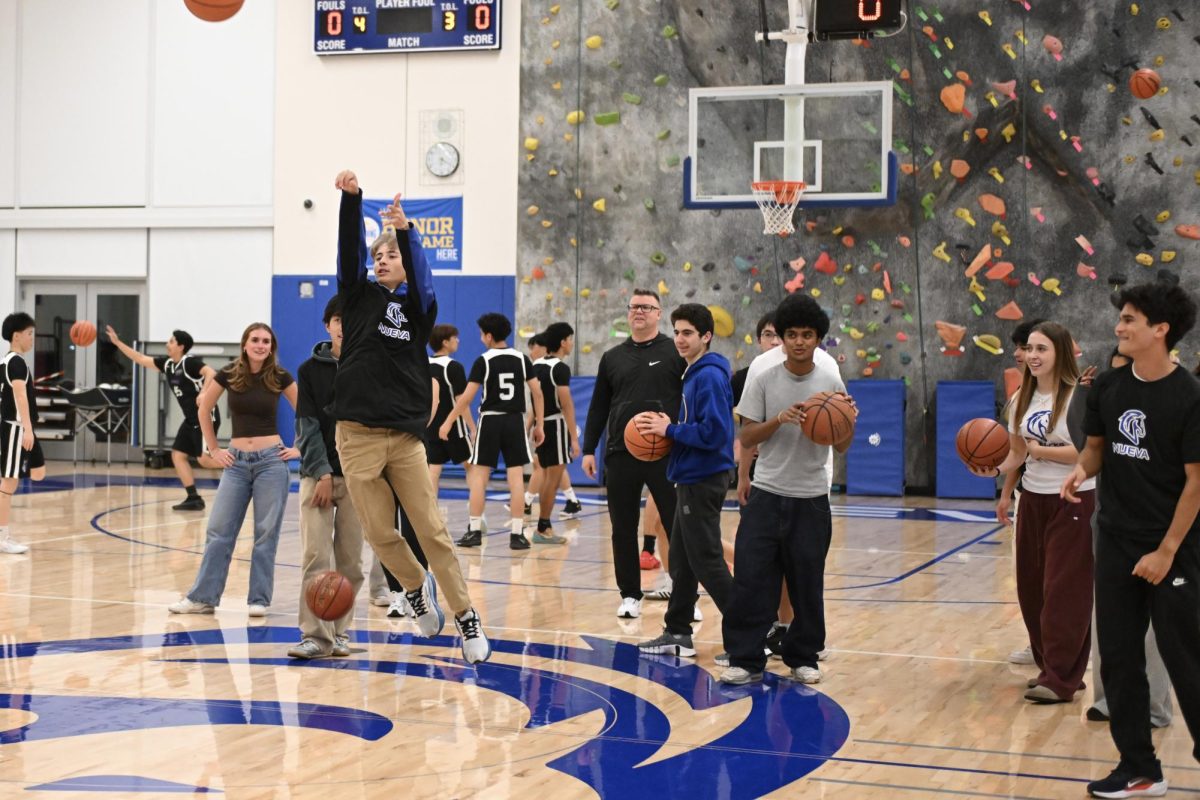

















During a November all-hands assembly, the Upper School student body gathered in the gym for a review of the school’s safety and security protocols. It was the first assembly of such nature since pre-pandemic, and the first for the current Upper School student body.
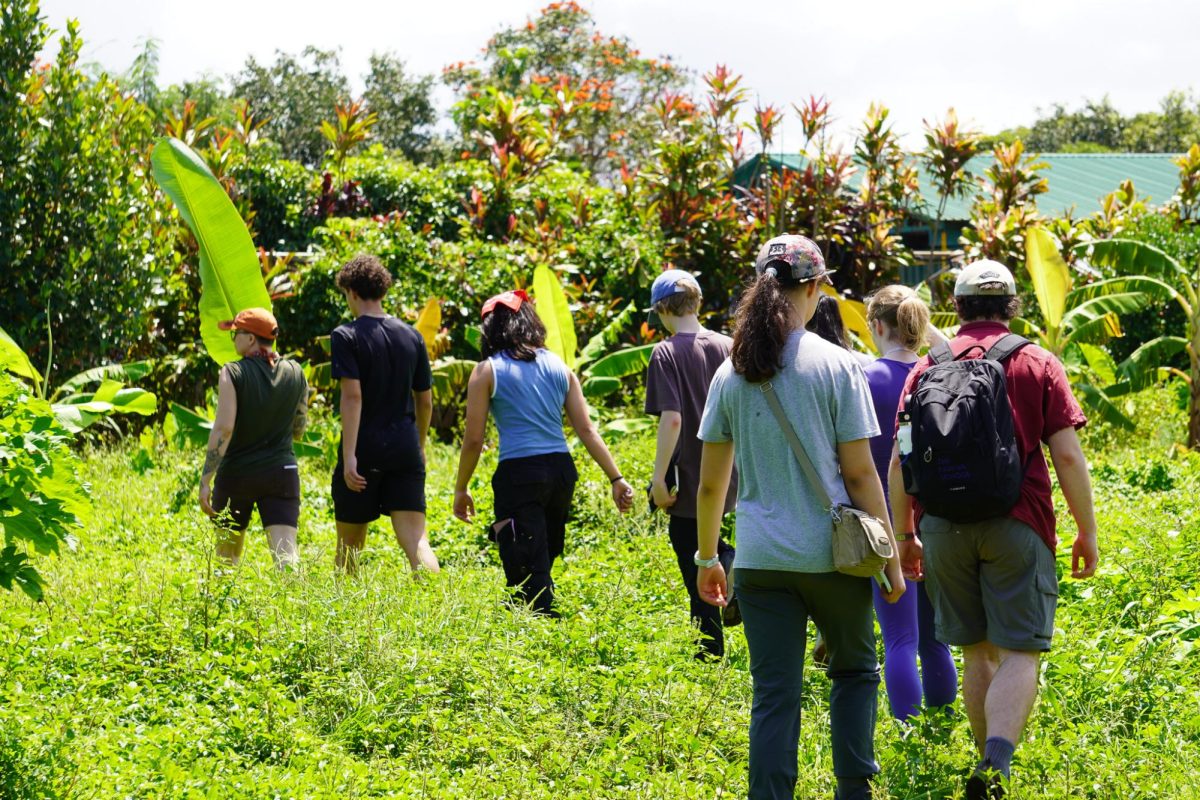
Addressing the community, Dean of Students Jackee Bruno discussed the importance of on-campus vigilance, alerting students to proper emergency exit routes, iterating the appropriate etiquette in a situation with an intruder, and lastly, facilitating a school safety tour where students across the grades gathered in groups of five and put into practice these safety tasks.
When Bruno entered Nueva in August 2022, he realized the need to reinvigorate school safety precautions at the Upper School. Alongside Director of Operations Steve Osborne, he increased attention, time, and space towards prioritizing regularly-scheduled safety drills and wanted to carve out a portion of his job to protect students’ physical safety.
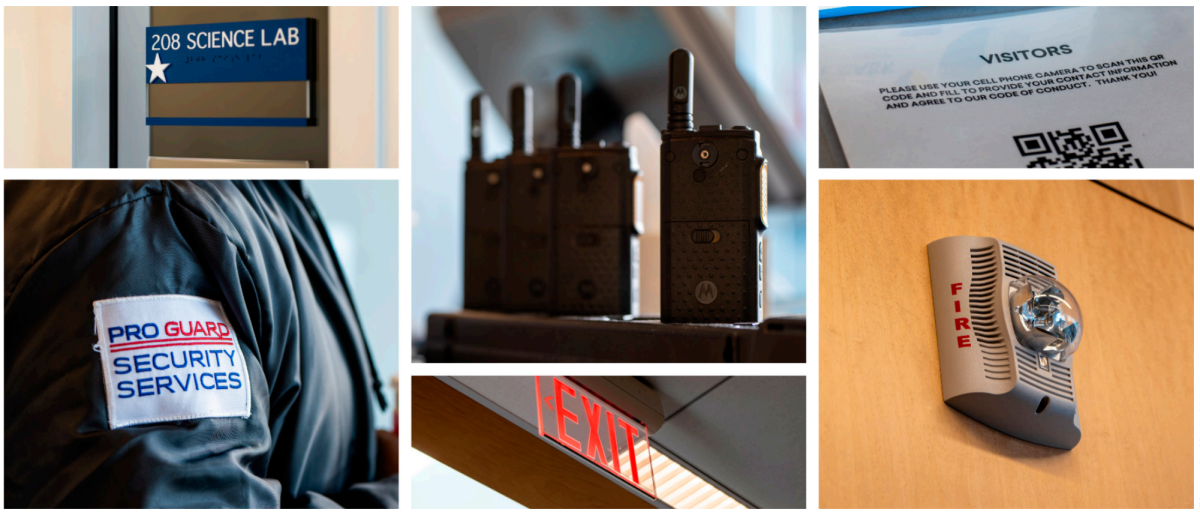
One of his efforts to prioritize students’ safety was to highlight white star stickers, which denote safe, enclosed areas on campus, including restrooms, classrooms, and closets. During the assembly on Nov. 8, he alerted students to these locations, candidly stressing that students’ familiarizing themselves with these places could save their lives
Since the November assembly, students have become more alert to these white stars, but the safety indicators themselves have been in use since 2018, first introduced as an initiative from the Nueva leadership team.
2018 is also when Osborne adopted and implemented the Big Five security protocol, a common emergency plan produced by the San Mateo County’s Coalition for Safe Schools and Communities. The framework provides a foundation for emergency response, as well as proactive trainings for faculty and staff. “It’s a common language for communication between the police department, the fire department—everyone,” he said.
Also tasked with ensuring on-campus safety is the Upper School Safety Committee, a task force that meets monthly to review concerns related to school safety. An additional resource is the Emergency Response Team (ERT), which are faculty and staff emergency responders that sweep the building in the event of an evacuation or medical emergency.
In addition to the physical presence of new safety mechanisms, technological advancements in Nueva’s internal software are aiming to streamline school safety, emphasizing transparency about where students are and at what time.
With the debut of Nexus, a centralized online platform supported by the cloud computing company Blackbaud, in August 2023, teachers are now able to view the status of their students’ attendance in a more accessible format than the previous MyNueva platform. Also in the vision of transparency, Nueva has made improvements to its check-in/check-out system, so that attendance data is immediately converted to the Nexus platform.
Due to its relative infancy at Nueva, the Nexus is still developing its capacity to protect student safety. However, Bruno is optimistic that it will eventually make an impact. “When everyone knows how to use it, it will be an improvement from the past. Currently, we’re in transition.”
Bruno and Osborne both emphasized the common goal of re-prioritizing students’ attention towards safety. “We do a lot of work behind the scenes,” Osborne said. “The last thing we want is for students to be worried about it.”
Due to recent increased student attention and awareness about a strong system of protocols, Osborne is “absolutely” confident in the school’s security.
With all of these precautions underway, students are reacting to this shifting playing field surrounding school safety in varied and sometimes conflicting ways.
Brenna Au Miller ’25 has always felt physically safe on campus at Nueva. “There’s a lot of people making sure that we’re safe at all times,” she said, referencing Nueva’s check-in system and the presence of security guards. Even so, her personal feelings of safety were yet improved after the assembly on Nov. 8.
“As we’ve had more safety drills, I have felt a lot safer. That assembly put a lot of my personal worries to rest,” Au Miller added.
For Izel Lopez Parra ’25, the threat of a potential school shooting is too looming to cast aside as an implausibility. The pervasiveness of school violence has “broken the facade of ‘this can’t happen to me,’” they said.
“At a private school, we’re very lucky to be in a very safe area and have really good security measures. But I feel like [the security protocols] came late. With gun violence being more in the news, Nueva realized that they needed to do something,” Lopez Parra said.
Samara Bainton ’24 agreed. Though she recalled feeling safe for the duration of her time at the Upper School, that didn’t hinder a wider fear of the threat of school shootings nationwide. “When it’s making national headlines, I’m forced to think about it,” she said.
Bainton added that Nueva’s geographical location is uniquely situated in the national dialogue about gun violence. “Living in the Bay Area, we tend to think we’re so liberal that [gun violence] can’t touch us here. But that’s just not true.”
Carson Middleton ’26 noticed that the November assembly lacked explicit references to gun violence, which caused some of his classmates to feel disconnected. “I think at this school we can be very sensitive when we’re talking about issues,” he said. “In many ways I understand that. But I think we need to treat these very severe incidents with the directness that they deserve.”
Later, Bruno said that he aimed to show in the assembly that threats to safety or security extend beyond gun violence. For Bruno, personally, an active shooter is the first security threat that comes to mind. However, “the threat of violence isn’t always a gun.”
“Words are important,” Bruno said. “An active shooter is an important thing to think about, but it’s actually not that common. In America, they take up a lot of space on the news and claim a lot of attention when they happen because they’re important. But they’re not commonplace,” he added.
According to the K–12 School Shooting Database, an open-source research project, incidents of national school shootings more than doubled in 2021, and 2023 saw the highest incidents of school shootings in the country’s history at an unprecedented 346. More broadly, 2023 was the second deadliest year on record for mass shootings with 656 recorded incidences, according to a report by CNN—second only to 2021, a year that saw 686 incidences.
Over the past few years, California has had at least seven school-related shootings annually—and 2022 saw a statewide record 16, Everytown Research & Policy documents. When factoring in California’s large population size, though, it has the sixth-lowest gun violence per capita in the country, according to Wisevoter, a political research think tank.
Moreover, Everytown ranks California as the strictest regulator of guns in the country, the efficiency of which has been backed by quantitative research. According to data in a press release by Gavin Newsom, enforcing strict waiting periods for prospective gun owners can reduce homicides by 17%. Moreover, California boasts a gun fatality rate that is 43% lower than the rest of the country.
Newsom’s office also presented data suggesting that California’s gun laws between 2013 and 2022 helped save 19,000 lives that would have been lost to gun violence, in comparison with the U.S.’s overall gun violence mortality rate.
According to Upper School security guard Jonathan Piper, contracted by Pro Guard Security Services to work at Nueva since August 2022, the physical safety of students has never been in jeopardy. Having worked on security teams at high-security-risk companies like Google and Apple, Piper remarked on the similarities between security measures at those companies and Nueva.
“The tech campuses all had badge readers where people were supposed to badge into areas. There’s a similarity here actually,” he said.
Upper School history teacher Simon Brown, who was previously employed at a school with metal detectors at the entrances and higher securitization, appreciates that Nueva’s approach to school safety de-emphasizes surveillance.
“That’s not an experience most students should have to have,” Brown reflected, adding “there’s a big cost to having a highly securitized school.”
At the Upper School, Brown experienced a pointed shift in school safety approaches. Students are not required to pass through metal detectors and there is no police presence on campus. On a daily basis at Nueva, Brown says he doesn’t think about school shootings very often and feels that the bulk of his concerns about national threats of school safety are put to temporary rest.
Upper School English & SEL teacher Pearl Bauer expressed similar confidence in Nueva’s approach. For her, safety is never top of mind since “there’s just an embedded trust” that the school will take the proper precautions.
“It might be a false trust, but the space itself makes me feel I don’t need to be in survival mode,” Bauer added.