















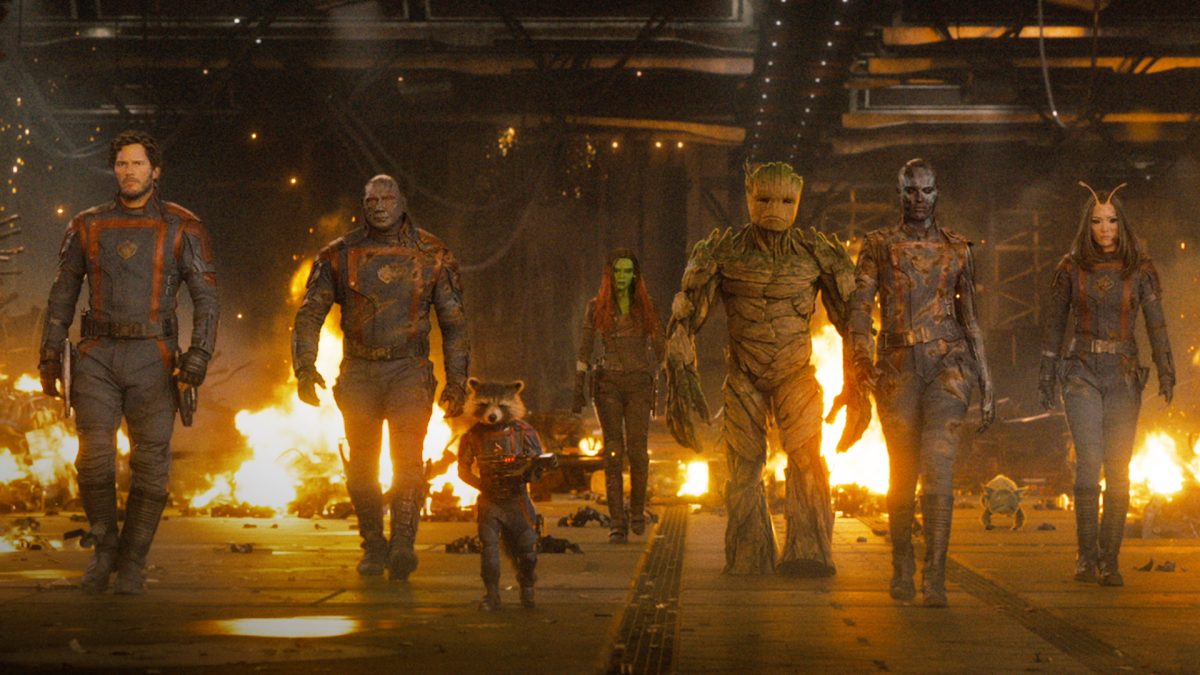
A sarcastic CGI raccoon, vengeful alien, and emotionally-stunted cyborg brought tears to my eyes in just two hours and 29 minutes. When the credits to “Guardians of the Galaxy Vol. 3” rolled, I realized that I wasn’t alone; I heard sniffles from the elderly woman sitting to one side of me, the gay couple on the other, and the teenage boys in the row below. A middle-aged woman wailed in the back of the theater.
This is the unique power of a Marvel movie: to invite an audience of all ages, backgrounds, and interests into a cinematic experience that doesn’t just promise well-choreographed fight scenes, but beautiful VFX, comedic and developed storytelling, and slightly-flawed characters to root for. Despite fans’ worries over the Marvel Cinematic Universe (MCU)’s decline since 2019’s “Avengers: Endgame,” “Guardians”—almost fully—restored my faith in the billion-dollar-grossing action movie franchise.
In the movie, director James Gunn wraps up the “Guardians” trilogy while setting the team up for the future. Released on May 5, the final film in the trilogy once again follows the Guardians of the Galaxy, an endearing team of misfits from around the universe: Peter Quill (Chris Pratt), a demi-god and the team’s leader; Rocket Raccoon (Bradley Cooper), a talking raccoon with a knack for engineering and sarcasm; Groot (Vin Diesel), a extraterrestrial tree monster that can only express the phrase “I am Groot” in a variety of tones; Drax the Destroyer (Dave Bautista), an obtuse and violent but caring alien; Mantis (Pom Klementieff), a half-god and half-insect empath; and Nebula (Karen Gillian), an emotionally-guarded robot warrior.
Notably missing, though, is Gamora (Zoe Saldaña), alien assassin and Peter’s soulmate. (She was murdered by her adopted dad, Thanos, in “Avengers: Infinity War.”) At the beginning of the movie, Peter is ruined by his grief for her and spends his time on-screen either drunk or moping around. Pratt delivers a surprisingly solid performance of grief—something the MCU has historically failed to do—and invites the audience to empathize with him.
The themes of grief, mourning, and loss permeate the rest of the film, especially once an alternate version of Gamora returns to join the team—explaining this further would require spoilers, unfortunately—that has no memory of Peter. Peter is forced to realize that the Gamora he knew is permanently gone, and the fallout is drastic.
With his destructive drinking, Peter fails his responsibility as leader to protect the Guardians and Knowhere, their homebase. As a result, Rocket is left vulnerable to an enemy attack and becomes fatally injured. His death is imminent—unless the Guardians go on a dangerous mission to steal the cure.
Thus, the journey begins. And the threequel promises the classic elements of a Marvel adventure: thrilling action fights, endearing humor, and a (generally) happy ending. However, it includes a surprise: numerous gut-wrenching flashbacks of Rocket Raccoon’s past, which New York Times’ critic Maya Phillips, amongst others, determined as “a visually off-putting two-and-a-half-hour A.S.P.C.A. nightmare.”
I disagree. While the flashbacks to Rocket’s past are CGI-heavy and unexpectedly horrific, they provide meaningful context for Rocket and the Guardians’ current identities by explaining their past ones.
It is part of a new era for Marvel. Stories centered on characters that are not necessarily physically-super white men (like Thor, Captain America, Iron Man, Hulk, Hawkeye, etc.) are now relevant and being brought to the big screen. While the shift to spotlighting more diverse characters has left some fans questioning the commercial appeal/viability of the future for the MCU, I think this shift has been happening for much longer than most realize, albeit less explicitly.
In a sense, “Guardians” has always done this on some level by embodying a team of ‘nonconformists,’ to put it nicely. While Peter Quill generally fits the Marvel “archetype,” the rest of the team hardly does. For one, Nebula essentially has dozens of prosthetics and uses them to her tactical advantage. Mantis is constantly underestimated because of her docile appearance, as are Groot and Rocket. Some even consider Drax a hero for the autistic community (though it is important to note that he is not human and cannot truly be neurodivergent or neurotypical in our terms).
I resonate most with Gamora, a character often torn between her head and her heart, or her nurture and nature. Earlier in the cinematic timeline, she is pressured to stay loyal to her evil father, Thanos, despite wanting to break free from his control—yet she feels indebted to him for taking her in as a young orphan. I can relate to a pressure to stay quiet or loyal, especially as a teenage girl. At times, Gamora has felt like my very own hero, and that’s the power of Marvel.
This sub-story has always been my favorite in the MCU. Not just because of the humor, space adventure, and stunts, but because the characters’ identity elements that do not fit the standard quo make them refreshing and relatable.
Therefore, it is fitting that the end of “Guardians” franchise leads into the new phase of the MCU, where Pakistani American teens (“The Marvels”), black men (“Captain America: New World Order”), and other characters of marginalized identities start to take on lead roles on the big screen, amongst the more traditional characters like Spider-Man, Doctor Strange, and Ant-Man.
While I am generally hopeful for the future of the MCU, I also understand where critic Phillips is coming from. Some elements of the final “Guardians” movie definitely disrupted the typical rhythm of a Marvel or “Guardians” movie. Still, I wonder: What if disruption is just what the universe needs?