











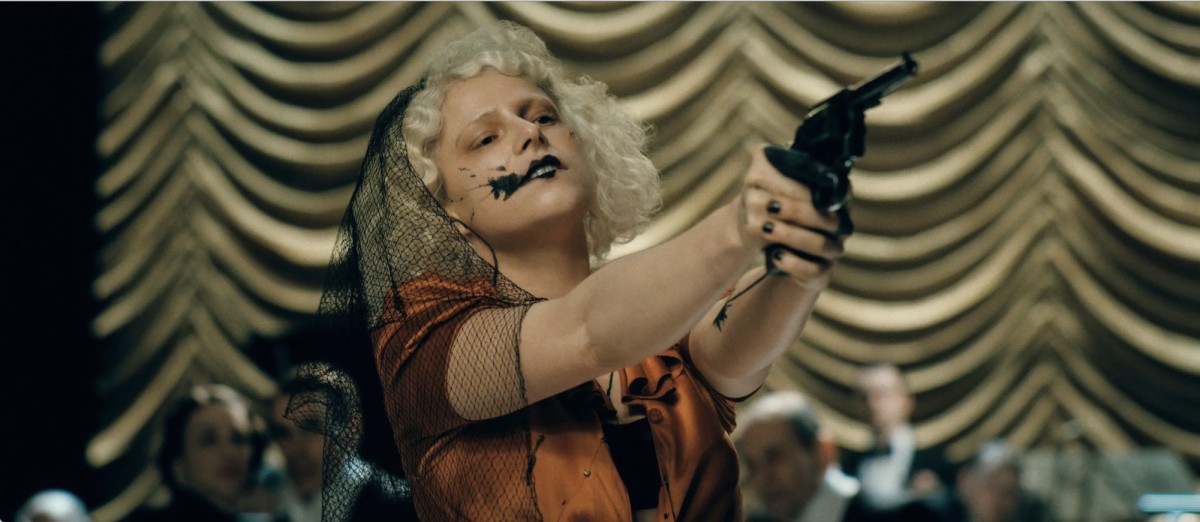
The premise of The Bride! sounds like it came out of a loopy Frankenstein Mad Libs: Mary Shelley partially possesses an amnesiac woman named Ida resurrected by an involuntarily celibate, cinephile version of Frankenstein’s monster in 1930s Chicago.
Directed by actress Maggie Gyllenhaal, the film switches between shadowy montages of Mary Shelley (who Jessie Buckley portrays in addition to the titular character) with weird sci-fi laboratory items, interspersed with the vivid rush of city life painted in rusty orange and crimson lighting. Dialogue swings from campy, dramatic exchanges to literary references imbued with Shelley’s British lilt. Even the soundtrack of the film swerves between Schubert sonatas and “Monster Mash” to electrifying jazz standards.
Though the film’s puzzling stitching of scenes and music can be disorienting at times, it’s clear that there is an intention behind it. As the Bride runs from the police with Frank (Christian Bale’s version of Frankenstein’s monster)—while struggling with consequences from her old life and Shelley’s cryptic warnings—Gyllenhaal masterfully dishes out a slow build of terror, the fear at the center of the film.
This terror is established in brutality. The film is a study in violence, and Gyllenhaal drenches the screen in it—and not just in gore. There’s plenty of bloody scenes, of course; most memorably, the head-stomping scene that turns would-be rapists into red, meaty corpses. But the brutality takes subtler forms too. There’s disgusting squelches and cracks of bone, the frenetic blur of bullets piercing skin, and the heavy weight of guilt in Frank’s cracking voice, more grotesque than his whorled face.
There’s also a persistent line of sexism that the Bride endures, horrific because of its realistic nature. Even as the Bride begins to fall in love with Frank, believing his lie that they were engaged before her so-called accident, drunk groping, harassment, and violent attempts at rape are all rendered in brutal detail. There is a creeping sense of dread that clings to the screen. This is a film where safety is never guaranteed.
It’s a reminder that, despite Shelley’s power over the narrative, their world remains dominated and controlled by men. And the men can be monsters, too.
However, Gyllenhaal never gives this thesis enough space to mean anything. When the Bride learns the dark secret of her relationship with Frank, she refuses his marriage proposal. There is a moment of hysteria, but before any real character growth occurs, a mob enforcer from her past fatally shoots Frank, and another explosive car chase ensues.
Later, when the Bride ordains herself as just the Bride—not of Frankenstein or to anybody, just the Bride—the film seems to gesture towards a meaningful statement about the way marriage can subsume a woman’s identity entirely. But instead, the movie devolves into a melodramatic, Romeo-and-Juliet-style climax, where the Bride is shot to her death, dramatically collapsing next to Frank’s body. There is no reckoning over what it means for her to be a singular character, or the violence she has both endured and created. Instead, the movie ends with a final burst of electricity from a mad scientist to awaken the Bride and Frank. The final shot is of their clasped hands.
None of this stops The Bride! from being a thrilling horror movie, through and through. The fear in the film feels real not because of the garish makeup or disembodied heads, but because of the stilted arc—the horror of life and death restrained in the bounds of marriage and love, female choice and consent long disregarded at the operating table.
Ultimately, The Bride! is worth a watch. It’s not the kind of movie you’ll want to see twice, but it’s certainly a story you won’t be able to look away from.