














If you’re a Nueva student, you’ve learned about sustainability in some capacity. Whether through dissecting and writing eco-poetry in tenth-grade English or participating in the Environmental Club’s Eco-Action Raiser, sustainability and environmentalism are ubiquitous at Nueva.
Nueva is one of the nation’s leading schools for sustainability, both in its education practices and its foundation. In 2021, the U.S. Department of Education named Nueva a California Green Ribbon School for its commitment to resource efficiency, health and wellness, and its emphasis on environmental and sustainability education.
In honor of Earth Month, The Nueva Current is highlighting Nueva’s achievements in sustainability by investigating the school’s clubs, classes, and design.
Environmental Club
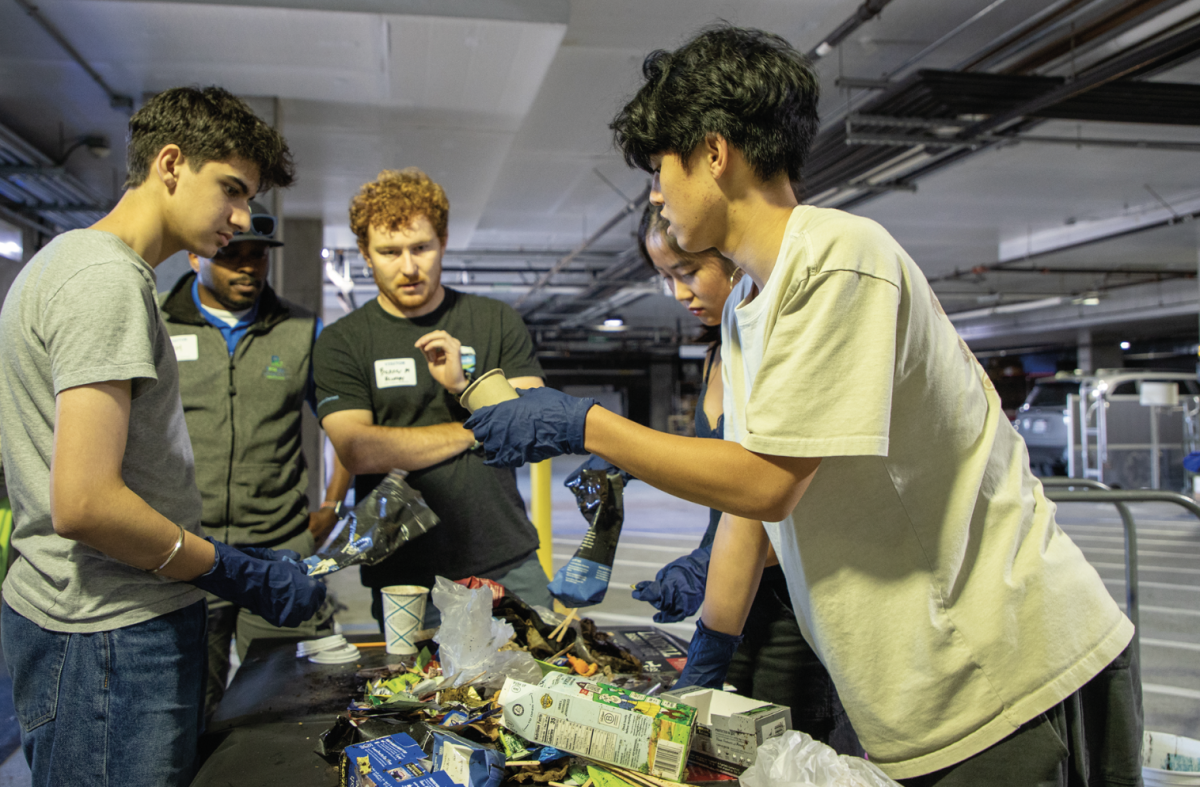
In Environmental Club, students focus on environmental projects both within the broader Bay Area and the school. Last month, they conducted a three-day waste audit, collecting, sorting, and analyzing 148 pounds of trash. They found that students were placing dirty paper and liquid-filled drinks into recycling, which, when spread to the whole bag, contaminates the bin, deeming it unrecyclable.
They also recently completed a mini-documentary in collaboration with the Social Impact Filmmaking Club (SIFC). The 6-minute film, No Scraps, documents food waste at Nueva.
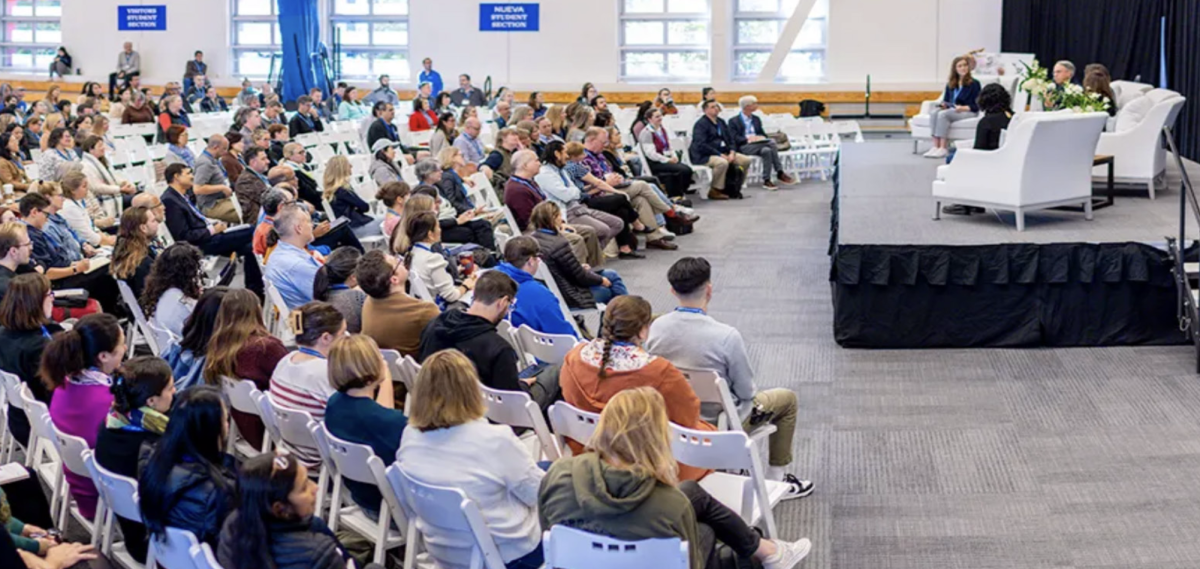
In the club’s environmental assembly on March 27, they screened the film and presented their findings from the waste audit. They also brought in two employees from Recology, Nueva’s waste collector, who presented on sorting trash, compost, and recycling, and the garbage collection process.
The Environmental Club also plans to lead discussions with other high schools’ environmental clubs to share progress, goals, and insights.
“In May, we’re going to be organizing our first youth eco-leadership gathering, to share some best practices and really cool initiatives that we can each implement in our own schools,” said Kayla L. ’26, the club’s co-lead.
Project Super Plants
Project Super Plants (PSP), a club created by Harper F. ’26, raises climate awareness and promotes science education in Bay Area schools. During the clubs’ visits to Bay Area elementary and middle schools, the team presents on the importance of biodiversity and CO2 emissions, then asks students to design and draw their own Super Plants, solving an environmental problem of their choice.
PSP ran 20 sessions in its first year; six years later, they offer roughly 60 educational sessions with a team of 45 people across multiple schools. As the club expands, Harper hopes to extend its reach to classrooms across the country with a video-based curriculum they are currently developing. Harper is hopeful that teaching young children will inspire future generations of environmentalists.
“I think a really important part of the project is our emphasis on hope—that’s why we end every session by growing super plants. [It’s] so that students are not left feeling overwhelmed, but know that they’re taking a small step toward making a difference,” Harper said. “We always end with the quote by Greta Thunberg, who said, ‘No one is too small to make a difference.’”
Clean Energy Investment Club
In 2022, the Clean Energy Investment Club team successfully lobbied to reduce Nueva’s fossil fuel investments from 7% to 3.2%. Through the club’s efforts, Nueva became the first of the High School Clean Investment Coalition—a group of around 50 private schools encouraging their schools’ endowments to be invested sustainably—to divest. The global coalition, which is co-led by Viola S. ’27, has already divested millions. Now, the Nueva team is able to provide other schools with their successful model, as well as connect them with contacts that can help them build the case they’ll bring to their endowment boards.
Viola is now planning a large-scale clean investment competition for April. Participants will receive a virtual portfolio of $100,000, and will have to balance making sustainable investments with maximizing profit. Ultimately, Viola hopes contestants will walk away with a deeper knowledge of climate finance and evolving sustainable technology.
Garden Club
On the analog side, Hayes S. ’27, the Garden Club lead, incorporates sustainable agricultural practices into the club’s tending of the Nueva balcony.
Last year, the Garden Club planted native plants alongside crops to measure how they grew together, and recorded successful planting combinations. In San Mateo County, he said, there’s an excess of monocrop planting, which harms soil health, whereas planting native and non-native plants together supports local biodiversity. This year, the club is working on cover cropping: covering the soil year-round so it retains moisture.
Curriculum
Environmental initiatives are not solely led by students—in the classroom, students explore sustainability efforts through a variety of lenses, from climate science to history. In English, Harper learned about eco-poetry, and in Biology Research Teams (BRT), she was able to connect her environmental science interests to other projects.
Jeremy Jacquot hopes to see this kind of interdisciplinary learning across all Nueva classes.
“Much in the same way that SEL [or] design thinking is at the core of Nueva, I would love it if environmental citizenship [was] more built in,” Jacquot said. “Any graduate would be able to speak to or have familiarity with some core ideas around sustainability.”
Jacquot first came to Nueva in 2015 as an assistant teacher for chemistry. While he still teaches chemistry now, he’s also involved with a host of new environmental electives. In 2021, with the arrival of Director of Environmental Citizenship Sarah Koning, Jacquot began to plan courses discussing climate change and sustainability.
Jacquot’s offering, Climate Change & Action, was co-developed and taught with Koning. They approached the course knowing that students were likely already familiar with climate change science, and instead chose to focus on tangible solutions and maintaining optimism for change. They discussed pathways from renewable and clean energy to regenerative agriculture, and solutions in small, private sectors versus on a wider, government-scale.
In tandem with a solutions-based environmental curriculum, Koning has taught Environmental Humanities for five years, providing students with the tools to tell the story of climate change.
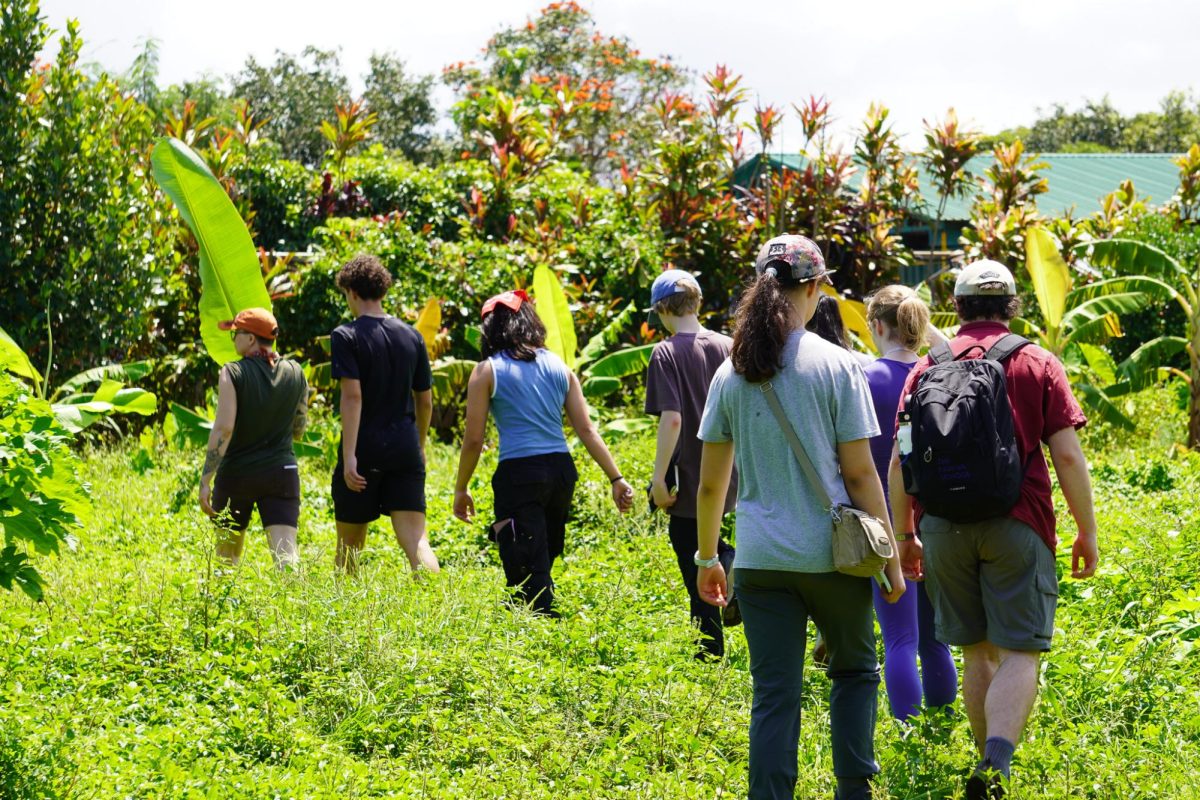
Throughout the semester, students read journal articles and engaged in philosophical discussions. They learned about the nuances of environmental conservation and preservation, talked about the future of environmental conservation, the Anthropocene, and also did hands-on work in the garden.
Koning hopes the class will broaden students’ understanding of climate science. “The way we can change people’s minds is not by providing data, but by giving them stories that are meaningful to their experience,” Koning said. “How can we learn to tell stories that will resonate with people who have concerns or denial about climate change?”
Infrastructure and Architecture
Both the San Mateo and Hillsborough campuses were built to reduce emissions. Constructed in 2007, the Hillsborough campus’ Hillside Learning Center was the first LEED (Leadership in Energy and Environmental Design) Gold K–12 building in the country.
Since then, all new construction and renovation projects on both campuses have been LEED Certified Gold. Solar panels, high-efficiency faucets and toilets, and lessened requirements for heating and cooling are all emissions and waste-reducing features installed on both campuses.
Acknowledging student-led and administrative sustainability initiatives, Koning is optimistic for further growth. She believes that all students, especially those who label themselves as “uninterested” in climate science, can take action against climate change.
“What I tell students is: incorporate sustainability, climate change science, or environmentalism into your interests,” Koning said. “I don’t believe that climate science or environmentalism should be a discrete discipline. It should be integrated into everything.”