


















Every January, students return to campus, and while the hallways might feel familiar, many classrooms do not. Schedules reset, electives rotate, and for a number of students, a yearlong class quietly changes hands.
For many students, the start of a new semester can mean a new teacher, new routines, and new expectations. This shift is not an exception, but the reality of a school that offers a wide range of courses and electives.
According to Assistant Upper School Head Claire Yeo, who also oversees academics, the practice dates back to Nueva’s roots as a school that emphasizes student choice. Since many electives are semester-long and offer only one section, they are scheduled first. Core and year-long classes are then built around them.
“It’s not a policy nor a rule; it’s a practice. [We] believe that students’ elective choices are paramount,” Yeo said.
Yeo acknowledges the challenges this practice poses: teachers need to align course curricula such that students can pick up where they left off. To address these issues, Nueva has implemented communication channels, such as shared pods and departmental meeting times. For “shared classes,” taught by multiple teachers across two semesters, each department coordinates content, skills, and pacing to ensure both “continuous student experiences” and teachers’ “individual liberty.”
In math, where content builds sequentially, that coordination is crucial.
“We have rubrics that lay out all the standards for every course,” said Upper School Math Teacher John Carter. “We decide the content to be covered in one semester, and stick to it, so that if a student is switching at the end of the semester, they’ve got that material.”
Even with shared standards, however, some students note that mid-semester swaps can be jarring, with different teachers having distinct approaches to the curriculum, assessments, and class environment.
Mila W. ’27 described how, since moving into a new Math 3 block, she has felt she didn’t bring with her the foundational knowledge to keep up with the lessons. Her new class, for example, expected fluency with specific trigonometry identities that her previous teacher hadn’t focused on.
Many teachers understand and are empathetic to this transition: it’s natural to experience difficulty in adjusting, not just to new material but also to new expectations and class dynamics.
“You take so long to learn the personality of the teacher, learn their requirements, learn how they operate,” Carter said. “And then December comes and—poof—you’re with another teacher, and you’ve got to learn their technique and what they expect.”
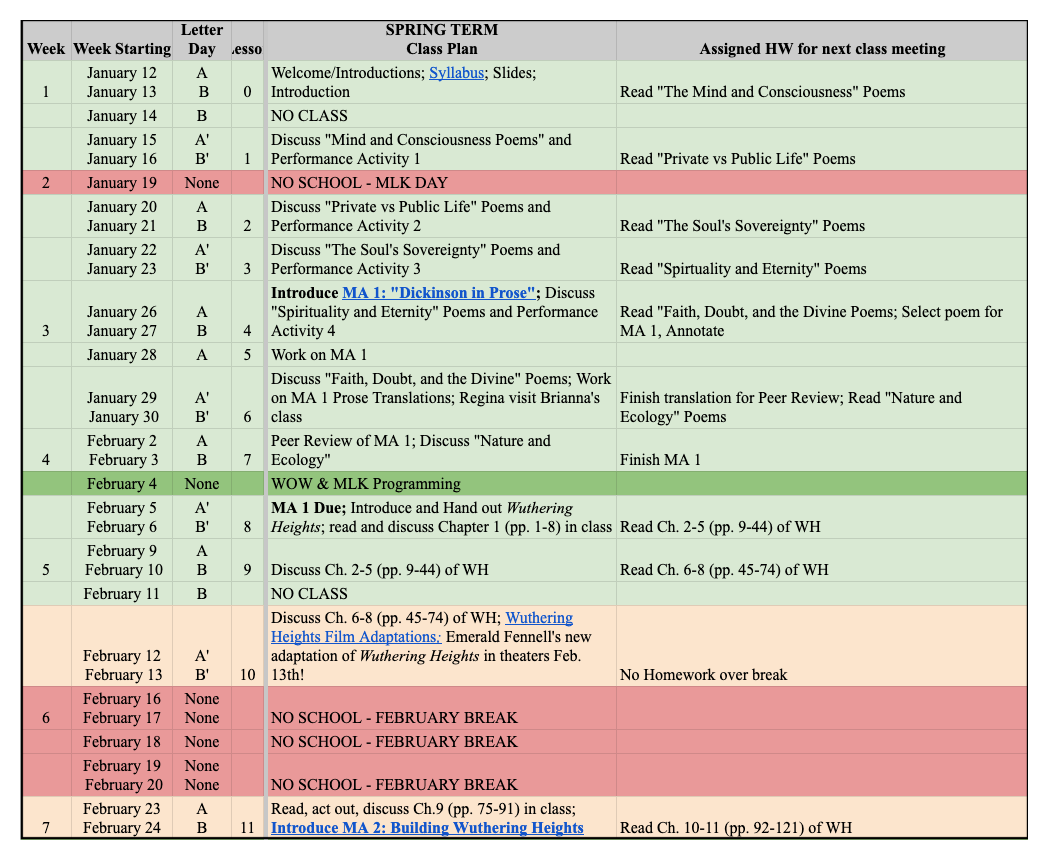
English remains a similarly flexible subject, but rather than units or tests shifting around, it’s the books and major assignments that change. In English 11, for example, some teachers may dive deeper into The Great Gatsby by F. Scott Fitzgerald, while others may choose to include “Passing” by Nella Larsen.
In the English department, all classes ensure coherence through a set of shared criteria: at least two common texts and major assessments per semester, and a consistent rubric within the same course, regardless of the teacher.
Additionally, teachers also align pacing through shared calendars.
“We abide by that calendar to a T,” said Upper School English Teacher Amber Carpenter. “If I have students reading 30 pages for homework, the other teachers have students reading 30 pages for homework.”
Still, careful planning cannot completely eliminate differences. Professional autonomy allows teachers to tailor content to students, so classrooms won’t feel identical.
“I think the most important thing was communicating with my teacher,” Mila said. “When you have a teacher who’s really trying to accommodate you, transition can happen a lot faster, but sometimes you just have to go through it on your own pathway.”
For her, clearer shared foundations and systemic support could make the switch more navigable.
“If there were certain baseline things that everyone did across classes, that would really help,” Mila said. “I don’t think it’s anyone’s fault. The school just needs a system that makes transitions easier for students.”
For Yeo, in a school year that shifts halfway through, paying close attention is key to ensuring students are still seen and supported as they move forward.