






















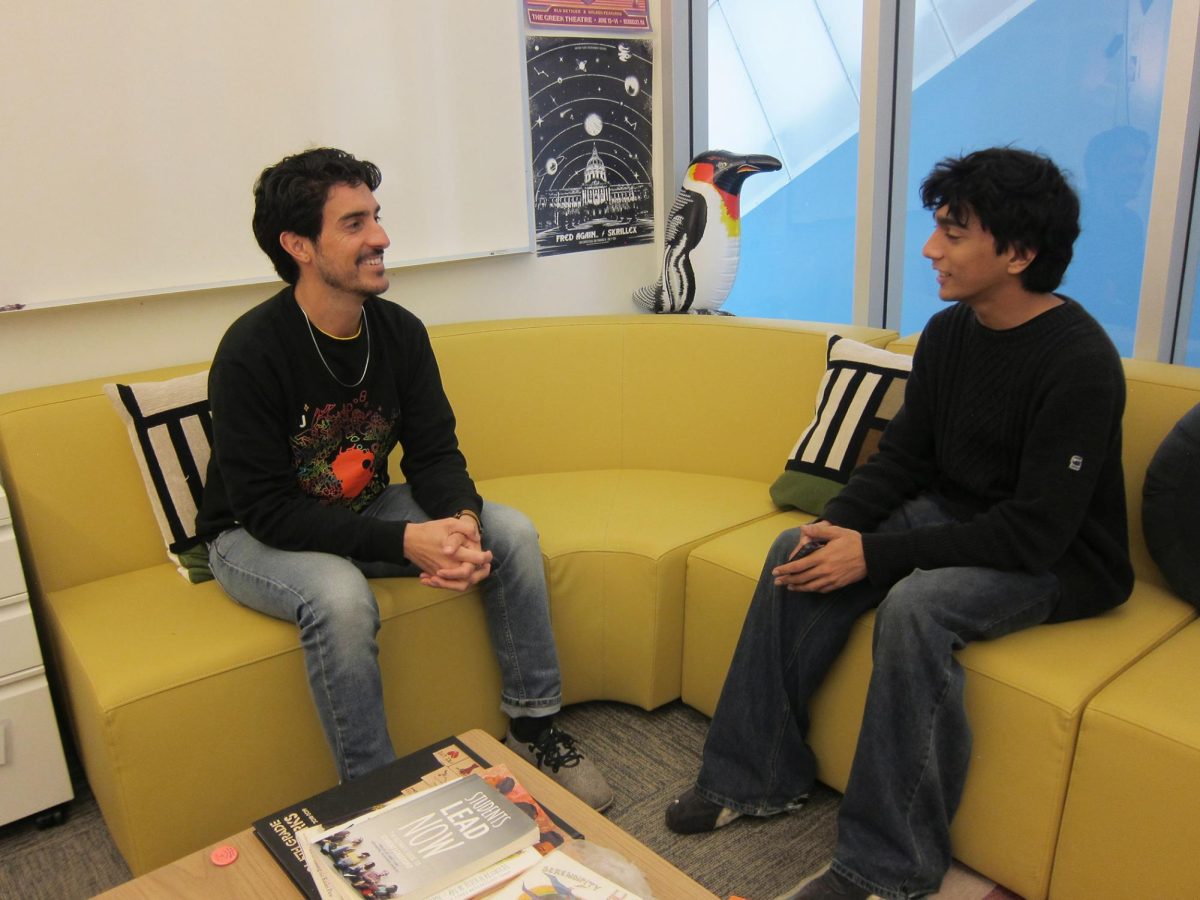
Equity and Inclusion Representative Anika Gupta ’26, wanted to ensure student voices played a meaningful role in advocacy and social justice efforts at Nueva.
Her goal was informed by her past experiences in equity work at school. As a freshman and sophomore, she served on the Nueva Honor Council (NHC), a student group primarily focused on addressing student conflicts through restorative justice. However, their involvement was often limited out of privacy concerns regarding the sharing of student information. The council was eventually disbanded during Gupta’s junior year.
“[The] NHC seemed most successful when it was used as a sounding board for admin, and at the end of its time, when it began transitioning to a more proactive organization,” Gupta said.
Drawing on these experiences, she conceived the Equity and Inclusion (E&I) Council, a committee of students from various grades tasked with exploring ways to address social justice at the school level.
Gupta brought the idea to Upper School Equity and Inclusion Coordinator Evan Vaughan, who responded enthusiastically. As they envisioned the council, the importance of a student-administration partnership stood out to Vaughan.
“The goal was to have more collaboration involved in driving equity and inclusion here at the school,” Vaughan said.
To reinforce that collaborative approach, Vaughan included students from different grades: a senior, three juniors, three sophomores, and a freshman. In the application process, Vaughan sought students who brought a nuanced and community-minded perspective to their day-to-day life.
“They had to have an awareness in connecting with others, advocating for people who have specific needs, and understanding where there are holes, deficits and a need for something to change,” Vaughan said.
The interview process itself offered a chance for students to engage with pressing issues. It coincided with the Nov. 5 StandWithUs assembly about antisemitism, which sparked debate and dissent across campus. E&I Council member Mars Resser ’27 recalled how Vaughan asked them about how they would have approached the assembly, a particularly meaningful request. It felt like a positive sign that Vaughan was committed to listening to student voices. Having participated in other equity inclusion initiatives that felt more “performative,” Resser was initially cautious about whether the council would be any different. But after the interview and the council’s first meeting, Resser feels confident in the group and its potential.
“Everyone was so empowered. There was an intentionality and boldness that felt powerful,” they said.
Looking to the future, Resser hopes to be able to implement a similar sense of purpose into school policies and programming regarding social justice. In particular, they are keen on transparency, through planned efforts like a statement of intention before discussions, or division-wide emails to provide background information on speakers prior to an assembly.
“I want the school to [be] proactive with the information that is shared [with] students, so we can build that trust in the school’s handling of [diversity, equity, and inclusion],” Resser said.
Gupta hopes to see the council reflect the wants of the community in social justice programming.
“As we move through a more politically divisive time, I hope that we are able to use the E&I Council to get a better perspective of how people are dealing with elections, political polarization, and global crises, and then [develop] an actual response for students,” Gupta said.