



















Amidst Earth Month, it’s easy to feel plagued by climate anxiety or confused by climate action. Dr. Ayanna Elizabeth Johnson, an American marine biologist, policy expert, conservation strategist, and podcaster came up with the concept of “Climate Venn Diagrams,” a simple method to determine one’s personal climate solution. Learn about three students’ climate solutions and how they would fill out their Climate Venn Diagrams, then fill one in for yourself!
SOPHIE DRUSKIN ’24
In the past few years, Druskin’s garage has perpetually been on the brink of overflow. The garage’s contents can only be described as “junk,” a strange assortment of flannel jackets, vintage wooden furniture, and random metal material. Yet, Druskin does not see it that way.
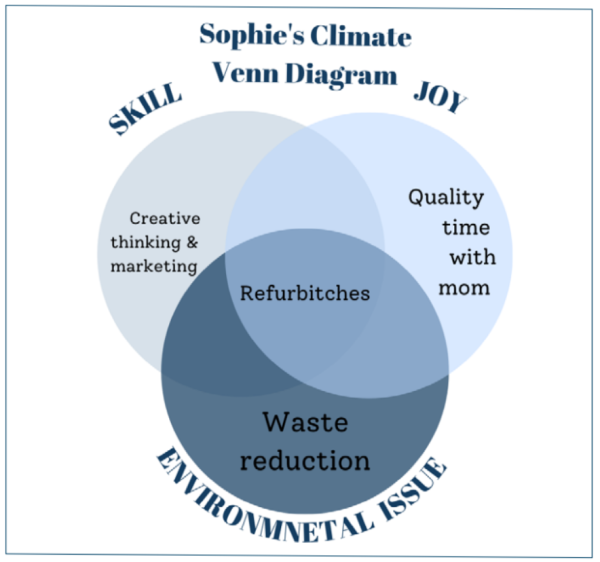 Instead, she sees a business: Refurbitches. Founded in 2020 by Druskin, her mom, and aunt, Refurbitches looks for and accepts unused or old furniture, clothing, and materials. The trio takes these materials and refurbishes them, infusing each project with creativity and renewed life.
The origin of the project started during the pandemic lockdown, when Druskin’s mom began to bring home free tables, chairs, and dressers that scattered the sides of the street.
With half a garage, a few power tools, and an abundance of free time, Druskin says that Refurbitches “started as just a cool little project.” Soon, though, Druskin and her mom were refurbishing dozens of items by sewing, woodworking, and painting.
Once the garage becomes entirely full, Druskin and her mom rent a truck to transport their work and set up a stall at the Alameda Point Antiques Faire, where Druskin markets, barters, and sells her wares. After making a sale, Druskin says, “It is so amazing to know that we are making things that people are going to treasure.”
Ultimately, reducing waste and being environmentally conscious is core to the business. By refurbishing, Druskin and her mom save dozens of items from going to the landfill. They also work together to establish a culture of reusing and repurposing, an anti-trend to a culture dominated by consumerism.
When taking on new refurbishing projects, Druskin considers both the creative and environmental opportunities. She asks herself, “What can we do that is not only useful and economical, but also really cool and unique? What can we do to give things another life?”
ALEX WAGONFELD ’24
Peek into room 1105 on Thursday afternoons, and Wagonfeld will be there. With enthusiasm and confidence, he is co-leading the environmental club meeting and encouraging club members to pursue meaningful environmental projects.
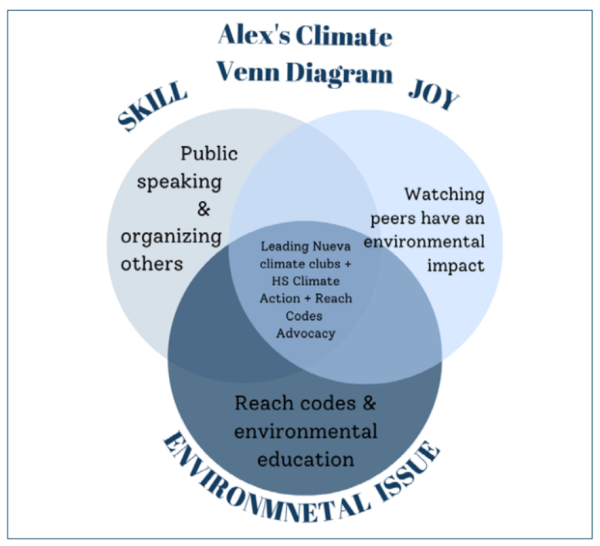
Wagonfeld’s projects in environmentalism go beyond the school’s walls: besides co-leading the school’s environmental and divestment clubs, he has advocated for reach codes (city-wide codes requiring stronger environmental features in new buildings) at city council meetings and has designed HS Climate Action, a platform for Bay Area high school students to easily find environmental volunteer opportunities.
Wagonfeld’s various projects stem from a strong passion to create change. “The fire has been lit under me and I’ve gone to the extremes,” he says.
Wagonfeld also credits his skillset: public speaking and organizing others. His unique environmental approach combines his skills and goals with his passion for watching his peers have a positive environmental impact.
No matter what project he is working on, Wagonfeld describes a guiding philosophy when it comes to working on environmental projects: “Whatever I do, I try to have the biggest impact I can, and do it to 100%. I’m not of the belief of doing a couple small things in different areas. Without 100%, I don’t feel like that’s where the true impact is.”
HARPER FORTGANG ’26
Every month, Fortgang leads a class educating on the science of biodiversity, climate change, and a potential solution: super plants, or plants that are especially capable of sequestering carbon dioxide. Here is the catch: her students are hyper, easily-distracted, but “still open-minded” fourth, fifth, or sixth graders. 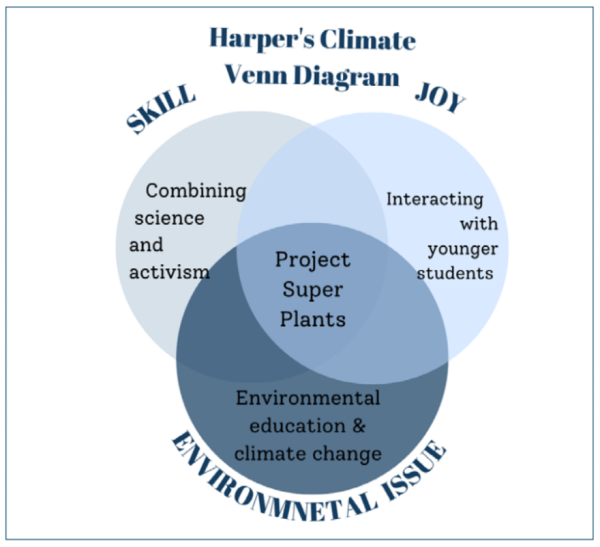
These lessons are the essence of Project Super Plants, an environmental education program founded in 2020 and led by Fortgang. The program’s mission is to motivate and mobilize fourth, fifth, and sixth graders to take environmental action by educating them about super plants. It accomplishes this during a 45-minute classroom visit including a customized presentation, a hands-on super plants planting tutorial, and discussions about the climate.
Reflecting on the inspiration for Project Super Plants, Fortang says, “Past generations have let us down, so we have no choice but to take climate action.”
Then, in sixth grade, she experienced a lightbulb moment: bridging her skill in science and educating younger students with her passion for solving climate change. She decided to educate and empower fourth, fifth, and sixth graders because it was the age she first learned about climate change.
Since then, Fortgang has expanded the Project, presenting to 896 students in over a dozen Bay Area schools, and started a Nueva leadership team to expand the program’s impact. She is currently partnering with nonprofits and hopes to eventually build chapters at other schools.
Fortgang explains the biggest emotional driver of her dedication: hope. She says, “We can only make a change if we are hopeful. We need to literally plant seeds for future generations.”