























Hayes S. ’27 can often be found out in nature, hiking and backpacking. As an artist whose work often portrays the natural environment, he also likes to capture what he sees through photography. Usually, he pulls out his camera during breaks in his hikes to capture lighting, movement, and scenery, using the photos as references for future paintings.
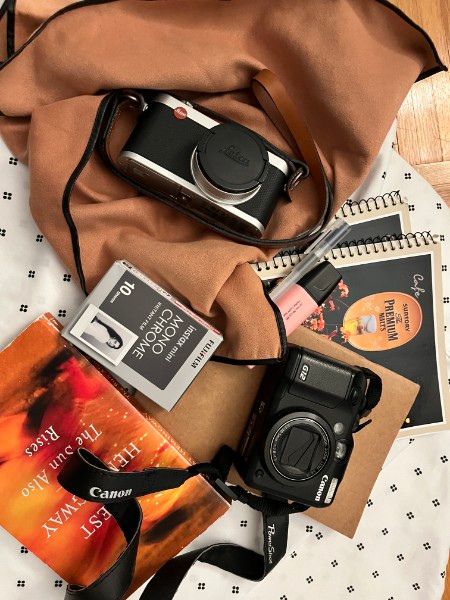
But recently, Hayes has changed the way he does so. Before, he would often take his phone with him on hikes, snapping photos along the way as references for future paintings. Now, Hayes almost always leaves his phone behind—opting instead for an analog camera (and a physical map). “It’s a lot more enjoyable to not have my phone with me,” he said. “When I used to take pictures with my phone, I’d jump onto other applications and it would distract me from where I was.”
He added that breaking away from social media’s focus on hyperpalatable aesthetics has made him more in tune with the landscape, “on a level that stretches beyond [trying to capture] the most beautiful snapshot.”
Eliya W. ’28 has also been experimenting with analog, using a camera and journaling on paper every night, and has felt many of the same effects as Schwarz: more presence, more clarity, and less distraction.
“[After] starting to do more things off my phone, I reduced my dependence on my phone to record my thoughts or take pictures,” she said. “It gets rid of that instinct that in order to do anything, you need to have your phone.”
Eliya and Hayes are all part of a broader cultural shift away from a constant online presence. According to a 2026 study by Talker Research, 63% of Gen Z is attempting to intentionally reduce their screen time for wellbeing. And popularity for app-blocking apps and “dumbphones” has surged.
Other students have found that going analog forces a different speed from the frenetic pace of digital life. Aerie L. ’28, who has been using a record player for more than two years, said, “I like that I have my playlist, but sometimes I just want to listen through a whole album.” She added that a record player’s lack of a streaming algorithm and customizable playlists is a virtue, not a downside.
Analog replacements are fundamentally different from their digital counterparts, though, and ditching phones often means ditching some degree of convenience.
“You notice how much extra stuff you’re carrying with you when you replace functions on your phone with other items,” Hayes said. But he thinks the switch has been worth it: “I feel more in the moment. That’s been really, really important to me.”
Eliya has noticed a change in how she relates to what she owns, since larger analog devices can often feel more fragile. “For my camera or for my journal, if that gets damaged, it’s pretty hard to get those moments back,” she said. “So I think that [fragility] makes me a little more intentional about how I treat those items and also what I record in those items.”
Aerie finds herself stepping out of the comforts of the repetitive digital algorithm when searching for new music.
“The cheaper [records] are more obscure,” she said. “It incentivizes you to find new music, and to be okay with getting records that you don’t know about yet.”
She sees this spirit of discovery as a way to challenge the “one-track mind” of generative AI. “[AI is] designed by a specific culture and will only spit out that culture back to you,” she said. “And I think we all recognize that.”
As an artist, Hayes prefers physical to digital media precisely for this reason. “I think some of my pieces definitely contemplate digital media and AI, especially because AI has become a very relevant force in shaping the art world,” he noted.
He added that creating physical art also pushes back against other aspects of the digital experience: “When I’m painting in a studio on a physical surface, it’s a lot easier for me to talk to other people.”
For others who are interested but apprehensive about going analog, Hayes suggests trying a phone-free day. If that feels too intimidating, he says that trying to replace select applications—like the camera, Notes, music apps, or calculator—can be a place to start. Wee, meanwhile, recommends picking up new analog habits like journaling instead of just trying to transfer existing habits onto analog mediums, which can feel more difficult.
Ultimately, Eliya says that personal experience with going analog has transformed not only her relationship with technology, but also the way she lives her life.
“Always being in a digital place is taking away from my actual ability to engage in my life,” Eliya said. “And I think especially growing up with all this technology, it’s something that previous generations didn’t really have to deal with.”
This summer, she’s considering taking her analog journey a notch further and using a flip phone alongside her camera and journal. And especially when the absence of school creates a vacuum of free time, scrolling can easily become the default.
“A lot of your life happens on your phone, which I think is [why it] is really scary, often, to go completely analog,” she said. “[Still,] I hope I can at least take some small steps towards that.”
