


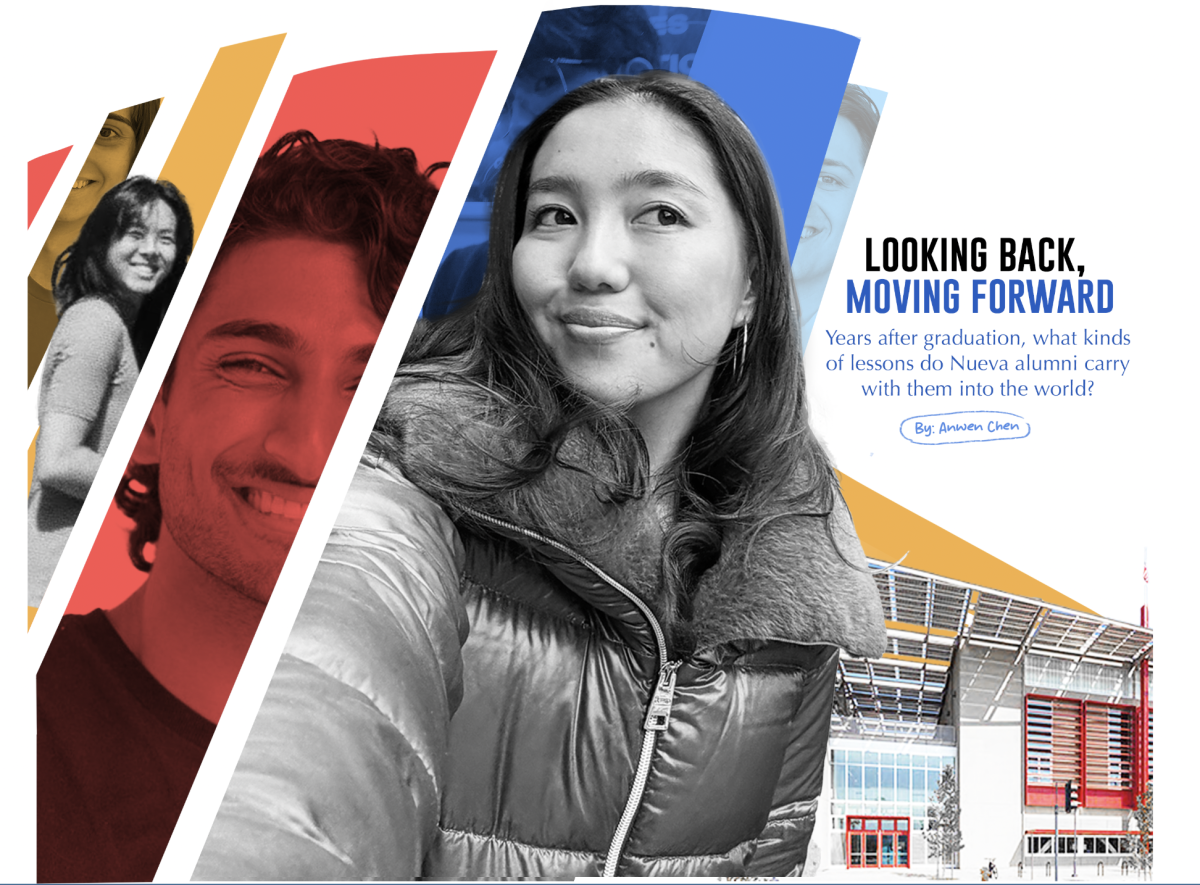




Since its founding in 2013, the Nueva Upper School has graduated nine classes of students. Most of them have gone on to four-year colleges, and today, many of them are navigating early careers, graduate programs, and the general business of finding their footing in the world beyond.
Not everyone looks back on their high school experience as a defining period of their life. But some do, and for many Nueva alumni, the influence of those four years has proven surprisingly durable.
Just ask Om Gokhale ’18.
These days, Gokhale works as a graduate researcher and designer at the MIT Media Lab: a “direct offshoot,” he says, of the time he spent at Nueva. The Upper School had only been open for a year at that point, but as a freshman, Gokhale was immediately taken by the energy on campus. Here was an environment where he was encouraged to pursue multiple interests, take ownership of his learning, and be a bit spontaneous all the while.
So maybe it wasn’t a coincidence that Gokhale was drawn to Nueva’s design thinking program. It was the “perfect” interdisciplinary environment, a space where he could blend his interests in visual design and systems thinking. Freshman year, Gokhale built a contact-sharing app—Swap—alongside a few classmates in an entrepreneurship elective. They started with researching and need-finding, and later spent the next two years pitching, spreadsheeting, and raising capital.
“If [I have] one takeaway from the Nueva experience, it was moments like that where what you think is just a task or an assignment can, with the right care and attention, become something much more meaningful and tangible,” he said.
The project eventually fizzled out, but Gokhale still looks back on it fondly. He says that it introduced a mindset that has heralded the rest of his career. After high school, Gokhale studied his own major—”Humane Design”—at a liberal arts college, focused on ethical interactions between people and technology. He then took a job at IBM; left it for a machine learning startup; and eventually landed a graduate position at the MIT Media Lab—as it happens, through a tip given by a close Nueva classmate.
Whether in his career or simply the way he moves through the world, Gokhale still traces a “phenomenal” amount of his identity back to his time at Nueva.
Oh, and this summer, he’ll be marrying fellow alumna Hannah Zucklie ’17.
Now, Gokhale doesn’t speak for all alumni; not every Nueva student will feel the influence of their high school years so acutely after the fact. But his story goes to show that many Nueva alumni view their high school years as an inflection point of sorts. A period of exploration, where something—perhaps a particularly enjoyable class, extracurricular, or mentor—came along and unwittingly altered the trajectory of their life.
Now a teacher at nearby Burlingame High School, Kayla Wagonfeld ’19 frequently finds herself reflecting on her time at Nueva.
“I credit Nueva with so much of my decision to be an educator,” she says. “[At Nueva,] I’ll always remember the way that my teachers made me want to come to school every day, made me want to learn, and encouraged me to be curious about everything and anything.”
That said, Wagonfeld left Nueva without a sure sense of what she wanted to do in college. Throughout high school, she’d wandered across different disciplines, from English to ecology to religious studies: “I was a very curious, happy learner,” Wagonfeld said. “I wanted to get to know everything and take advantage of all of Nueva’s opportunities.”
The turning point, then, came during her first year in college. COVID-19 shutdowns were taking effect across the country, but Wagonfeld was determined to find a job she could do in person. She eventually found a summer teaching position at a startup charter school in St. Louis, Missouri.
“I loved the energy of it all,” she said. “I felt like I was at Nueva again, where we were all invested and creating things together with our students. After that, I was like, this is awesome. And I never turned back.”
This year marks Wagonfeld’s second as a full-time teacher, and her first after returning to the Bay Area. These days, she continues to find ways to bring her own Nueva experience into the classroom. Some of her teaching practices she’s borrowed wholesale, like Alexa Hart’s ninth‑grade English exercise of “vomit journaling.” Other influences have been more philosophical, like Nueva’s emphasis on collaboration and the importance of finding joy in the process of wrestling with ideas.
“[These] are such satisfying [parts of learning], and I think public schools sometimes don’t build [them] into the curriculum as much,” Wagonfeld said. “So, much of my work now is trying to give [my students] some of that experience.”
Wagonfeld still carries a lot of Nueva with her. But what would it be like to have a Nueva student as your coworker? Or even yet, your co-founder?
For the past year and a half, that’s been life for Madeline Park ’20. Park is a startup co-founder based in NYC, and she’s been building Vega—a social networking app—alongside former classmate Ben Lee ’20.
In high school, Park and Lee were good friends; they ran cross country and track together and took the same advanced STEM electives. And although the two went their separate ways in college—Park headed to Columbia to study engineering, and Lee studied Computer Science at Brown—they stayed in touch, working on side projects pitched by their friends.
Growing up in the Bay Area, Park said that she’s always been drawn to startups. But it was only after college—and a short-lived job as a machine learning scientist at Uber—that she decided to try building one of her own. She reached out to Lee via email, and quickly discovered that they both cared deeply about the same problems: tackling loneliness, fostering relationships, and connecting the right kinds of people together. They also shared the same frustrations about the limitations of current matchmaking apps. Then came the question: Could they create something better?
Determined to find out, the two reconnected in NYC and got to work building Vega. The thesis of the app was simple: whereas existing matchmaking apps relied on users to self-input information, Vega would allow users to vouch for their friends, and connect them to other users. It would be a platform for “setting people up,” in other words.
With their pitch locked down, the two spent the next months in development mode, flitting between different startup accelerator events, raising capital, and navigating the high-speed thrum of NYC’s tech startup scene.
A year and a half in, Park says that the pressure can still feel intense at times. But through it all, she says she’s grateful to work with someone who can match her passion, trade inside jokes, and draw on a sort of shared history: “[Ben’s] always the thoughtful one—he thinks things through. [Meanwhile,] I’m more like, let’s just go and get out there. We might break things or fail, but in any case, we’ll try again. I think those opposing ways that we work are actually really complementary.”
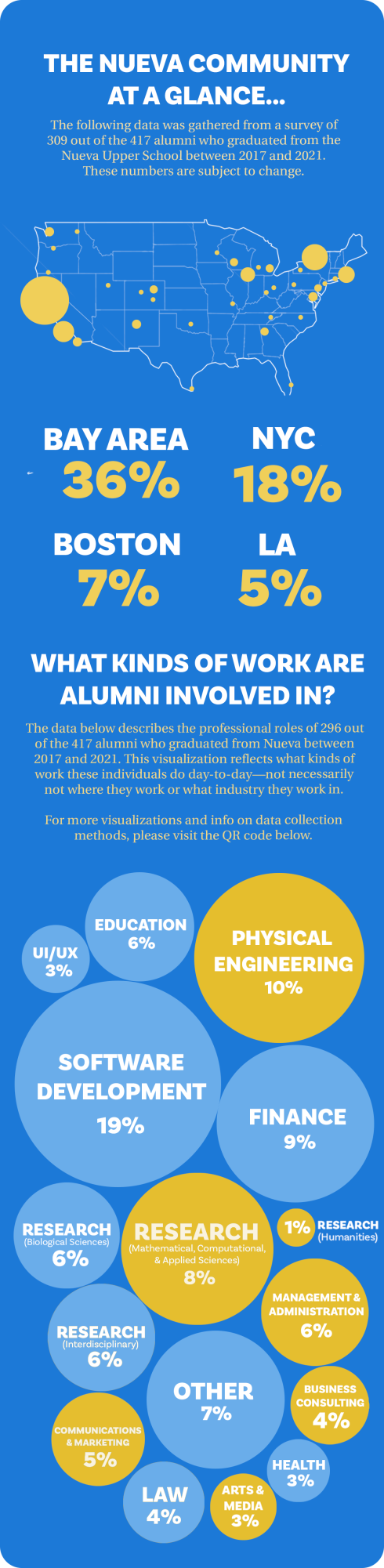
While Park and Lee may occupy the unique position of having founded a startup, plenty of their peers have wound up at one. In a survey conducted by The Nueva Current, 26% of alumni who are formally employed (outside of academia) currently work at startups, defined as companies founded within the last 10 years, centered on rapid growth and market disruption, and usually reliant on external funding.
Similarly, Park and Lee are two of many Nueva alumni who now work in the tech sector. According to the survey results, 23% of alumni who graduated between 2017 and 2021 are currently employed at tech or software development companies. 19% hold technical positions related to software development specifically, making it the most common sector by a large margin.
So why does tech draw so many Nueva graduates? And is there something about Nueva that encourages alumni to seek out startup environments in particular?
Park says yes. Nowadays, she sees a direct line between the freedom she found in Nueva’s curriculum and the freedom she now enjoys as a startup founder.
“[At Nueva], I remember having a lot of agency in my work. I found that I was the most inspired and motivated when I could own and decide what I was doing,” she said.
Others shared similar experiences. Jordan Mak ’21 works as a UI/UX designer for a travel planning startup, Shrtlst. For Mak, the appeal of startup life comes down to visibility and ownership: “[Being at a startup] is particularly fun and rewarding because a lot of the work you do is a lot more visible, and you have freedom and autonomy to make your own decisions.”
Like Park, Mak also credited Nueva with giving him the skills to thrive in such an open-ended and at times unpredictable environment.
“[Nueva] taught me how to carve your own path and take advantage of any opportunity,” Mak said. “That’s something I loved in high school, and it’s the same thing that I find the most enjoyable about working at a startup now.”
But not every Nueva alumnus can trace a clean line from their high school experience to their current career. For some, the years after graduation came with turns and pivots they never could have seen coming.
Ishani Gupta ’18 can speak to her experience. At Nueva, Gupta was convinced she was headed towards a career in biology research—stem cell research, to be exact. She had nurtured a love of lab research through the Biology Research Team course, loaded up on advanced biology electives, and when it came time to apply for college, confidently put herself down as a major in the Biological Sciences.
She held to that plan through her first year of college. But in the summer of 2019, during a study abroad program at Oxford, she began to have second thoughts about her trajectory. In her first public health seminar, Gupta encountered a framework she hadn’t fully considered before: disease not just as a microbial problem, but a policy one. She learned about the outsized role of governments, economic systems, and historical injustices in shaping access to care.
It was a whole new lens for understanding disease and human biology. And for Gupta, it brought a paradox that she couldn’t shake: What good was advancing the science of medicine if most people couldn’t access it?
“As a researcher, I knew I was going to raise the ceiling of science and medicine,” she said. “At the same time, I knew we also had to raise the floor.”
It was a lucky time for her to be at such a crossroads. Gupta was a freshman; she still had time to switch her major. Even so, she deferred the decision until the following year—the year the COVID-19 pandemic hit, and the failures of the US public health system became impossible to ignore. For Gupta, this was it; if there was ever going to be a “perfect” time to pivot, it was going to be this one.
“I cared about [health equity], and I struggled with figur[ing] out how stem cell research and [these] advancements in medicine could be made available to everybody when we still have gaps in [basic health] coverage,” she said.
Gupta officially switched to a public health-related major as a college sophomore. And over the next few years, her life began to look nothing like she’d imagined. Things started to move with a new rhythm: days at the lab bench gave way to nights spent pouring over research on population health outcomes. She eventually graduated in 2022 with her degree in public health, spent the next two years working to improve health education at a children’s hospital, and in 2025, returned to her studies as a master’s student at Harvard.
Now six years into her public health journey, Gupta admits that what she does now is a far cry from what she envisioned herself doing in high school. But in the time since, she has learned to carry her choice with pride.
“What I just keep focusing on—and what I keep reminding myself—is that this is the work that I’m so passionate about,” she said. “It’s the work that makes me want to get out of bed.”
Like Gupta, Sora Cullen-Baratloo ’19’s path started out deceptively straightforward. In high school, she was skilled in math and had a knack for coding—all reason enough, it seemed, for her to keep on the STEM path in college. It felt like the natural way forward, “the default thing to do,” as she called it.
So for years, she stuck to those defaults. In 2023, Cullen-Baratloo graduated college with a joint degree in mathematics and computer science. Not wanting to lose the momentum, she defaulted again to enrolling in a CS PhD program at the University of Maryland.
“[At the time], I was like, I don’t really know what to do. I’ll just go to grad school. I’m familiar with [CS], I know how to do CS. I’ll just keep doing it.”
In undergrad, getting by had been enough: CS might not have been her passion, but at least she was competent at it. Graduate school was different. Coursework and test scores only got you so far; eventually, you had to do actual research. And research required something she was running out of: genuine interest.
On the other hand, Cullen-Baratloo had become interested in something else. It just didn’t have anything to do with coding or algorithms. In the fall of 2024, she attended a student panel where someone mentioned the university’s graduate student union in passing. Intrigued, she decided to get involved. She started becoming a regular at union meetings, began working advocacy events herself, and quickly discovered her passion for labor organizing in the process.
“I wasn’t sure that [CS] was something that I wanted to spend the rest of my life doing,” she said. “I was involved in organizing already on the side, and it felt like much more meaningful, fulfilling work.”
So she made the call. In late 2025, Cullen-Baratloo took an indefinite break from her PhD program, and now spends her days working as a United Auto Workers (UAW) affiliate full-time. She says it hasn’t been easy. Day-to-day, her work now consists of a lot of “exhausting social labor”: hosting meetings with stakeholders, going door-to-door, and generally fighting the same uphill battles that plague many in her profession. Still, Cullen-Baratloo says that the switch has felt worth it.
“I haven’t been involved [in this work] for that long, and at times, there’s a part of me that’s still a little [hesitant],” she said. “But at the end of the day, I don’t wish I was back doing CS.”
Cullen-Baratloo’s story is not a common one. It’s a full career reversal, one that’s hard to explain to friends and family, and harder still to justify on paper. But the decision made sense for her, and ultimately, she’s been happier for it.
Like Cullen-Baratloo, many Nueva alumni have had to grapple at some point with the question of whether or not to pursue graduate school. According to survey data, 37% of post-college alumni have obtained or are currently in the process of obtaining a graduate or professional degree. And of those 37%, most begin their graduate studies immediately after earning their four-year degree. For some, graduate school presents itself as an opportunity to build deep expertise. For others, like aspiring doctors and lawyers, it’s an occupational necessity.
But graduate school is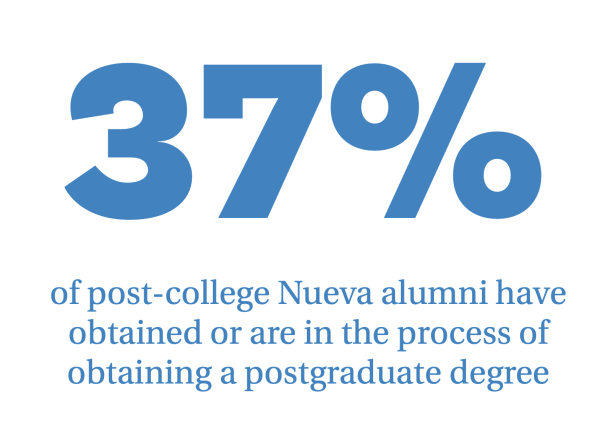 n’t for everyone. At least, not right away.
Scott Brasesco ’18 came into undergrad with a plan: he’d start out studying political science and history, go through the pipeline of academia, and end up a history teacher. But after taking a course on democratic backsliding, that plan took a backseat. If Brasesco had the skills to make an impact on the world, then he knew he had to put them to use: “I wanted to go out into the world and try some things—maybe some journalism, some government, some policy, all kinds of different [subjects],” he said.
Today, Brasesco serves as a policy researcher at Global Action on Gun Violence, a DC-based nonprofit that litigates against gun manufacturers. He says that moving directly into the working world has helped him “build an identity” as a young person: he’s gained valuable experiences by situating himself in the hubbub of DC politics, experiences that he wouldn’t have gotten just going from one classroom to another.
Brasesco still thinks back to Nueva occasionally. He’s grateful for the soft skills he developed there, from learning how to deal with uncertainty to building the confidence to approach people for help. But, as he’s found, life after high school opens up a whole new testing ground for these skills.
Chief among them has been self-advocacy: “No one’s gonna hand stuff to you if you don’t ask for it. And if you do ask, you’ll find that people will be surprisingly generous with their timeand resources,” he said.
Other alumni have also found that some lessons can only be learned through experience. There are many things in the world that no amount of schooling, Nueva or otherwise, can fully prepare you for.
Ben Cheng ’19 has a name for it: growing up. Now in his second year of medical school, Cheng has felt a palpable shift in the years since leaving high school. “When you’re young, you have so much support around you,” he said. “Especially in Nueva, [you have] the privilege of being able to access an almost infinite number of resources. So, sometimes you can feel a bit sheltered.”
Still, he added, “This is not necessarily unique to Nueva, but I think Nueva amplifies it.”
Willow Taylor Chiang Yang ’21, who will begin her master’s in political research this fall, also said that “success” becomes harder to define as you get older. Things can’t just be categorized on academic rubrics or resume lines anymore; rather, being an adult means confronting important, and sometimes existential, questions.
“Now, I often think, what does it mean to cultivate other parts of myself that are more important [than my academics or career]? Like my self-identity, my confidence, and my curiosity towards the world?” she said.
Brasesco agrees. For many high schoolers and college students, it is natural to want to map out your future, to know what options are available and blueprint accordingly. Yet, if Brasesco’s learned anything in the near-decade since leaving Nueva, it’s that there’s a limit to how much you can plan ahead.
“I’ve always been someone who likes to think a few years out in advance and be like, This is my plan. This is what I’m going to do, and this is what I have to do to get there,” he said. “[But] what I know now is that those plans are more like guidelines.”
And for any high schooler reading this, still in the thick of figuring it out, Brasesco has one last piece of advice:
“Life happens, things change, and that’s okay. So have some trust in yourself. Things will always turn out right in the end.”