









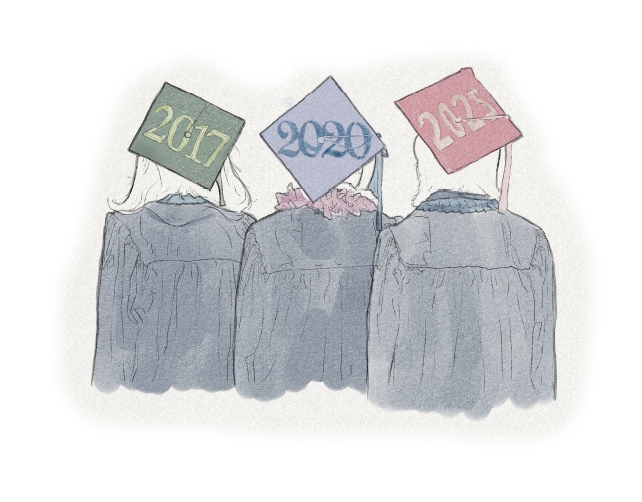
Nueva welcomed its first ninth-grade class in the fall of 2013: a small group of students stepping into an educational experiment that was still very much in the making. Grading systems, curriculum development, and even the daily school schedule were in flux, changing nearly every year as faculty and administration tested new ideas to shape the school’s identity.
Debate teacher Les Phillips, hired in 2014 to be the first formal Upper School debate coach, described the environment as one of open-ended possibility and experimentation.
“Everybody was improvising one way or another. I would ask somebody, ‘How do you do that here?’ and they’d say, ‘We don’t know. How do you think we should do it?’” Phillips said.
To thrive and learn in this inventive environment where routines and expectations were not yet defined required a certain degree of faith and tenacity. Five teachers described the first graduating classes as “pioneers,” who embraced the opportunity and challenge of forging their own path. Those students were excited to shape their ideal high school experience, one informed by a deep love of learning and passion for exploration.
“You had to be a student who was willing to deal with a certain amount of risk,” said SEL teacher Lee Holtzman, who began teaching at Nueva in 2010.
Holtzman continues to see the intrinsic motivation and love of learning necessary to adapt from those early years remaining strong among Nueva students today. However, the school itself has changed drastically, having grown into a more established institution with larger class sizes and clearer, lasting systems. At times, that accomplishment had its trade-offs. Shortly after the high school was founded, Nueva gained a reputation for strong college acceptance rates, attracting new families with higher expectations for what they wanted out of the school experience.
“We were suddenly an established, famous school perceived as a gateway to Stanford. That drew a different crowd, and with it, more anxiety about competition and grades,” said Upper School Assistant Division Head Claire Yeo.“Somewhere between those first few classes and [the current grades], there became an impression that there was more anxiety about college. You all shouldn’t be as anxious as you are.”
The pandemic, which occurred a few years after, further negatively impacted students’ social and academic behavior. Science teacher Jeremy Jacquot recounted the transition back into in-person learning as somewhat rocky.
“Students had to relearn how to be in a classroom, how to socialize and get used to being around people,” Jacquot said.
He added that things seem to have returned to normal now.
Despite these shifts, teachers emphasized that the change they had observed was not altogether negative or positive. They stressed the continuity of Nueva students’ passion for learning.
In particular, Yeo insisted that the core of Nueva’s identity and culture remains intact.
“The kindness, the sheer joy of learning, and shared wonder and curiosity have been consistent. That’s the treasure we hope never to lose,” Yeo said.