

















“Let’s push all the tables to the outside of the classroom,” Upper School History Teacher Barry Treseler said to his U.S. History students at the start of class.
Instead of sitting at desks, he invited them to take seats on the floor of Room 217 for a change.
While the majority of the class decided amongst themselves who would represent each of the 13 colonies, two student volunteers sat behind the teacher’s desk at the front of the classroom, role-playing Royal Advisors to the English Crown.
“It seems silly, but when you’re role-playing, and someone is sitting up on an elevated space, there’s a psychological impact there,” Treseler said. “It’s not that we think they’re really royal advisors, but you can use space in a dramatic way. Theaters do this all the time, and there are some parts of teaching which are actually theatrical or dramatic. So you can use perception and you can use space to help students come to certain understandings and realizations a little quicker and easier.”
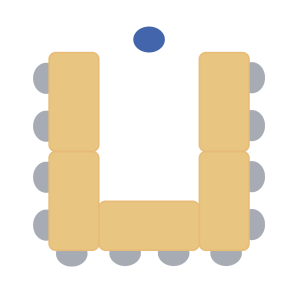
Jonathan H. ’27 prefers the Horseshoe as well. “If you can see the faces of the people who are sitting with you, it’s a lot easier to discuss.” (Alexis C. ’27)
By manipulating the arrangement of tables and chairs in his classroom, Treseler intended to match the content of his US History course with the form. Treseler is not alone in his beliefs; for many teachers, space plays a large role in the balance of a classroom—altering learning and teaching dynamics, as well as fostering class culture and connection.
When delivering information in a lesson, Treseler prefers a large horseshoe, or “U” shape so that students can see him and the whiteboard at the front of the room. Other times, Treseler prefers students to face each other in small group discussions, with everyone seated around clusters of tables pushed together.
Math teacher Ihmar Aldana also prefers clusters of group tables.
“It makes it easier for me to monitor the learning and facilitate it. When there’s space to walk around, it makes it easy for me to ensure that they are staying on task, and I’m able to redirect them if needed,” Aldana said.
Aldana prefers teaching in larger classrooms. To him, the added space makes it easier to facilitate gallery walks and board demonstrations, where students can walk around the room to observe their peers’ work.
Conversely, fellow math teacher Andrew Alexander prefers smaller and cozier spaces—“dense” classrooms, as he puts it. Drawing upon his observations from weddings and parties, Alexander believes that more room often means less interaction. His preferred table arrangement in class—a “U” shape— comes from his experiences in liberal arts settings.
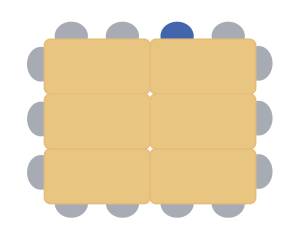
In SEL, Anton Krukowski mimics the Harkness table by arranging multiple tables in one large square, with the intent to foster connections between students even across the room.
“Having the table fully connect feels different,” Krukowski said. “You see that the point of being here is to share. It’s like we’re physically connected to each other.” (Alexis C. ’27)
“I grew up as both a teacher and a student in liberal arts seminars, where we’re all sitting around a big table trying to sustain a single conversation among the 15 of us,” Alexander said. “That’s how I think a classroom should be. It’s a single community, it’s a single team. We’re all working together to understand these really challenging, beautiful, and difficult ideas.”
But there is more to classroom design beyond the layout of seats and room size. In addition to the arrangement of seats and size of the room, SEL Teacher Anton Krukowski believes that the furniture itself plays an important role in space design.
When he started teaching in Room 343A, Krukowski advocated for tables that seated multiple students, as opposed to single-student desks.
“The tables in [343A] were very individual, very small, and hard to move. So as soon as I started teaching in A, I wanted to have [more] flexibility.” Krukowski said. Hoping to easily switch the layout between one large table or clusters, to facilitate personal conversations, Krukowski’s request for larger tables was ultimately approved.
Psychology and SEL Teacher Amy Hunt similarly uses clusters of tables, but with a unique twist: by rotating each square on a diagonal, almost every student can feel a part of a larger class collective.
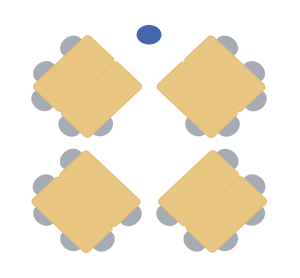
Sitting at one of her table groups in Room 1103, Hunt gestured at how easily she could see other table members, as well as the board. “When I sit here, it doesn’t take very much for me to turn and look [at the board]. But when [I’m facing]straight on, we both have to crank really hard to see,” Hunt said.
In addition to seating arrangements, Hunt cares about small aspects of a classroom that can support student comfort and learning—such as temperature and access to windows.
Comfort remains a shared priority for many teachers in addition to Hunt. English Teacher Amber Carpenter believes that more flexible seating offers a unique advantage when it comes to making a classroom feel inviting.
“If I were to imagine just the perfect space, I think students would have bean bag chairs, even couches. There’s something to be said about comfortability, because otherwise [the classroom] can feel pretty sterile,” Carpenter said.
In some schools where teachers have their own rooms, distinct furniture and personalized decorations can make a space feel more lively and approachable. At Nueva, however, teachers are not assigned individual classrooms and often teach in several rooms throughout the day.
However, when Hunt needs a space to quietly work, she turns to the silent lounge for faculty on the third floor. Spaces like these are what she believes Nueva needs more of, for students especially.
“To think that the only way to get a quiet space is to put your headphones on… I think that’s incomplete,” Hunt said. “I know students are searching for [quiet] places because as soon as there is an empty classroom, somebody grabs it.”
Ethan E. ’27 is one student who wishes for quieter spaces that don’t currently exist. “Besides the WRC, Nueva does not have that many [study spaces],” Ethan said. “[In] the fireplace area, gym couches or outside area, there’s so much going on. They’re more communal than study spaces.”
Concerns like Ethan’s highlight the broader role that physical space plays in learning. Whether it’s quiet study nooks for focus, or flexible classroom layouts for collaboration, the thoughtful arrangement of space can be crucial to foster valuable learning experiences. In many ways, “Space is the third teacher,” as Hunt said.