

















This semester, a new elective has students discovering the inner workings of the words you’re reading right now: Linguistics. The interdisciplinary class, taught by Ted Theodosopoulos, has been investigating the mathematical logic of linguistics and exploring questions about translation, communication, and meaning.
“The intent was for it to be a bridge between the two cultures—STEM and the humanities,” Theodosopoulos explained. “There would be reading and writing, but there would also be the scientific study of language, as well as concomitant fields like neuroscience.”
Lila P. ’26 came into the class most comfortable with the humanities lens. The amount of computational work was a surprise to her, but after completing her first computational assignment, she realized that she actually enjoyed it.
Others went into the class determined to pursue their own niches. Colin C. ’26 came into the class eager to use linear algebra and matrices to break down and reconstruct words. Over time, he’s discovered that linguistics reaches into almost every corner of STEM.
“There’s never been a stopping point,” Colin said. “I always want to keep working on whatever we’re working on.”
The structure of the class, modeled after Theodosopoulos’ signature “modular architecture,” encourages this type of wide-ranging exploration. Over the course of six two-week-long modules, students probe at linguistics from all sides, learning about phonetics, morphology, syntax, semantics, and more.
The modular format felt both natural and logical for Theodosopoulos, as someone interested in both mathematical and literary fields.
“The whole structure of the class [is] an eclectic collection,” Theodosopoulos explained. Although he describes himself as an “amateur” linguist, he acknowledges that his unique background in the maths and sciences has equipped him to expose his students to a smörgåsbord of topics, theories, and challenges. In Linguistics, students are encouraged to both dive deeply into their niche and to venture wildly outside their comfort zone.
“I really appreciate [the class], because it allows students to pursue what they’re interested in for short spurts of time,” Colin said. “Because linguistics is one of those topics where you could go down a rabbit hole in a million different things, having a module every couple of weeks allows you to get a wide array of understanding in different areas.”
At the end of each module, students synthesize their learning in group projects. One group, during the phonetics and phonology module, recorded around 20 bilingual Nueva community members saying one phrase in their native language before writing a computer program to determine the language by its audio waveforms. Another group constructed a trialogue wherein each student was speaking a different language: Korean, Mandarin, and Japanese.
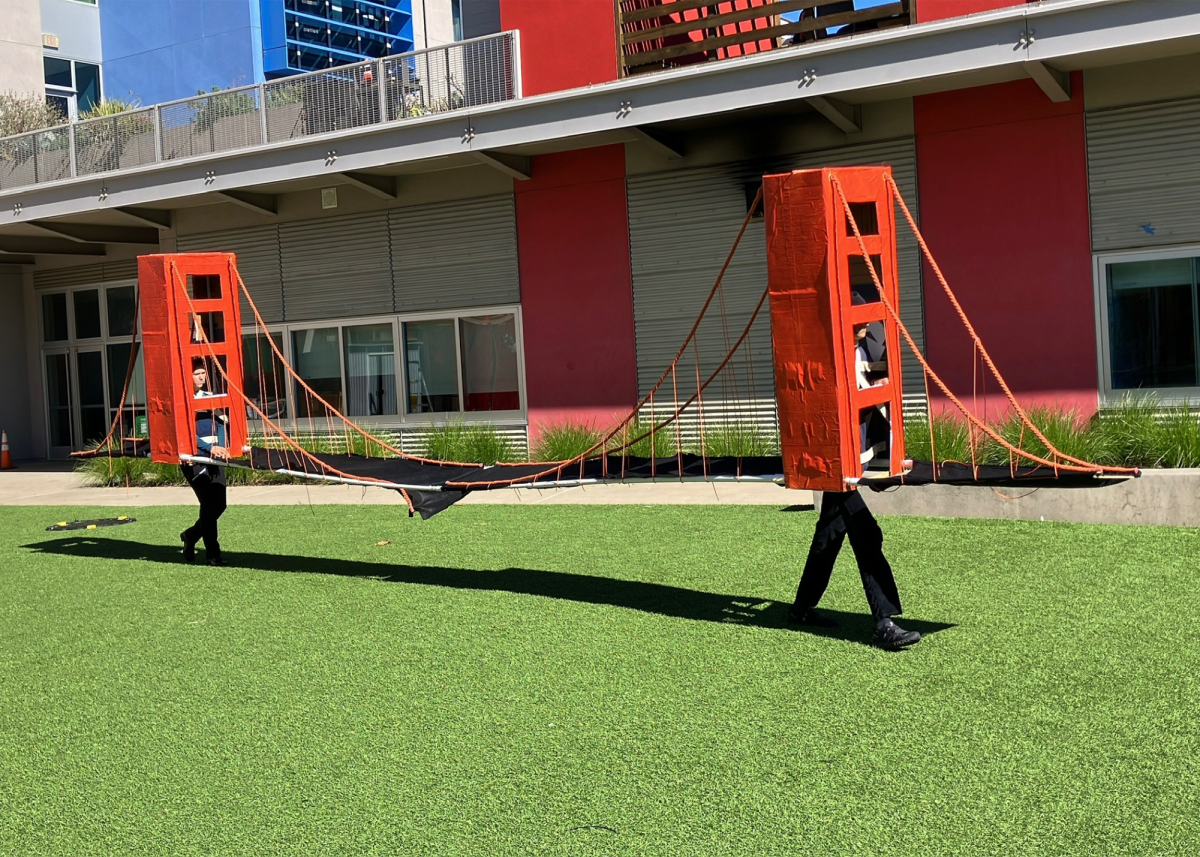
In addition to the group projects, Theodosopoulos has experimented with oral presentations in the form of creative skits. “The intent is to demonstrate the learning to the others, not to me,” he said. “Language is something to be used, not only to be talked about.”
The student response has been overwhelmingly positive.
“I didn’t realize that such a technical class would have so many creative aspects, but I really love that,” Hannah B. ’28 said. “My group performed the first chapter of Harry Potter, but without any words containing any sound found in the word ‘Voldemort.’”
Student buy-in has been a crucial part of the course’s success. “[Being] willing to be vulnerable and try new things, perform in front of other people, work with other classmates—I think our class has done a really good job of that,” Colin said.
The result has been a classroom environment where students collaborate while investigating complicated questions.
“What I’m looking for is for them to surprise me,” Theodosopoulos said. “This is why this class has been so enjoyable.” He has been gratified to hear students share that they have been more creative in Linguistics than in any other class.
In addition to science and literature, Theodosopoulos has described philosophy as the ever-present “third strand” of the class. “What could it mean to mean anything? Why does anything mean anything else?” are central questions he asks.
“The students really eat that up,” he added. “So whenever we veer into that direction, they love it.”
Allowing the class to exist between disciplines often portrayed as at odds with each other has opened up a space where every student can find their niche.
“It’s one of the classes where I feel like 90% of the student body would really enjoy the class, regardless of what they’re interested in,” Colin said. “There’s so much freedom. There are so many resources shared with you.”
Lila shared a similar sentiment.
“Connections are everything,” she said. “All the best classes are when you’re making connections all the time. Since language is how we communicate, how we think… I think it’s really important to see it from different perspectives.”
