









I. The Responsibility to Serve
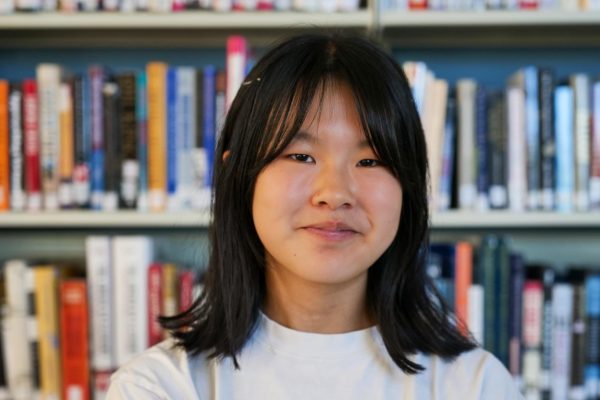
Three nights a week, TJ L. ’28 works in a grassy lot in Redwood City, greeting as many as 100 unhoused people. There, under a tent, TJ directs 12 adult and high school volunteers to serve fresh, warm meals like fried chicken and steamed vegetables. On Halloween, the volunteers pass out candy; on Thanksgiving, they offer turkey and mashed potatoes. If someone needs clothes or toiletries, TJ sorts through a large closet of items, including jackets.
TJ has been volunteering with Street Life Ministries, a Bay Area organization addressing housing instability, for over a year. Through this experience, he has gotten to know many locals struggling with housing instability, substance abuse, and family issues.
“[They] want a place where it’s welcoming, safe, and where they have a lot of people they know on a consistent basis,” TJ said.
Volunteering has also reshaped his perspective on his own life. Through spending time with people experiencing housing insecurity, he has developed a deeper sense of gratitude for the stability he has. He’s also learned how to volunteer in his own time, how to lead other high schoolers, and most importantly, how to build genuine connections with people of diverse backgrounds. “I’ve learned a lot about not judging people by their appearance or how they act, [but by] if they have a good heart on the inside,” TJ said.
Stories like TJ’s illustrate what many educators describe as the promise of community service learning, or CSL: giving students opportunities to learn through sustained engagement with the communities around them and to grapple with complex social issues in real-world settings.
Luke Terra, a parent of Nueva alumni and current Deputy Director of Stanford’s Haas Center for Public Service, believes that CSL can also strengthen students’ academic pursuits.
“Engaging in service learning is going to make you a better writer, a better communicator, a better thinker, a better scientist, a better historian,” Terra said. “All of that is improved by grounding your disciplinary learning in the real and messy complex context of social community life.”
In a recent survey, 94.6% of 184 Upper School students said that CSL is a worthwhile use of school time. Many community members also pointed to how CSL is rife with opportunities for better understanding social inequalities; preparing for post-high school life; and engaging with the school’s motto of learn by doing, learn by caring, a belief in hands-on experiences and care for others. And yet, many community members have expressed disappointment with the lack of institutionalized CSL programming and a desire for more.
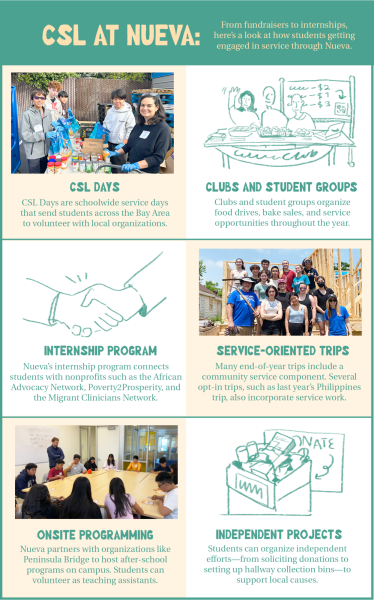
Though not coordinated at a formal level, community engagement work at Nueva still takes on many forms. Student-led clubs partner with local organizations; a number of Nueva trips integrate service components into their itineraries; and internships place students directly inside nonprofits working on issues from immigration law to environmental justice.
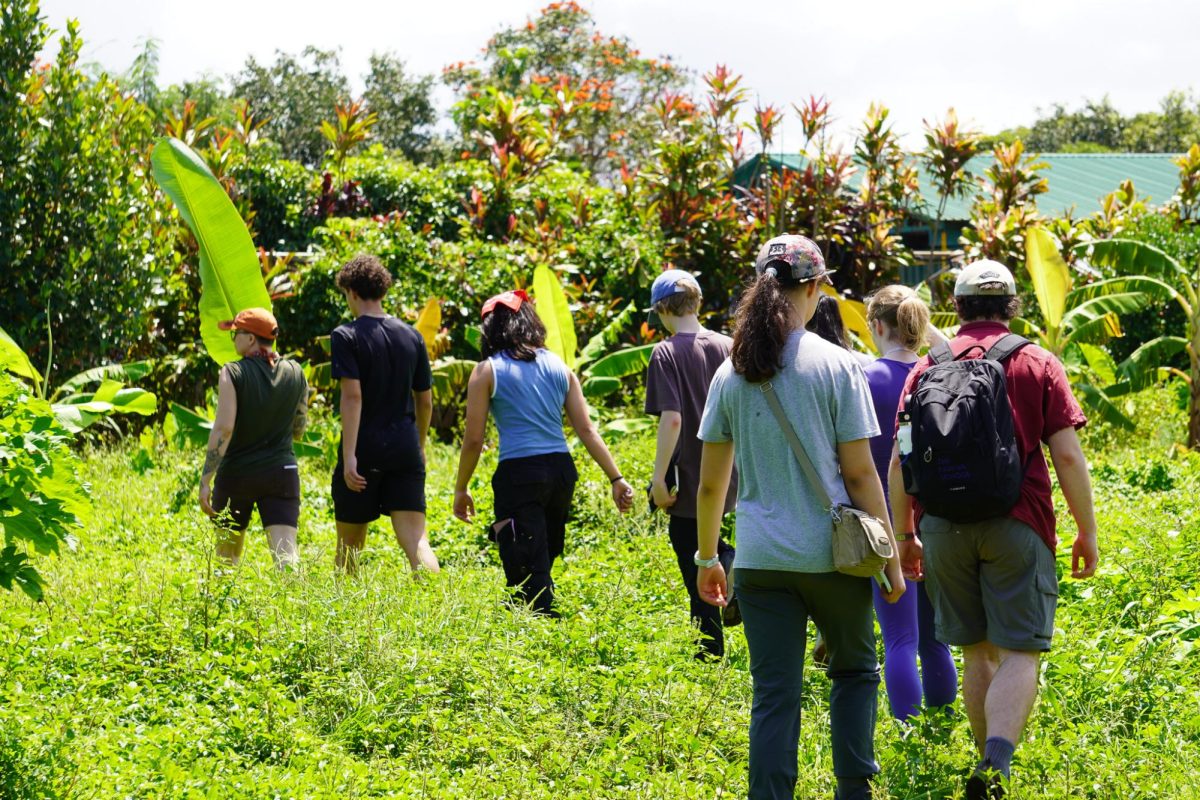
And yet, for many Upper School students, the most visible—and memorable—instance of CSL consists of a single event: CSL Day. Once or twice a year, students fan out across the Bay to volunteer at local organizations—from serving breakfast at GLIDE Church in San Francisco’s Tenderloin to clearing brush at San Mateo County Park. Ultimately, the activities are designed to introduce students to community organizations and social issues beyond campus.
On Nov. 19, Nueva held its first, and only, CSL day of the year. While the format remained familiar, several changes set this year apart. Students volunteered in advisory groups rather than signing up individually, which markedly improved attendance rates. In the days leading up to and following CSL day, advisors also facilitated “pre-briefing” and debriefing conversations to allow students to reflect on their volunteer experiences.
Many of these changes were introduced with the support of Extended Learning Coordinator Kamryn Marks. In addition to running the Internship Program and supporting Intersession, Marks now oversees CSL initiatives in the Upper School, including this most recent CSL day. In thinking about how to deliver CSL programming for the Upper School, she draws from years of experience coordinating volunteers at nonprofits, such as the Ronald McDonald House and Samaritan House.
Here at Nueva, Marks recognizes the unique opportunities for philanthropy and community engagement open to members of this community.
“I think it’s no secret that this school is extremely privileged,” Marks said. “We collectively share a lot of resources, and with that comes the responsibility to give back.”
For many students, that responsibility is felt most clearly through hands-on work: packing grocery boxes, serving food, or cleaning up local nature preserves.
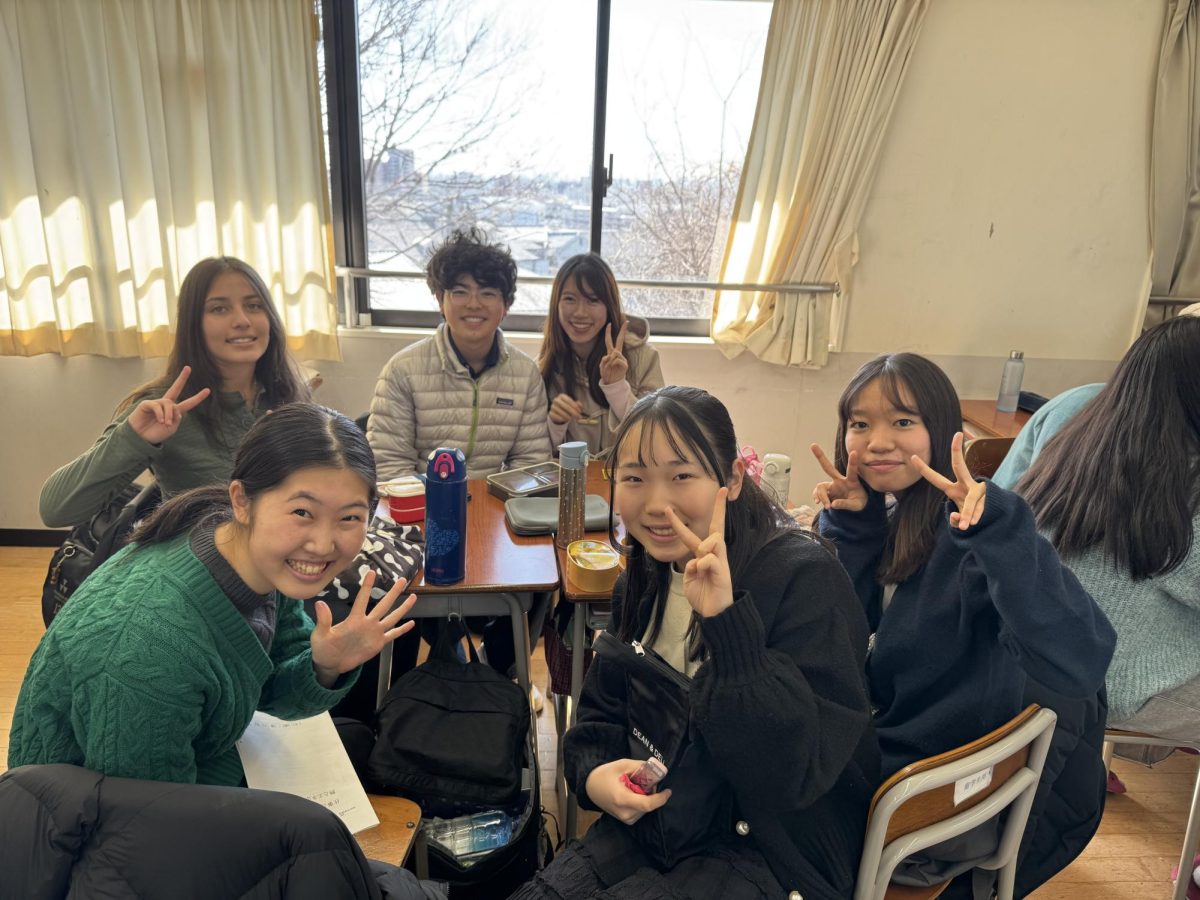
Jane J. ’29, who volunteered at GLIDE Church, explained how CSL Days have opened up her worldview.
“We’re kind of sheltered in our day-to-day lives,” Jane said. “We research [social issues], but we don’t really see the diversity of the world. Through CSL, we really implement the school’s motto, learn by doing, learn by caring.”
For others, CSL Day is an opportunity to forge personal connections with organizers and leaders.
“What’s really meaningful for me is sitting down and connecting with the people whose initiatives we’re working at—people who’ve dedicated their lives to service,” Rowan B. ’26 said. “When you talk to them, it’s impossible not to be like, oh, I need to be a little bit more like them.”
Yet for Rowan, these moments of connection are short-lived. Because CSL is largely concentrated into one day each year, it can feel difficult to develop a long-term relationship with the organizations he works with. What happens after volunteers leave, such as the continuation of work and its impact over time, often remains out of view.
This sense of detachment, Rowan notes, is reinforced by the structure of Nueva’s CSL program itself. While some schools track community service hours or mandate service as a graduation requirement, Nueva has no formal mechanisms in place to incentivize student participation in community service outside of school. As a result, CSL Days are often the most direct—and sometimes only—interaction that students will have with service during the school year.
“Because it’s so isolated and infrequent, [CSL] doesn’t feel like a sort of essential part of our community values,” Rowan said. “I don’t feel like people see it as part of school the way that they should.”
Others echoed this tension between accessibility and depth.
“[Nueva’s CSL program] definitely shines in how easy it is to participate in,” Max K. ‘26 said. “I think the trade off with that is that you are, [to] some degree, sacrificing depth and breadth for simplicity and ease.”
CSL club co-lead Audra L. ’26, meanwhile, remains optimistic about the service opportunities available to Nueva students. Through organizing CSL Days as an underclassman, she’s seen firsthand how students can make a tangible difference at the organizations they volunteer with. Still, she hopes to see Nueva adopt a greater emphasis on regular, voluntary service.
“We should frame [CSL] as not just something we do for one day, but [something that] we do throughout our lives,” Audra said. “I think Nueva’s focus should be more long-term so that our understanding of our community will become more robust.”
Marks agrees that CSL Day is not meant to be an end in itself. Rather, she sees it as a “launchpad”—something to encourage students to move beyond a single, school-mandated experience and towards sustained engagement.
“[CSL] should not just be another checkbox,” Marks said. “My hope is that CSL Day could be a starting point for people—to get uncomfortable, get their hands dirty, and keep going.”
II. CSL Through the Years
Over its 12-year history, the Upper School CSL program has gradually evolved from a homegrown effort led by students and faculty into a part of school programming.
In Nueva’s early years, English teacher Alexa Hart coordinated CSL Days focused on specific social issues. For instance, in 2017, Hart tasked the 10th grade with learning about food deserts—areas where low-income residents do not have accessible, healthy food nearby. She sent groups to volunteer for food banks and community gardens in local food deserts, before students walked to find lunch for themselves in the local neighborhood.
Later, Hart and history teacher Barry Treseler supported as faculty advisors for a student-led CSL Club, which expanded the logistics of CSL Days—transportation, food, partnerships—to accommodate hundreds of students. That responsibility remained with the club until it was passed to former teacher Morgan Snyder in the spring of 2025, and most recently to Marks.
Yet while these shifts have helped CSL Days grow into a formal fixture of the Upper School experience, the frequent leadership shifts have also created discontinuities. In the handoffs between organizers, the school has lost out on long-term relationships with community organizations, which often require time and consistency to deepen. On the most recent CSL Day, just six of the 23 organizations had been partners for the last student-organized CSL Day in 2024.
But changing leadership is far from the only challenge that Nueva’s CSL program has faced over its tenure: Hart also noted the logistical challenges of coordinating transportation for hundreds of students and finding local organizations with the bandwidth to accommodate large groups.
Noticing the limitations of isolated CSL Days, parent leaders on the Board of Trustees and the NPA were galvanized to bolster CSL opportunities at the school. In the summer of 2019, a group of parents worked with the school administration to create a CSL task force.
The task force conducted research over six months through school-wide surveys and focus groups with teachers and students. The surveys found that 90% of Middle and Upper School students and 83% of parents believed it was important for Nueva to offer CSL opportunities.
Yet, far fewer parents—29%—found the school’s existing CSL program to be effective. In focus groups, Upper School students “expressed frustration at the lack of opportunities, funding, and support” for CSL initiatives. And, data showed that Nueva-organized avenues for service would fill a gap: 68% of MS and US students were “not very involved in community service (either through or outside of Nueva).”
Next, the task force got in touch with both national and local independent schools known for their strong CSL programs. Two parents, Tammy Crown and Jen Sepulveda, interviewed a total of 15 schools including San Francisco Friends School, Francis W. Parker School in Chicago, and Menlo School in Menlo Park.
At Lick-Wilmerding High School in San Francisco, Crown and Sepulveda learned about the school’s flagship Public Purpose Program (PPP), which is housed within their Center for Civic Engagement. The Center has three full-time staff members, including PPP Director Ravi Lau, who specifically manages community partnership opportunities.
One of Lau’s main priorities is to oversee PPP-specific electives, which Lick-Wilmerding juniors and seniors are required to take. These courses include learning about fabrication through building furniture for local public schools or learning photography by taking portraits at local senior centers. Freshmen take a year-long course about identity and community, while sophomores complete 40 required service hours in a year. Students’ courses form the base for each of the four PPP Days facilitated by Lau in a year.
Ultimately, no student at Lick-Wilmerding can graduate without engaging in community engagement and service learning.
Lau credited the school’s strong community engagement programming to its broader culture regarding service. “We’re trying to live up to the ethos of being a private school with a public purpose. That’s built into our mission,” Lau explained.
By looking to Lick-Wilmerding and other schools across the country, the task force ultimately identified specific strengths and weaknesses of Nueva’s CSL program. In their culminating presentation to school leadership in January 2020, the CSL task force described the Upper School’s community engagement program as having “a lot to offer [while being] the least structured and organized division around service learning.”
At that point in time, Head of School Lee Fertig explained that Nueva lacked “carrying capacity” for a fully developed CSL program: the Upper School was in early development, and there was no dedicated, paid role for organizing CSL initiatives.
In the years since the task force report, students and faculty have continued to pursue service initiatives, often outside of formal school oversight. Groups such as the CSL and Environmental Clubs regularly create service opportunities for members. These often take the form of bake sales, donation drives, and even educational outreach.
At the same time, some teachers are finding ways to weave CSL into everyday classroom curriculum. In Patrick Berger’s Economic Inequality elective, students use real-world data to investigate socio-economic disparities in the Bay Area and beyond. In Creature Comforts, I-Lab teacher Rob Zomber has students build animal enrichment toys for Zoo to You—an animal conservation site based in Paso Robles, CA.
For Marks, these diverse community-based initiatives are full of potential but require strategic development. “[CSL] is part of what we do in many small ways. But in order for that to be systematized and made more intentional, I think we need to have some clarity around larger priorities,” she said.
Sepulveda, now reflecting back on her research with the task force, similarly emphasized the importance of defining Nueva’s goals: “What do we mean by community service? Who are we defining as the community?” she asked. “Then you can be more intentional about why and what type of activities you’re doing, whether they’re happening on trips, in the classroom, or [through] dedicated days.”
Fertig echoed Sepulveda and Marks. With the Upper School now in its twelfth year of operation, he sees an opportunity to build on the CSL program now that the division has more organization and experience. “[CSL] is a space at Nueva that is ripe for a lot of growth. I think it still has room to amplify itself,” he said.
III. The Future of CSL at Nueva
Fertig believes that, if Nueva were to engage more sustainably and intentionally with CSL, the positive effects would be meaningful not just for community partnerships, but for students, too.
“[CSL] shifts us. We talk about our vision of enabling gifted learners to make choices that benefit the world. There’s no better way of nourishing that than by doing this type of work,” Fertig said.
Terra shares a similar sentiment. To him, the value of CSL lies in its ability to connect students to their community and situate their experiences within broader social issues.
“Immigration, homelessness, and climate change and sea level rise don’t stop at the school’s door. Those are a part of the communities that we’re all living in and a part of,” he said.
Yet the push for CSL doesn’t stop with students and educators; parents, too, are asking for deeper engagement.
“There’s no shortage of interest,” Nueva parent and Lower School CSL Lead Nellie Ling said. “There are so many families and parents who tell me that they want to have more service in their lives. [Parents] want to teach [their kids] to be cognizant that we live in a very privileged community… and that we also have a responsibility to serve.”
For Fertig, the challenge now is translating that enthusiasm into lasting infrastructure.
“What’s best suited to our learn by doing ethos is actually doing the work with communities that are radically different from ours. I don’t think it’s a tag-on,” Fertig explained. “I think it could be core to the Nueva experience.”
In the next strategic framework for 2027–2032, he plans to advocate for CSL to be a key tenet. Moreover, he intends to hire a full-time Upper School CSL coordinator in the next one to two years, who would encourage teachers to infuse CSL opportunities into their classes and curriculum.
The Lower and Middle School divisions at Nueva have made progress toward developing more comprehensive CSL offerings by integrating food system education into the Lower School curriculum and emphasizing design engineering for diverse communities in the Middle School. According to Fertig, the Upper School conducted an audit several years ago of the courses that could more easily incorporate service aspects. While a positive starting point, Fertig noted that the catalogue-wide review “probably needs to be redone.”
Terra imagined some community-class partnerships at Stanford could be adapted to Nueva: biology or chemistry classes working with local farmers to conduct soil analyses and learn about the complexities of field work; Spanish students helping to translate U.S. citizenship applications to personally reflect on the value of citizenship, improve their Spanish skills, and support immigrants; a history class working with the archives of East Palo Alto to document the rich and resilient history of the city.
“If you confine your exploration of that topic to the four walls of your classroom, you are missing a key way that that knowledge works out in the world,” Terra said. “Our hard sciences have known this for a long time, which is why they do field experiments. They know that there’s a difference between studying chemical reactions in a lab setting and studying them out in the world.”
From witnessing current success at Lick-Wilmerding, Lau recognizes the many benefits of applying academic learning to community service.
“[CSL is] sticky, relevant, and meaningful. It’s much more engaging than if you’re doing it for the grade or for the teacher. You’re doing it because this community organization is really depending on you to collect this data, or to make this thing. It’s a different level of impact,” Lau said.
Finally, Fertig hopes to have many more touchpoints that extend CSL Days to more than one or two occurrences—“in advisory” and beyond, he suggested—throughout the year.
Even Hart, having led many past annual or biannual CSL Days, dreams of participating in four CSL Days throughout the year: “I would love to see one be by advisory, one based on geography, one based on interest, and one that’s kind of like a grab bag. I want the whole Nueva community to be surprised by what they get to do and how they get to see their impact,” she said.
Many hope that students, excited by their volunteering on CSL Days, would be inspired to follow their unique passions and to pursue service on their own time.
TJ emphasized in particular the power of volunteering with an organization like Street Life over the long term. “Every night when I go, it’s good to see people come back, because that means they’re doing good, or at least they’re not in trouble. Being able to build that connection with people is really important,” he shared.
It’s the same kind of continuity that Marks hopes to encourage moving forward. Immediately after the Nov. 19 CSL Day, she launched a volunteer opportunities hub— shared via email—to make it easier for students to find and return to service opportunities beyond a single CSL Day.
Looking ahead, Terra encourages patient but intentional progress. “We need to give ourselves grace that we’re never going to be there all at once. It’s more common for institutions to move incrementally,” he said.
For Fertig, the goal is ultimately to generate a cultural shift among students, faculty, and parents. “[At Nueva], we have a culture of innovation, design thinking, and social-emotional learning. I want to add a culture of collective responsibility through civic engagement,” he said.
That shift, Fertig emphasizes, will take time and trust. But he remains hopeful that, with patience and shared buy-in, Nueva’s CSL program can mature into something deeper, more sustainable, and more meaningful for everyone involved.
“For those that are skeptical, who believe [CSL] is performative—I do see why. What I ask for is their goodwill and their patience,” Fertig said. “I hope that they can presume positive intent that we want to elevate this to a different level.”