










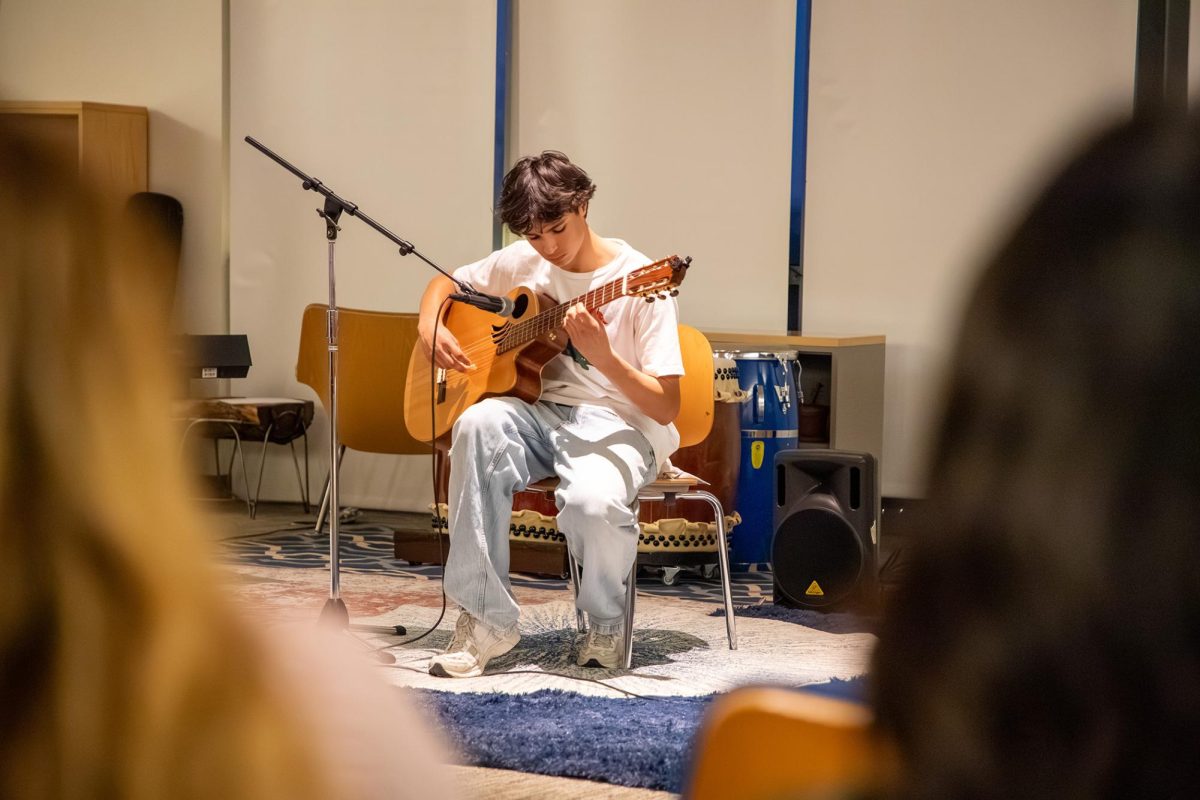




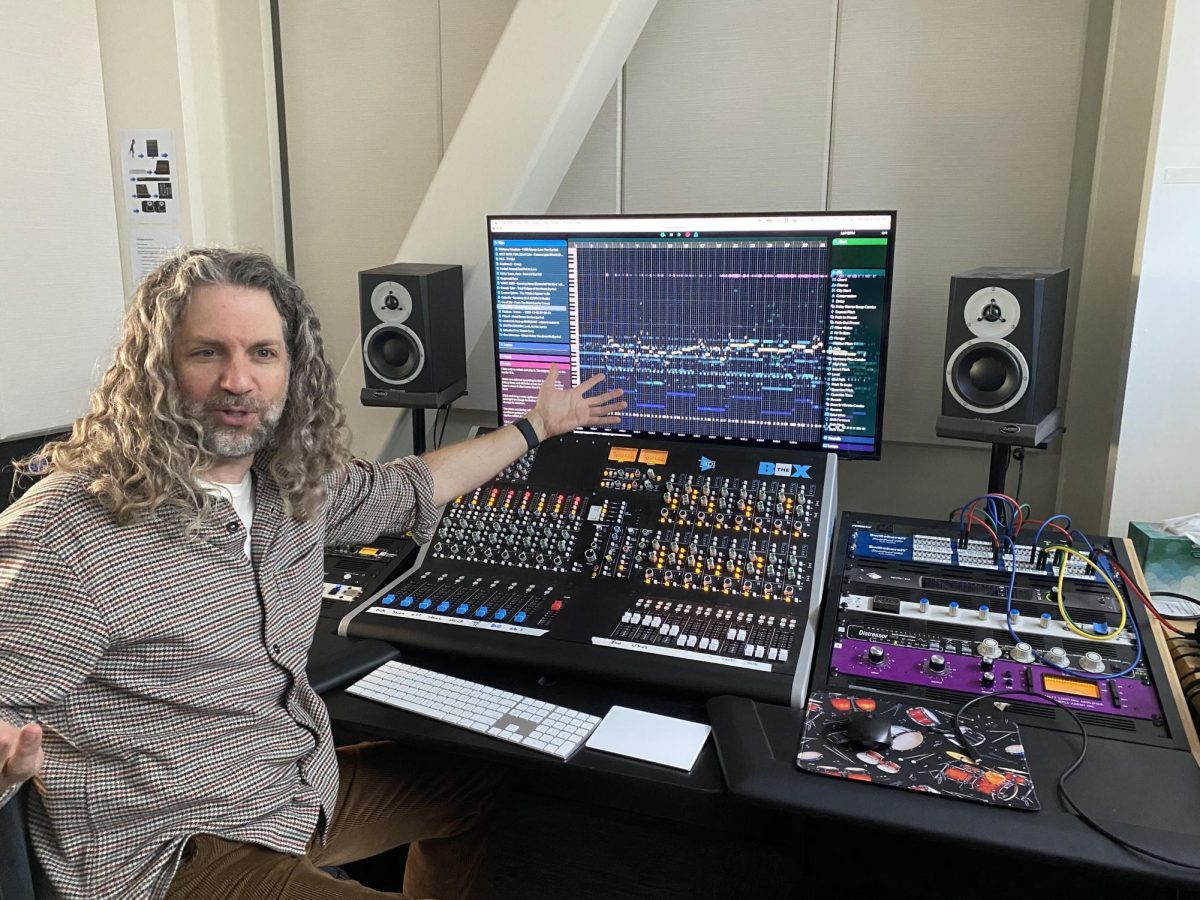
Two to three times each week, Upper School music teacher Max Cowan makes the 52-minute commute from Berkeley to teach only one block of his elective: Sound Experience. With the class in its first year, Cowan is excited to dive into the nuances of sound perception even as he continues to fine-tune the elective’s direction.
“The idea [of the class] was to include musicians and non-musicians in an environment where we could learn how to manipulate sound based on the principles of auditory perception,” Cowan said.
A professional performer with an extensive performing career, Cowan has spent decades giving live performances and sharing his passion for sound through music. Now, he aims to share his love for sound through teaching sound history and techniques to the nine Upper School students in Sound Experience.
Similar to other performing art courses in its incorporation of imagination and technology, the course shifts away from the sole focus on producing songs and expands on the umbrella term of sound itself. Inspired by his curiosity for sound’s history and impact in life, Cowan aims to use Nueva’s new music studio and API Box 2 board to enhance how students interact and produce sound.
“The whole point of the class, from my perspective, is to offer students an opportunity to work with sound,” Cowan said. “We spend a lot of time experiencing sound, and I want to integrate that experience when creating with it.”
Cowan was initially unsure how the elective would be received and if anyone would sign up at all. For Yazzie A. ’29, Sound Experience was first in her course request form, and she was elated when she got in.
“Sounds have always been a big part of my life,” Yazzie said. “I am constantly distracted by what is going on and how we perceive it to be going on, and this class gave me an opening into a world of music and sound.”
Assignments focus on projects that challenge students in engaging with how sound alters perception, including recording seemingly random noises and turning them into soundbites for short films. Recently, students recreated a Star Wars scene by transforming their own recorded sounds.
Oliver S. ’29 noted how the preproduction of adding sounds into a movie clip changed his perspective on how screenplay editors include sound into films.
“One thing I thought was really interesting was that although Star Wars is filmed in space, many of us chose to incorporate wind,” Oliver said. “Sound doesn’t happen in space at all, but it just makes sense in our brains, and without it, the scene felt off.”
Cowan has helped his students into an editorial and evocative style of thinking through Logic, a digital audio workstation.
The idea that people’s minds fill sound with emotions and memories is central to Sound Experience. For Cowan’s students, this means seeing past the isolated noises. Abela noted, “I’m not thinking of the sound individually. I’m thinking of an emotion, an object, or something like that. But I don’t think about the actual sound itself.”
Through building the foundations of linking emotion and memory to sound, deeper questions arise: “How do we hear stuff now from a new perspective? How do I manipulate the things that are already in my environment?” Cowan asked. “Soon, we’re going to be talking about concepts around music and emotion and some broader perceptual phenomena, such as how we interact in conversations with language.”
Cowan’s enthusiasm for learning how people perceive and interact with music resonates with his students as well.
“I feel like this class actually gives me a new window into how our perception of sound changes how we emotionally interact with it, and therefore it might impact us,” Elie W. ’26 said. “It’s changing how I interact with writing music.”
In addition to being engrossed with different interpretations of music, Elie emphasized the class’s sense of community: “I think it’s a very collaborative environment, but we also have a lot of fun because of how small the class is. I think it gives us room to engage in the weirdness of Sound Experience.”
As the semester progresses, Cowan hopes that students will continue to bond over the music and sounds around them and listen with deeper insight and understanding of the frequencies and their purpose.