


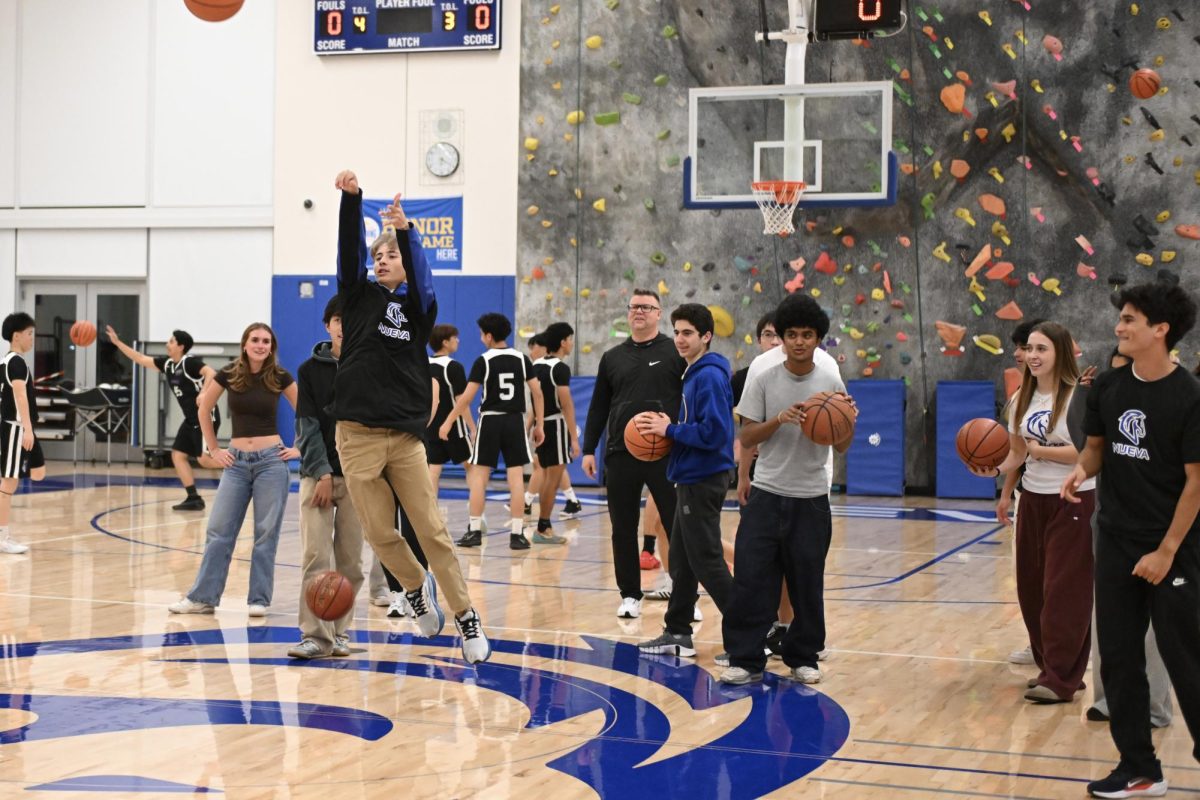











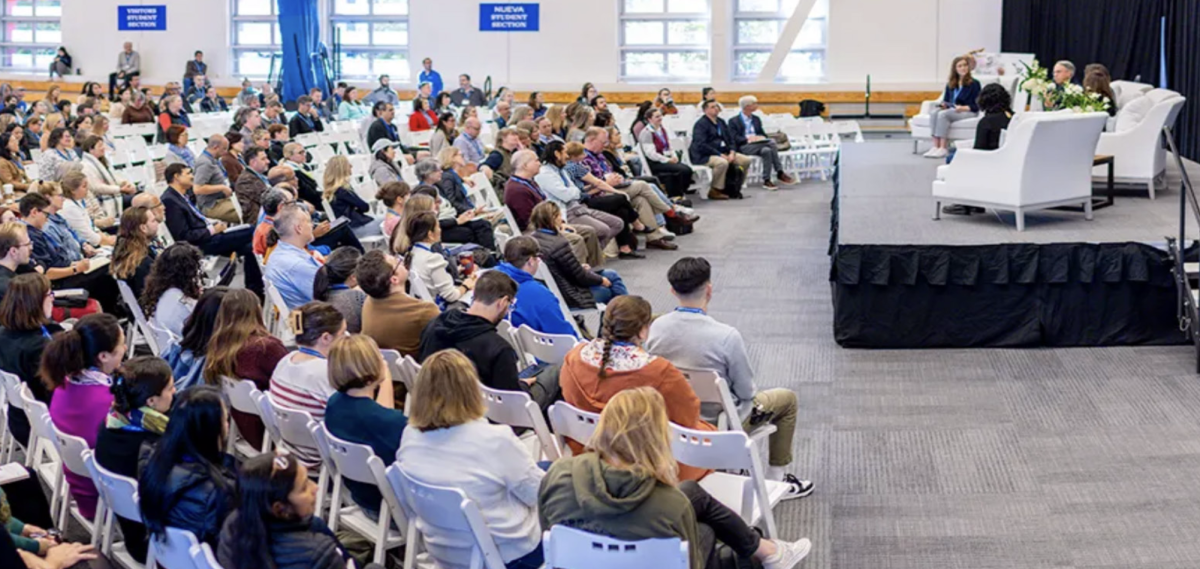

At 3:30 p.m., the walkway to the 2nd Floor Rosenberg patio bursts to life: laughter, chatter, and a swarm of backpacks in motion. It’s another day for Peninsula Bridge’s Middle School Academy program.
Near the entrance stands Ms. Sam, the woman in the bright blue T-shirt. She’s the site coordinator for Peninsula Bridge’s after-school program at Nueva, and nothing gets past her watchful eye. While students filter in, she checks attendance, and directs students and volunteers where they need to go. Around her, parent helpers and Nueva TAs gather supplies and flip through activity sheets.
The all-hands-on-deck energy is warranted, because today is a special day: activity day.
On the second floor, a group of students huddle over bingo cards. Spider cookie decorating and sponge art stations are setting up on the patio classrooms. Down on the astroturf below, a group of kids tee up for a round of tag. It feels like pure fun at first, but every moment fits into a larger mission.
Peninsula Bridge is a Bay Area nonprofit that supports more than 900 first-generation, low-income students from fourth grade through college annually. Between the games and the workshops, the organization’s goal remains the same: to expand educational opportunity and, ultimately, college access. Yet what sets Peninsula Bridge apart is its unique, holistic approach. Rather than offering short-term enrichment or one-off programming, the organization commits to 13 years of academic and personal support.
During the school year, that commitment translates into twice-weekly sessions hosted on nearby campuses, where middle school students in the program meet for small-group lessons in ELA, math, and financial literacy. The curriculum emphasizes hands-on learning and small-group discussion as a way to keep the students engaged and learning, even after a full day of classes.
Bridge runs this model with several partner schools, including Menlo-Atherton and Crystal Springs Uplands. And at Nueva, the partnership has taken on a particular depth.
Nueva began opening its doors to Peninsula Bridge programming as early as 2017. But in the eight years since, the collaboration has also grown into strategic support for Bridge’s high school pathway and volunteering opportunities that put Nueva students directly in the classroom as mentors.
To Rachel Chen, the Manager of Community Partnerships at Peninsula Bridge, having those student volunteers is at the heart of what makes the program special.
“It’s something that we like to call our secret sauce in our programming,” Chen said. “Our students really thrive when they have role models come into our program who can bring that fun and excitement into the classroom.”
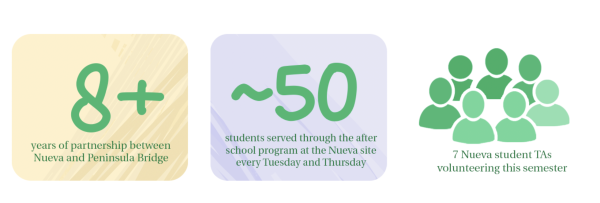
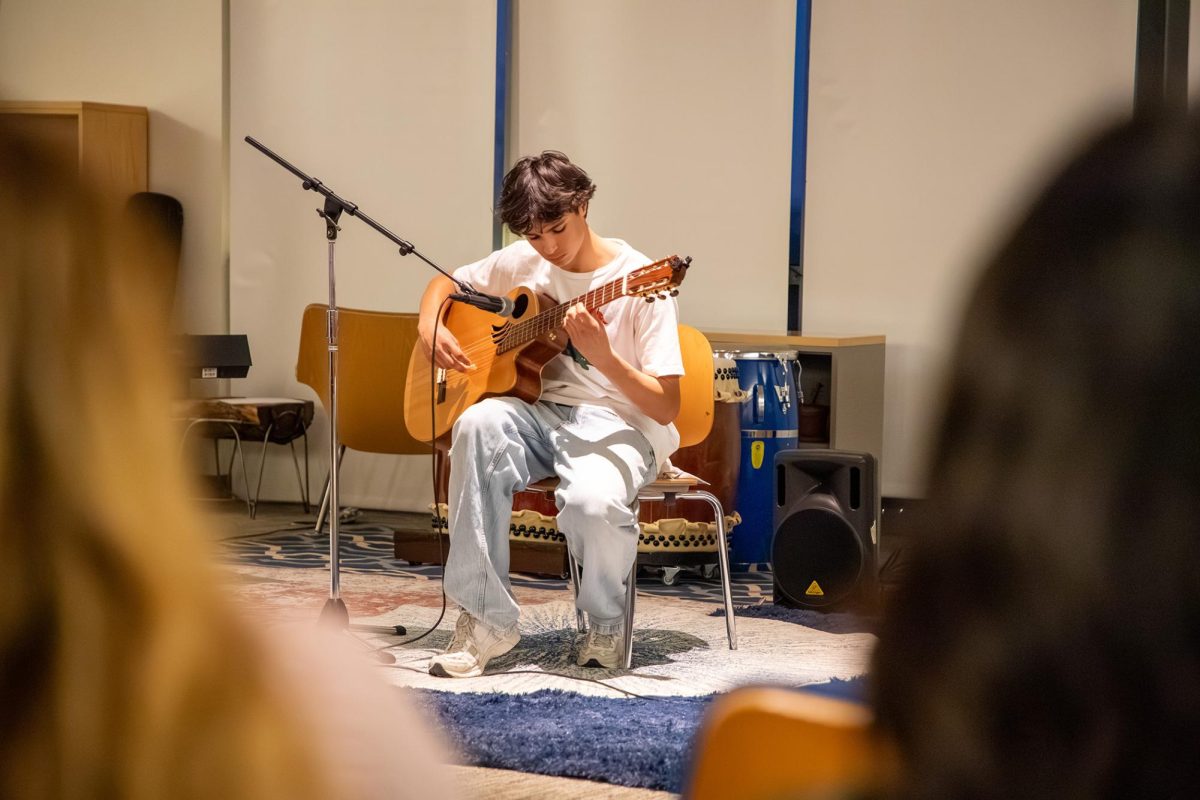
At Nueva, one of those mentors is Andy M. ’26. After hearing about the organization through a former middle school teacher, Andy first got involved with Peninsula Bridge as a teen coordinator the summer before junior year. His days were spent setting out snacks, helping run activities, and jumping into games—whatever was needed in the moment. What he found most rewarding, though, were the connections he built with students.
“You get to know the kids [and] hear what they’re excited about, what they’re proud of,” Andy said. “You get to watch them become better people.”
By fall, returning as a TA during the school year didn’t feel like a decision so much as a continuation.
“I felt a responsibility to be a role model figure,” Andy said. “Someone who [the students] actually trust and want to talk to, essentially like an older sibling.”
As Andy grew more familiar with the organization, he started looking for new ways to make an impact. During his junior year, Andy built an engineering-focused STEM curriculum from the ground up: a three-week course on Lego robotics. By summer, he was piloting the program at Episcopal Middle School. Alongside it, he launched the “Trailblazer Trivia Table,” where students could earn candy by sharing facts, beating him at board games, or reciting digits of pi. Eventually, what started as a way to spark engagement turned into a unique community fixture.
“I ended up having a line of like twenty kids every morning,” Andy said. “Some kids really started going to me every morning with ten facts, twenty digits of pi, and then playing me in connect four, or chess or checkers…I’d be playing, like, four games of chess at once.”
Back at Nueva, Andy continues to volunteer during the school year. For him, the value of the program lies not just in the act of teaching, but in the process of making sure everyone feels engaged and welcome.
“You’re walking around, you’re getting to know the kids, and you’re building a community,” Andy said.
For Wendy E. ’26, that sense of community connection feels a little more personal. As someone who first joined Peninsula Bridge as a middle school student, she remembers firsthand the impact of having mentors and support, and the ways it shaped her own learning. Now a high schooler at Nueva, she’s looking to spread the favor.
This past year, Wendy worked with Isabel Q. ’26 and other co-leads of Systema, a student-led club dedicated to expanding access to hands-on STEM education in underserved communities across the Bay Area. When the club began looking for local partners, Peninsula Bridge stood out immediately. The organizations already shared history, community, and mission.
“It felt natural to give back to the same organization that helped me earlier,” Wendy said, “It [was also] nice to connect with younger generations of Peninsula Bridge scholars.”
This past April, Systema launched a six-week series of STEM workshops for Peninsula Bridge students. With the help of faculty advisor Jeremy Jacquot, they blended their own interests in STEM with online resources and experiments. The resulting curriculum was something that made scientific concepts fun, engaging, and most importantly, real. To learn about freezing-point depression, kids could make ice cream in a plastic bag. To learn about the building blocks of life, they could extract DNA from strawberries.
With every workshop, what struck Wendy most wasn’t just the curiosity the kids brought to the table, but the ways each student “made each activity their own.” If an experiment stalled, students began troubleshooting together. If an idea sparked, they ran with it.
Isabel recalled one group who, after finishing their strawberry DNA extractions, insisted on experimenting with oranges instead. Though it wasn’t part of the lesson plan, the Systema team guided the students through their hands-on exploration.
For Wendy, moments like this highlighted the importance of curiosity and creativity in the classroom.
“Seeing their confidence evolve and grow over the course of just even one workshop [was] really great,” said Wendy.
Isabel echoed that same sentiment. For her, one of the most rewarding aspects was watching students make real-time connections between scientific concepts and the hands-on activities in front of them.
“It really showed me how powerful interactive learning can be,” Isabel said. “Education works best when it feels collaborative and fun.”
To Isabel and Wendy, the experience has also sharpened their understanding of access and responsibility. At Nueva, interactive learning and mentorship are the norm, but for many students elsewhere, they are a luxury.
“[As Nueva students,] we have the privilege to learn in a place where classes are often interactive and collaborative,” Wendy said. “There’s a responsibility that comes with that. If we can share it, we should.”