

















Midway through One Battle After Another, an aging revolutionary yells into a pay phone frantically trying to find his missing daughter—except he can’t remember the secret password that will confirm he is a member of the leftist rebel group whose members he is contacting.
It’s moments like this one that make One Battle After Another shine. The film is packed with action, but also with moments of profound emotional tenderness; relationships are its beating heart, around which weighty themes of power, freedom, race trauma, and political warfare coalesce.
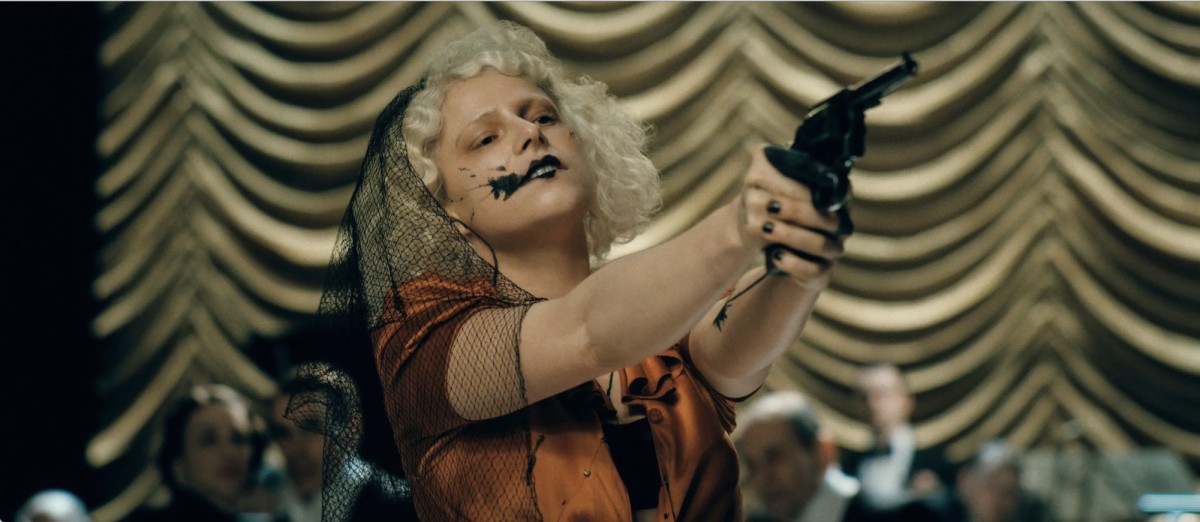
The dystopian adventure is divided into two chapters, sixteen years apart. The first, set in an alternate America in which far-left revolutionaries rebel against an authoritarian government, opens at an immigration center on the US-Mexico border. There, a revolutionary group—the French 75—frees detainees, sets bombs, and arrests the man in charge, Colonel Steven J. Lockjaw (Sean Penn). The mission is led by the volatile, outspoken revolutionary Perfidia Beverly Hills (Teyana Taylor).
But the French 75 isn’t invincible. Sixteen years later, thwarted by systems of government and authority they are unable to break apart, the organization has faded and Perfidia has run away. Meanwhile, Pat, now Bob, and his daughter, Willa (Chase Infiniti), are living secluded in the NorCal redwoods. Willa is a smart, sarcastic teen, but the normalcy she tries to cultivate is a thin cover for a life of self-defense training, paranoia, and the caretaking of her addled father. Despite his reliance on substances and her chafing at the rules, though, Willa and Bob love each other fiercely.
Their relative stability changes when Lockjaw reappears, hell-bent on removing any trace of Willa and shattering their world. The second chapter of the movie follows this harrowing hunt, populated by a colorful cast of characters, with Sensei Sergio St. Carlos (Benicio del Toro), Willa’s karate teacher, being the most endearing—a calm contrast to the chaotic, blustering Bob.
Although Bob wants to protect Willa, he is bumbling and incompetent (also surprisingly funny), unable to cull her independent streak—ultimately, Willa fights her battles on her own.
These battles are set across California, with scenes in El Paso, Texas. One Battle After Another is fundamentally rooted in the notion of setting, both physical and not. It is undeniably visual: the outline of a body on a rooftop, the lush, hazy redwoods where Bob and Willa live, the muted sterility of various bathrooms and hospitals, the warm messiness of a lived-in home, the dull concrete of immigration centers where the brightest things are Mylar blankets, the dusty, winding Texas road on which a brilliant (and horrifying) car chase takes place.
But setting in One Battle After Another is also about spheres of power, and how they generate conversation and action. For example, chilling conversations about dominance, racial purity, and war happen in the hushed office of a group of racist extremists into which Lockjaw desperately yearns to be accepted. In contrast, Willa’s reckoning with her past—and the choices that her parents made—echoes off the walls of a cavernous church in the middle of the desert, a part of a convent where she is hidden by an old revolutionary ally in hopes of escaping Lockjaw’s manhunt. And her parents’ revolution was one formed on the margins, with the aim to disrupt and destroy an authoritarian government through force, not roundabout political rhetoric.
It is this obsession with setting that fuels One Battle After Another, and allows it to probe such a diverse set of issues—politics, parenting, freedom, community—without feeling incoherent or overly ambitious. The locations, both physical and philosophical, give color and urgency to the battles of individuals and communities that are at its core.