













I like to think that my ancestors would be proud of me. They hunted deer in the open plains; I hunt leather jackets beneath the fluorescent lights of my local Goodwill. They scanned river currents for fish; I look for my prey, the die-cast finish of a Riri zipper, hanging limp on a plastic hanger. The aisles are crammed, the racks are cluttered, and the smell inside is so thick that it’s almost palpable—like every human experience has been bottled, worn, and donated. Yet I live for it.
Eventually, sorting through the chaos, I catch a rhythm and rely purely on instinct. After two years of maniacal thrifting, I’ve become well-versed in determining quality, decoding value, fabric, and construction almost immediately. My first stop is always the new racks in the back. I move methodically, hanger by hanger, fingers brushing through the polyester and rayon until something catches: the chilly bite from a mother-of-pearl button, the dense weave of a Super 150’s wool suit, or a luxury designer tag.
Thrifting hits every part of me: fashion obsession, frugality, and sustainability. It teaches me to slow down, spend carefully, and practice patience.
My belongings are a collection of second chances. Everything I buy is secondhand: clothes, headphones, my desk monitors, and even the shaving kit by my sink. After enough time spent digging through secondhand things, the appeal of “newness” faded; it only lasts until the first wear. Once a garment’s tags are cut off, it’s indistinguishable from everything else, including many of the “used” pieces at the thrift store that have seen one or two wears.
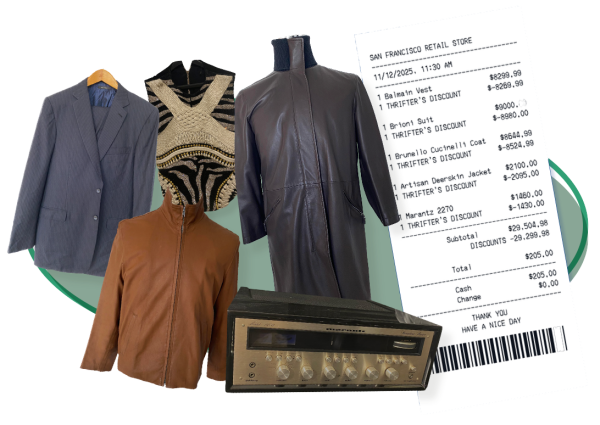
The tradeoff for buying secondhand is simple:a little wear for a heavy discount. Thrift store trips play like blackjack: one week, it’s a stained pair of jeans; the next, designer tailoring that fetched five figures in-store, priced down to pocket lint. After accumulating enough wins, the retail value of my wardrobe is absurd, but in reality, almost everything was purchased at a small percentage of its original price.
At some point, I thought of myself less as thrifty and more as a witness to the boondoggle of retail fashion. Now, paying full price for anything feels like a punch in the gut. Most people (understandably) wince at the prices of luxury fashion; I nearly convulse at H&M, where paying $30 for a shirt that will disintegrate after two washes feels unjustifiable.
When anything needs to be bought, whether for me or the family, I will try to hijack the purchase, scouring eBay or Facebook Marketplace for the same item at a fraction of the price. I will do just about anything in my power to bargain—I have three eBay accounts to hound sellers with absurd lowballs, and I will decry even the tiniest flaws to solicit a discount. Shameless? Possibly. Petty? Probably. Effective? Undeniably. My point isn’t bravado but practice and experience: the savings are real, they compound, and they’ve taught me to see value as a sport, not a set standard.
Thrifting is a privilege, and I’m so lucky to live in such an amazing city that makes it possible. Still, my pastime is entirely self-sustained. Whatever doesn’t fit me, I’ll sell it online to fund the next find. Every purchase has to justify itself, and there’s no safety net if I make any mistakes.
Thrifting has taught me patience in a way nothing else could. Clothing is one of my biggest hobbies, which means there’s always something I want, but I don’t buy much for myself outside of the thrift store; I take what it has to offer.. The hunt is slow, and I leave empty-handed more often than not, but I’ve learned to accept that. Because I buy things so infrequently, I think twice before spending, and I have stopped chasing every impulse purchase the moment it hits.
My favorite jeans are proof. When I first saw them online—natural indigo dye, perfect cut, already half off retail—I wanted them right then and there. But I didn’t bite. I waited. For six months, I checked eBay every day until a pair was finally listed in Japan at a reasonable price. Of course, first I messaged the seller to complain about a missing swatch of extra fabric and haggled the price down to 80% off retail.
Thrifting didn’t get me into fashion—it got me into clothes. After seeing thousands of garments pass through my hands, I’ve come to understand what’s worth keeping. Fashion is a carousel of fleeting trends that will be gone in months; clothes are more interesting. They show in construction, fabric, detail, how a fabric breathes, or how a cuff holds its shape.
Somewhere along the way, society’s appreciation for these things disappeared. Most people don’t care how their clothes are made anymore; the fashion economy of convenience thrives on our willingness not to. The average American throws away more than 80 pounds of clothing each year, proof that fast fashion has stripped intentionality from purchasing and guilt from discarding.
Especially in the Nueva sphere, we are told that fast fashion is wasteful, exploitative, and unsustainable, but that message never comes with an alternative. Thrifting is the alternative. It’s affordable, sustainable, and it’s the best way to develop your own style. Even curated secondhand stores or online resale sites make it easy to buy quality clothing for the same price as fast fashion.
Thrifting is more than a hobby for me; it’s a worldview. It’s changed how I see worth, how I spend, and how I resist a culture that makes thoughtless purchases. The search never really ends; it’s become a permanent way of seeing—of slowing down, of being patient, and living intentionally.