





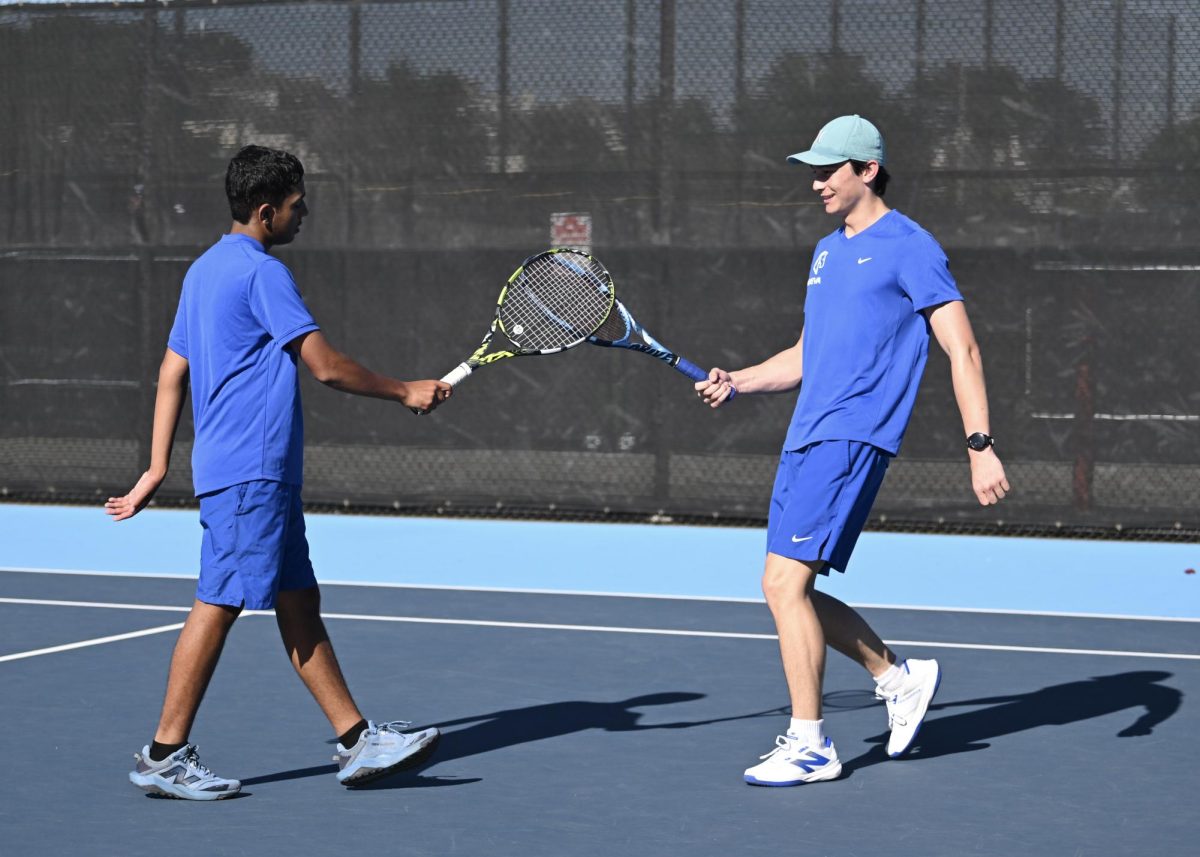













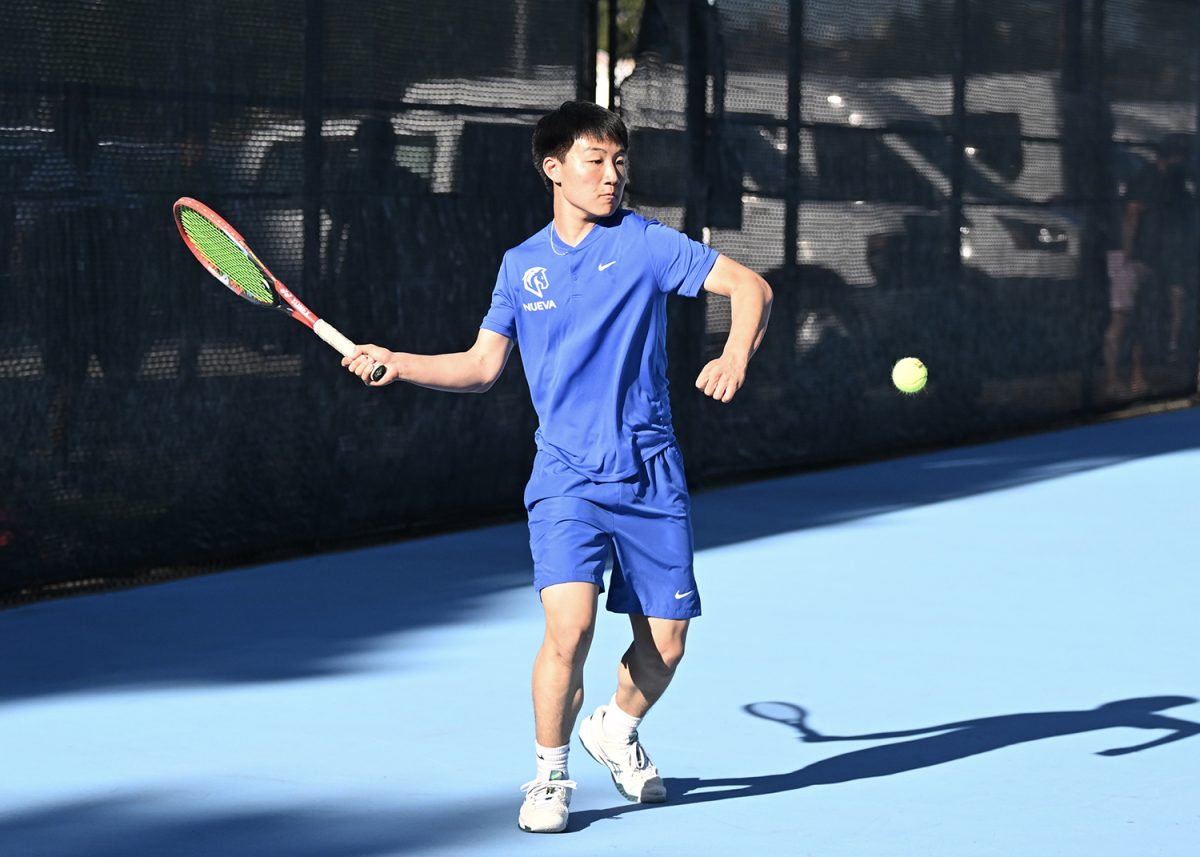
Before every high school tennis match, the captains and coaches announce each of their players and their position—from Singles #1 to Doubles #3. There’s always a few cheers and claps with each name, and then customary shouts of “good luck!” and racket taps.
With the boys tennis team, though, the routine gets a little more colorful. Instead of calling out each player’s full name, the captains use unique nicknames that seniors have bestowed upon each player. Trevor Cho ’28 becomes “the Cho-sen One.” Julian Deery ’28 is crowned “King Julian,” after the infamous lemur from the animated film Madagascar. Co-captain Vian Yang ’26 is “Grandmaster Vian,” a reference to his aptitude for chess.
“Having those nicknames definitely adds a great sense of fun within the team,” Deery said. “It’s also a great energy for people who are new to high school, because it makes you start to feel like you’re part of the community.”
Ethan Cai ’29, a new player on the team, emphasized how small traditions like these can enrich an already welcoming environment. He pointed to the older players as particularly instrumental in cultivating a supportive team dynamic.
“A lot of the upperclassmen are always willing to practice or play doubles with you,” Cai said. “It feels good to have a team that has your back.”
For co-captain Brooks Wagonfeld ’26, building this kind of team culture is just part of a captain’s duties: “I think our goal as captains is to get to a place where people can come to us [not just for] information and questions about tennis, but also school and life,” Wagonfeld said.
Whether that support comes through during team dinners, a mixed doubles tournament with the girls tennis team, or just some well-planned warm-ups, Wagonfeld hopes to build a team dynamic that extends beyond the court. Deery says he really appreciates these small moments of camaraderie. As a player with experience in solo tournaments, he described the team atmosphere as simply irreplaceable.
“When you are playing a tournament, it’s just yourself, and the people who are watching you are the people who are most critical of you, like your parents or your coaches. You feel like [there’s] a lot more pressure,” Deery said. “For school tennis, it’s a lot better because you feel like you’re playing with a team at all times. It’s a lot easier to play freely.”
All in all, Yang is excited to see how the team progresses through the season. He and coach Gerald Sargeant think the team can end the season in fourth place this year, a step up from sixth and seventh place finishes they’ve had in the past.
“I think skill-wise, we probably should be there,” Yang said. “I believe that we can and Gerald believes that we can as well. But, making sure that everyone believes that we can [make it is] necessary.”
Yang and Wagonfeld both see the mental aspect of the sport as crucial.
Grueling drills and practice help to shape form—sharp serves, seamless footwork, and flawless groundstrokes. But tennis, first and foremost, is a game of resilience. Whether it’s singles or doubles, a player has to be able to move past every double-fault, botched hit, and miss. The next point is always waiting.
“[When I’m playing doubles], if I make a mistake, I need to be able to move past that, because it’s not just myself that’s relying on [me]. My partner’s counting on me and the team too,” Wagonfeld said.
Yang expressed a similar sentiment, highlighting the importance of effort above all.
“There’s a saying by a coach that I saw online: You don’t have to play your very best to win a match,“ Yang said. “And that’s fine, because in reality, you’re not gonna play your best every single match. Even when things are not going your way or seem unfair, you just need to try your best.”