














Ask any high schooler what’s on their bucket list before they graduate, and you’ll get a handful of predictable responses: getting a driver’s license; spending time with friends; going to prom.
For Maia C. ’27, that list includes just one, additional thing: completing a full Ironman.
Widely considered the crown jewel of endurance triathlons, the Ironman is one of the most brutal athletic challenges in the world. To get to the finish line, competitors must traverse a 2.4-mile swim in open waters, pedal through a 112-mile bike ride, and complete a full, 26.2-mile marathon run. That’s a total trek of 140.6 miles—and even well-trained athletes often take between 10 to 17 hours to complete the grueling journey.
Maia isn’t intimidated by the scale of the challenge, though. If anything, the difficulty is part of the appeal.
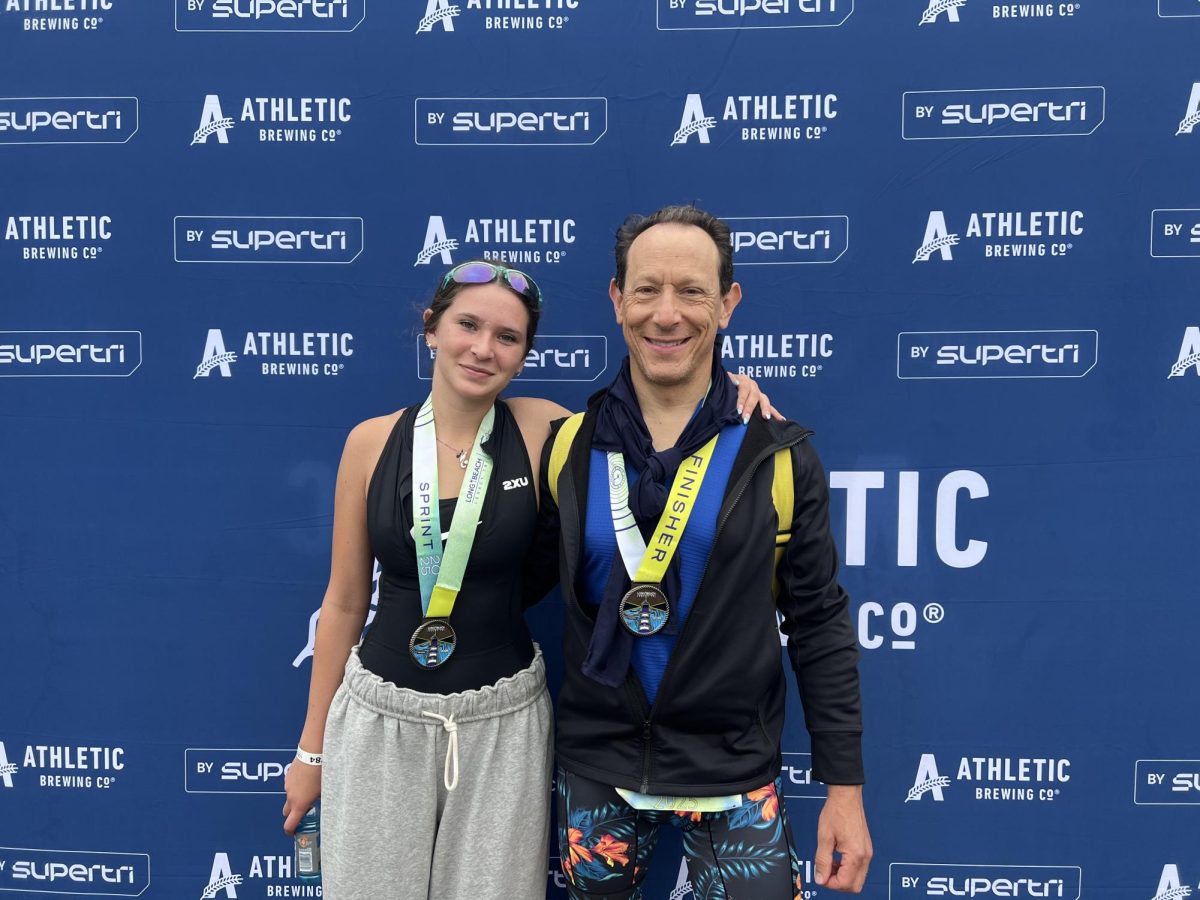
Growing up as a lifelong swimmer and runner, Maia participated in club athletics from elementary school through to the beginning of high school. Choosing to pivot to a multi-event sport in her sophomore year, though, was a “spur-of-the-moment decision.” She caught wind of a 16-mile “sprint” triathlon being held in nearby Sonoma, and wanted in on the challenge.
That trial run quickly became something more: “I absolutely loved it. In the moment, I thought, ‘maybe this is the right decision.’ And ever since then, I’ve just stuck with it.”
Due to the sheer intensity of the sport, the Ironman race committee requires participants to be at least 18 years old before they can officially compete. Yet in the meantime, Maia remains intent on building her physical fitness and mental endurance. She’s moved beyond sprint triathlons, and now competes primarily in the standard, 32-mile “Olympic” event.
It’s a commitment that requires serious training. Six days a week, Maia blends high-volume cardio with structured strength work under the guidance of her coach, Jamii North. Weekdays typically rotate between lift-and-swim, lift-and-run, or lift-and-bike sessions, while Saturdays are reserved for hours-long biking and running sessions designed to simulate race fatigue. Maia calls the latter her “brick” days: in the triathlon community, the joke is that by the end of these workouts, it’s impossible for one’s legs not to feel completely “bricked,” or spent.
All that training builds toward race day. And for Maia, the best part comes right at the start with the long-distance swim. She says the appeal lies in the intensity of the moment: the noise and clamor of the start, the rush of cold water, and the feeling of being alone against the ocean.
“While being in an ocean can bring you horrible conditions—it can be the most painful swim of your life—it’s really fun to push yourself,” she said. “I really enjoy it, the energy of it all.”
The finish, however, is what keeps her coming back. For Maia, there’s a sort of catharsis to be found in reaching total exhaustion.
“When you finish a race, you fall over, and there’s absolutely nothing left,” she said. “For some reason, I really enjoy that feeling. It’s appealing to know I pushed my body to its absolute limit—and to think, next time I can push it even farther.”
Navigating the demands of training, racing, and schoolwork all at once—on top of a part-time job as a swim instructor—certainly hasn’t been easy. Still, Maia has devised strategies to help her manage the load. When it comes to athletics, she engages in “de-loading” periods in the weeks leading up to a race, prioritizes injury prevention exercises, and fits in recovery where she can. Meanwhile, when it comes to school, she optimizes for time management. Maia says that she often listens to readings during her commute, and when the workload gets particularly rough, she’ll type out assignments while training on her stationary bike.
Looking ahead, Maia will be racing her first 70.3-mile half Ironman this summer, and will later compete at USA Triathlon Nationals in Milwaukee in August. But more than the titles or awards, or even the races themselves, what motivates her is the opportunity to push her limits.
“Sometimes I finish my race and I don’t actually remember what I was thinking or remember how it felt. All I know is that I’ve finished it, and I’ve done it,” she said. ”I think I really chase that feeling—the feeling of having pushed myself far.”