











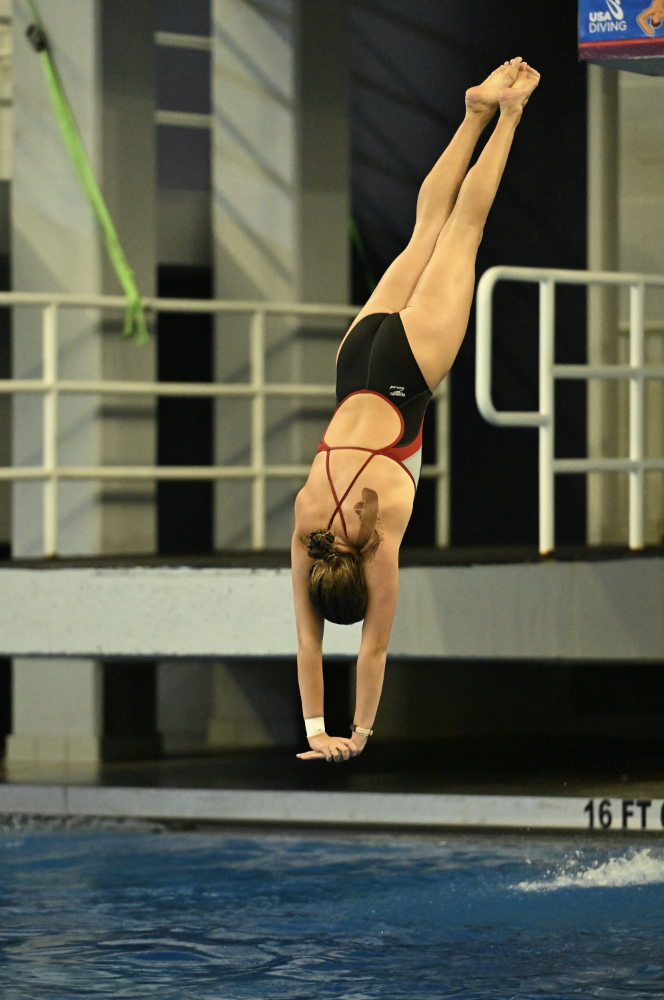
For most athletes, preparation for an important meet is all about getting a good night’s rest and visualization. But for Ollie and Mollie G. ’27, bowling and a Secret Santa exchange is the formula to success. It is a yearly tradition that helps them bond with their team, where they trade gifts and advice before the competition.
The twins started diving over a decade ago, after being introduced to the sport by a family friend. However, before the pandemic—and before the twins started to dive competitively—training was only once a week, and relatively unserious.
“I was really young, and I kind of didn’t care that much [about diving]. I was just doing it in the same way that any kid does, like a sport or an extracurricular,” Ollie said.
Mollie had a similar experience. “Initially, it was completely for fun, and I didn’t think I would go anywhere with it. I actually started [diving] because I had a friend who could do a backflip into a pool.”
Their mentality changed after observing their diving club’s Junior Olympic team. Watching them practice and hearing about the way their team operated motivated the twins to join and compete at the next level. The twins began training with their own personal coaches and saw significant improvements. After a short period, they were invited to join the Junior team.
That invitation marked a turning point in both of the twins’ journeys in competitive diving.
Now, in their junior year, training is six days a week after school. Hours of dryland training—including trampoline flips and core strengthening—diving, and conditioning, are required to maintain the high performance they consistently achieve.
However, this strict regimen is hard to maintain. Burnout is a common challenge for top athletes, and Ollie and Mollie are no different.
“I guess everyone gets burnt out. Sometimes I don’t really want to go to practice, or it can be really difficult to go,” Ollie said. “But Mollie going [to practice] is very encouraging, so I end up going anyway.”
Without each other, neither twin would have been able to get this far. “Especially since it’s such a mental sport, there’s a huge team aspect, and [Ollie’s] a built-in support system,” Mollie said.
Ollie added, “Sometimes it’s impossible to do things that you don’t think you can do. But if someone else believes in you, it makes it a lot easier.”
The twins have also acknowledged that diving has made their bond stronger. “I care about how well my teammates do in practice, but I definitely care a lot more about how Mollie does her practice just because I don’t want Mollie to be upset with her diving,” Ollie said.
Mollie echoed the sentiment, saying, “Just being able to compete with someone I know so well and to travel with is great. If I were to not have a sibling, it would definitely be harder.” Together, the twins have competed at the highest level, supporting each other every step of the way.
Throughout their diving experience, the twins have experienced many highs and only a few lows. Mollie is proud of her back-to-back second-place finishes at Zone championships, but what she remembers most are the moments with her team, bonding through travel and other activities.
“Activities like bowling and escape rooms make the sport more appealing,” Ollie said. “If I were not as close to my teammates and were not able to do things like that, I don’t think I’d have nearly as much fun as I do.”
Now committed to Yale’s swim and diving team, the twins expect the road ahead will be tougher—but that they’ll face it side by side.